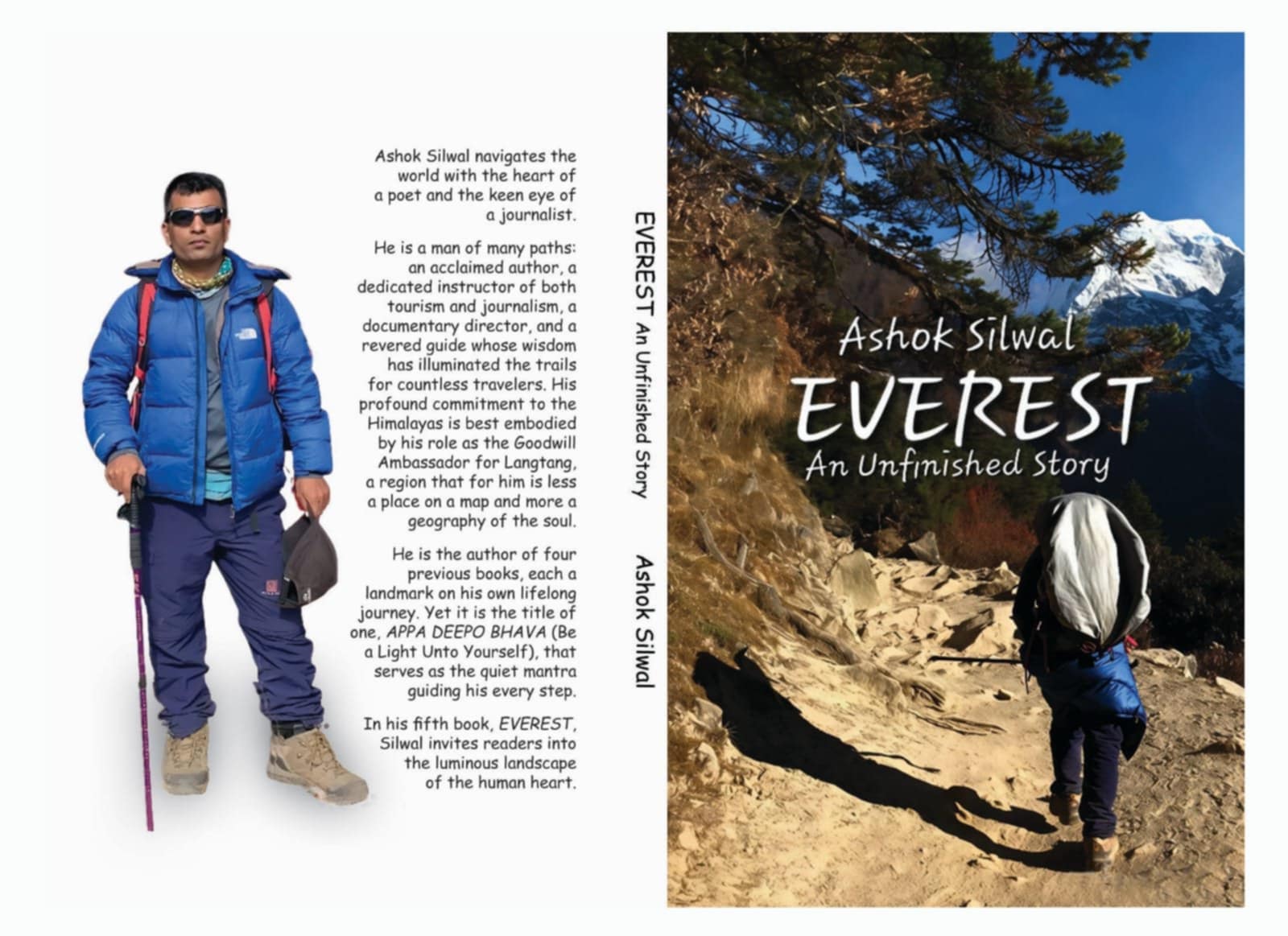
Do you love Sagarmatha? If yes, then— by hook or by crook— you must read Everest: An Unfinished Story. If you love Nepal, trekking, tourism, or traveling, this book is a must-read. Anyone planning to visit the Himalayas should read Everest: An Unfinished Story as a guiding direction. It is an appealing guideline enriched with poetic and philosophical reflections on the Everest Base Camp trek. It mirrors Mount Everest in words, reflecting humanity and life.
Silwal’s background as a journalist is evident in his clear, engaging prose and his ability to contextualize events within broader social and environmental frameworks. He skillfully weaves historical accounts of expeditions with contemporary issues such as commercialization, overcrowding, environmental degradation, and the changing ethics of high-altitude climbing.
‘I was walking in the woods.’ In English, this phrase conveys a genuine sense of walking through the jungle— lovely nature combined with risk and romance. However, wood literally refers to non-living material. Everest: An Unfinished Story, by the prolific writer, journalist, and trekking teacher Mr. Ashok Silwal, challenges the English language by injecting life into the so-called woods or stones of the Everest region. Though these elements are considered non-living, he succeeds in giving them life through his words.
An English novel by a Nepali writer with outstandingly clear editing is a challenge even to native English writers. The language of the novel is simple yet impressive in style. It is not merely a novel but poetry infused with philosophy— living, exuberant words on an Everest walk. Silwal gives life to every plant, stone, river, and mountain through simple yet philosophical lenses. Thus, it becomes a challenge even for professional novelists. As readers go deeper and deeper, the book evokes the feeling of gifting a rose— a rose is a rose is a rose— to a beloved. As you get closer and closer to the highest peak, Everest, or deeper into the book, life appears in everything. Nothing in nature is dead; everything is alive— this truth is justified by Ashok Silwal’s Everest.
A short novel, travelogue, or memoir, Everest: An Unfinished Story is a pocket-sized book containing 14 chapters, including random lines inspired by Everest. The chapter ‘Sagarmatha’ begins with a flashback email about Ashok’s divine love, Jenifer. This relationship is thousands of times purer than worldly love. However, his journey to Everest Base Camp began when his beloved wife was pregnant. He logically proves the mistake of naming Everest and redefines it as Sagarmatha. He also shows that men and women can be best friends rather than something else.
‘Internet Within Us,’ ‘Dai Namaste,’ ‘The Wretched Diary of a Cigarette Slave,’ ‘The Living Stone,’ ‘Oh! Whichever Way You Turn, It Is Divine,’ ‘We Are Not Going to Base Camp Anymore,’ ‘A Letter of Analysis,’ ‘Pemba Was Like a Mother to the Dogs,’ ‘The Diary I Did Not Write,’ ‘The Freedom of the Cliff,’ and ‘Clean Memories on Dirty Clothes’ are among the most heart-touching stories in the book. Though it has only 123 pages, it is filled with the rich experiences of a trekking guide and teacher. The book was published by Jyoti Basnet and designed by Nagendra Lama.
One of the book’s strongest features is its refusal to romanticize Everest as a ‘conquered’ peak. Silwal repeatedly emphasizes that Everest remains unfinished—not geographically, but in meaning. Despite decades of expeditions, studies, technological advancements, and media attention, the mountain continues to challenge human understanding. This central metaphor of ‘unfinishedness’ runs consistently throughout the book, giving it thematic coherence and intellectual depth. In Silwal’s narration, Everest becomes a living symbol of natural, ethical, and psychological limits. It is an interwoven network of nature and human attitude. It is the story of a boy from Nuwakot and a blueprint or guideline for visiting or trekking to Everest Base Camp.
In conclusion, Everest: An Unfinished Story stands out as a mature, thoughtful contribution to Himalayan trekking and tourism literature. Ashok Silwal does not attempt to finish Everest’s story; instead, he reminds us why it can never be finished. The journey never ends. Life is not a destination but an unlimited journey. The book invites readers to reconsider their relationship with nature, ambition, and achievement. It is a valuable read for mountaineers, trekkers, scholars of tourism, and anyone intrigued by the quiet questions that mountains pose to humanity.