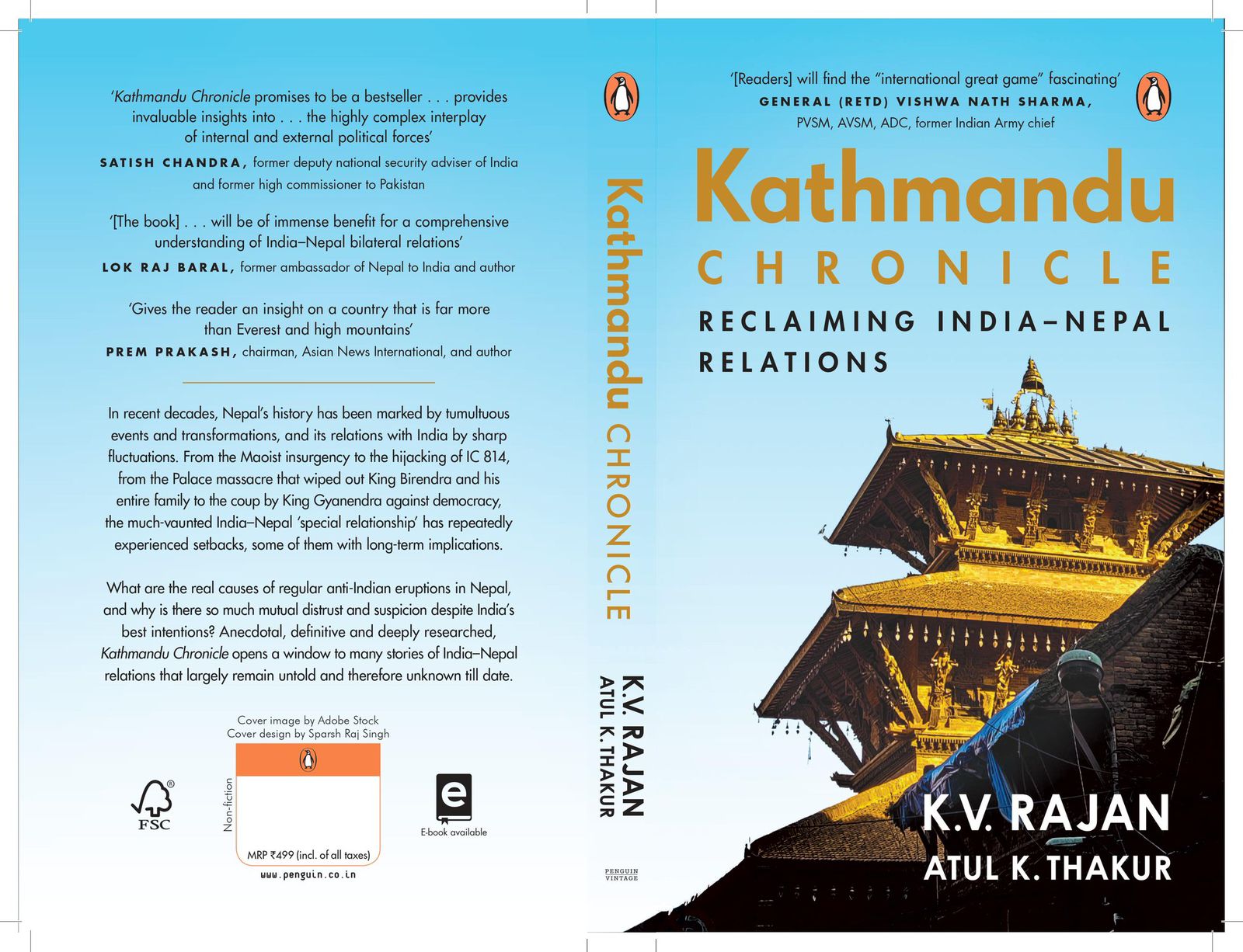
The book “Kathmandu Chronicle: Reclaiming India-Nepal Relations” by India’s former ambassador to Nepal K V Rajan and acclaimed authority on Nepal and India-Nepal relations Atul K Thakur remarkably succeeds to discover the radical changes and development of Nepal and its history unlike other books on a very complex though soft-sounding theme that is ‘India-Nepal Relations’. Even those who haven’t had the privilege to meet the distinguished authors of this book can sum up their deep intellectual depth from a look into their amazing masterpieces in the purest form of literature. No doubt this book is amongst finest works, head and shoulders above its compatriots. What made me write the review of this book was its slenderness and that it was uncluttered with conceptual clarity.
One probably doesn’t require any beforehand preparations to read this, only can learn from easy examples and a beautiful barrage of words. A very clear, crisp India-Nepal relations have been perennially dynamic without losing the substance of geopolitical substance. This book is a reflective and evocative narrative that blends personal recollections, history, facts and brilliant sets of opinion to present a textured portrait of Nepal’s capital city, Kathmandu –- one of the nerve centers of India-Nepal relations just next to New Delhi. More than a simple book on diplomacy with unwavering focus on very unique India-Nepal ties, the book captures Kathmandu as a living, breathing civilizational space—layered with history, spirituality, politics, and everyday human experience.
Through a sensitive and observant lens, the authors’ have explored the various layers of India-Nepal relations. For instance, the beautiful city of Kathmandu has not been merely presented as a destination, but as a cultural idea shaped by centuries of continuity and change. One of the book’s principal strengths lies in its chronicle-like structure, which allows the author to move fluidly between time periods. The authors’ words are measured and thoughtful, marked by intellectual curiosity rather than romantic excess. The narrative avoids complexities; instead, it treats Nepal with seriousness, making the book appealing to readers interested in South Asian studies, diplomatic history and cross-border civilisational links between India and Nepal. The authors’ do not shy away from addressing Nepal’s democratic struggles, shifts in monarchy (finally its abolition), chronic democratic transition, and the broader implications of regional geopolitics.
The book comprises of three Sections viz:
SECTION-I (Diplomatic Gleanings: A First -Person Account): Personal experiences and interactions of an Indian diplomat in Nepal (Amb K V Rajan), Maoist insurgency, hijacking of IC-814 in 1999 and royal massacre (2001) have been deliberated. King Birendra regime (1995-2000) with political leaders from India to Nepal and interactions with the authors’ are also deliberated therein. Clear prospect of instability due to hung parliament, monarchy and tensions in democratic forces are therein spelt. Need for a healthy relationship between India and Nepal in terms of equality and interdependence has been highlighted therein. In the era of Political Vengeance and instability, a dire need for governance, democratic credibility’s leading to cordial relations from poor political instability. The authors’ have discussed the ties of India with Nepal over the last seven decades. The mistrust between two nations and end of Monarchy in Nepal lead to Nepal becoming a federal secular republic. Indeed, both countries need to accept their special relationship, seeing it as a transformational leap in all arrays of technology, hydropower, human security and removal of regional disparities.
SECTION-II (Transitions of the Himalayan Kind): This main chronological section traces Nepal’s modern political evolution and how it has intersected with India–Nepal relations. Roots emanate from the Shah to Rana (1846) dynasty where there was no development and monarchy existed only in name. The leadership and institutional constraints have been described with exceptions of King Tribhuvan and King Birendra. The bridging of the trust deficit was in cards as whenever any relations with China were bad with India, Nepal came to rescue. The book also covers in great details the geopolitical compulsions, impacting India-Nepal relations. Also the chronology of the democratic transition is elaborately discussed.
SECTION-III (Repurposing India–Nepal Relations): This section is more analytical and prospective, focusing on why the relationship has endured setbacks and how it might be revitalized.
The major arguments and topics include:
-Mutual distrust and empathy gaps — why India often misunderstood Nepal’s sovereign aspirations and why Nepalese mistrust Indian intentions (despite deep cultural links)
-Critique of bureaucratic mindsets on both sides that have hardened perceptions.
-Discussion of major irritants — border issues, treaty interpretations, and political sensitivities.
-The role of civil society and media narratives in shaping public opinion.
-Need for a new diplomatic style that embraces mutual respect and contemporaneous geopolitical realities.
-Elements of cooperation on economic and strategic fronts.
The book holds high importance for its brilliant overview on Nepal’s major transitions and India-Nepal relations. Among others, this aptly covers the crucially significant contexts like: Early post-1950 developments after the India–Nepal Treaty of Peace and Friendship; Monarchy transitions — from King Tribhuvan’s era to King Mahendra, King Birendra and King Gyanendra; Strains of the “Twin Pillar” strategy (India engaging both palace and parties); Maoist insurgency and peace process; Impact of IC-814 hijacking on bilateral trust; Royal Palace Massacre (2001) and its political aftermath; Nepal’s journey to multiparty democracy & republic; Frequent political instability and the effect on foreign policy choices in Kathmandu; Nepal’s path to a secular federal republic was rocky and intertwined with internal power struggles; Anti-Indian sentiment often rose not merely from policy but from perceptions of sovereignty interference; The China factor (a factor but not the sole driver behind Nepalese foreign policy choice)s.
The book frames the relationship not as adversarial but as one needing fresh diplomatic imagination. It calls for acknowledgment of mistakes without dwelling on blame. Emphasis on engaging with Nepali partners as equals rather than through transactional tactics are main takeaways
Thus, Kathmandu Chronicle is not merely historical narrative—it is a policy-oriented interpretation of how India and Nepal have interacted, why closeness has often been fraught, and what might be done to reimagine this neighbour-to-neighbour relationship for the future. A must for readers as is written in clear, accessible prose with analytical rigour.