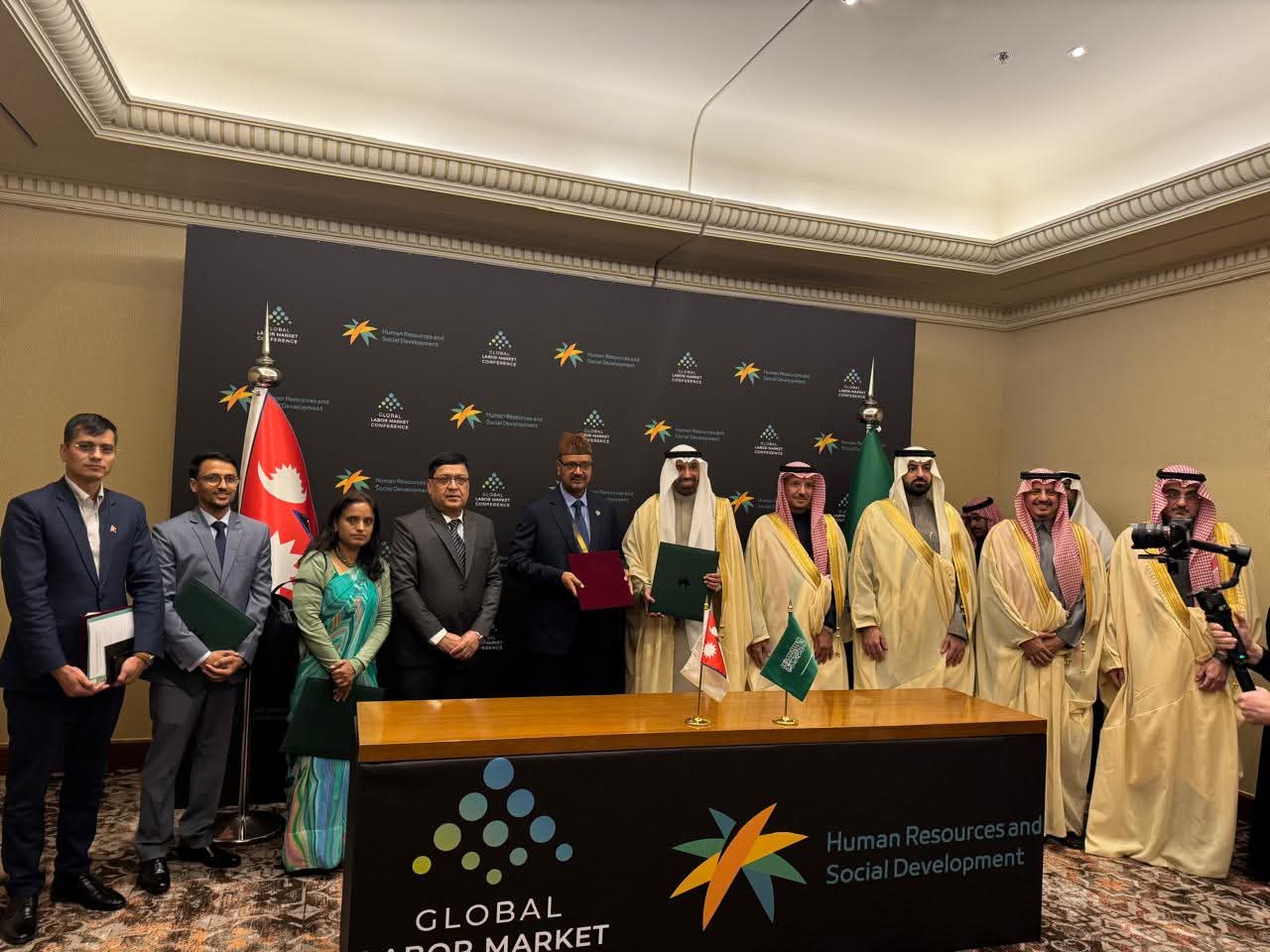
After almost five decades of establishing bilateral diplomatic relations Nepal and Saudi Arabia finally came to a labor agreement. On January 25, the two countries signed their first labor agreement in Saudi Arabia’s capital, Riyadh.
“The Government of Nepal and the Government of Saudi Arabia signed an Agreement on Workers’ Recruitment to promote safe, orderly, and dignified foreign employment of general workers,” reads the statement published by Nepal’s Embassy in Riyadh.
The agreement was signed between Minister for Labour, Employment and Social Security, Rajendra Singh Bhandari, and Minister for Human Resources and Social Development, Ahmad bin Sulaiman Al-Rajhi.
The two countries established diplomatic relations on 15 March, 1977. Today over 400,000 Nepalis are working in the Kingdom, according to the government of Nepal.
Including Saudi Arabia, Nepal currently has labour agreements with 13 countries: UAE, South Korea, Bahrain, Japan, Israel, Jordan, Malaysia, Mauritius, the UK, Romania, Germany, Qatar and Saudi Arabia.

According to Minister Bhandari, the labour agreement with Kuwait and Oman is also in the pipeline. “The government of Nepal has already approved the agreement for Kuwait, and we are waiting for the signing date from Kuwait,” he said. “Oman is currently in the process of the agreement. We are also working to renew labour agreements with South Korea, Mauritius and Malaysia.”
Dr. Keshav Bashyal, a labour expert and faculty member in the Department of International Relations and Diplomacy at Tribhuvan University, Nepal, commented that after a long time, Nepal and Saudi Arabia have signed a labour agreement, which is an important step. “Now, we need guidelines to work with. But as we know, the agreement itself is not full and final; the important part is its implementation. Moreover, we should look after wages, skills, workload, social security, and other important aspects of migrant workers in that country,” he said.
Whereas Nepal has already sent labour agreement frameworks proposals to 16 countries through coordination with the Ministry of Foreign Affairs. Those countries are Albania, Austria, Turkey, Malta, Maldives, Serbia, Cyprus, Luxembourg, Brunei, Poland, Bosnia and Herzegovina, Croatia, Belgium, Thailand, Australia, and Vietnam.
Pitamber Ghimire, a joint secretary and spokesperson of the Labour Ministry, said that they have prepared and sent all the required documents to sign the bilateral labour agreement with the 16 countries. “We have shared the documents through the Ministry of Foreign Affairs and have been coordinating with Nepal’s embassies in the respective countries,” he said, adding that the government of Nepal is working for safe labour migration through required labour agreement.
Labour expert Dr. Bashyal emphasised that Bilateral Labour Agreements (BLA) are one of the major components of labour diplomacy. “It serves as a tool for economic growth and development of a country. As a labour-sending country that relies heavily on remittances, this agreement was of utmost importance to us. Despite countless mechanisms in place and reformation on the national governance front, labour migration comes with many challenges that need careful handling at the bilateral and multilateral level,” he said.
“BLA is important but it requires implementation. Without effective resourceful institutions and qualified staff in mission, it is almost impossible to get objectives of BLA for migrants. Despite BLA, in many cases, Nepali migrants are not getting proper solutions. Migrant workers are subjected to violence, punishment, whimsical treatment, including discrimination, humiliation and of course, exploitative contractual agreements.”

Dr. Bashyal said Nepal’s negotiation strategy has been very poor compared to other origin countries. “I hope this will fill the gaps. It should be in line with national and international laws and practices. Excluding women workers in the BLA is not fair. And there should be zero cost migration and it’s vital to ensure full protection of migrants in the destination. The BLA should be oriented in this way,” he added.
Nepali labour migrants are employed in over 172 countries worldwide excluding India, according to the data from Nepal government. Nepal’s top labour migration destinations are Malaysia and Gulf Cooperation Council (GCC) countries such as Bahrain, Kuwait, Oman, Qatar, Saudi Arabia, and the United Arab Emirates. These days, there is a growing number of labor migration to European countries as well. Almost all those countries are members of the International Labour Organization (ILO). Out of the 187 member countries of ILO, Nepal has officially opened 111 countries for institutional foreign employment for Nepali workers.
As of January 2026, an estimated 4 million Nepalis are abroad for employment. Around 2.5 million are in the Gulf and Malaysia. UAE 478,000, Saudi Arabia 384,000, Qatar 357,000 lakh, Malaysia 350,000, Kuwait 175,000, Oman 25,000, Bahrain 28,000, Japan 160,000, Republic of Korea 75,000, Europe 100,000, and Africa, around 31,500 Nepali labour migrants are working in the respective countries.
In Malaysia, currently more than 400,000 Nepali migrants are working, and around 1.3 million Nepalis are working in the GCC countries. There are many migrant workers in other countries, including India. Because of open borders and no visa requirement for Nepalis, there is no proper documentation of Nepali migrant workers in India. While there is no accurate data, many organizations including Nepal and the Indian government believe there are 2 to 8 million Nepali migrant workers in India.
Hom Karki, a journalist who has been reporting for more than 15 years, and author of a book narrating stories of Nepali migrant workers, stated that Nepal needs to enhance their ability in labour diplomacy. “Our labour diplomacy has been working in a traditional approach. Now, we need to elevate it through proactive and strong labour diplomacy,” he commented.
According to the Foreign Employment Act 2007, the government has started to appoint Nepali labour attachés officials in the major labour destination countries to protect the rights, welfare, and safety of Nepali migrant workers. Moreover, they are also responsible for settling disputes with employers, rescuing workers in trouble, coordinating repatriation, and providing legal assistance with the coordination of respective embassies. Now, there are eight labour attachés in the UAE, Qatar, Saudi Arabia, Kuwait, Oman, Bahrain, Malaysia, and South Korea.
Author Karki said that both the government migrant sender and recipient countries should talk during the joint committee meeting to address the problem of migrant workers, and solve the problem.
“Nepal believes that after sending migrant workers, host countries should look after them. However, migrant-receiving countries argue that Nepal has already sent its workers at a high cost. These issues should be resolved through diplomatic dialogue between the two countries,” author Karki added.
For safer and better migration, Nepal needs to make the cost of migration zero. There must be social security for migrant workers. The host countries should treat their workers and migrant workers equally. The Government of Nepal should increase labour agreements with host countries of migrant labour for the welfare of Nepali migrant workers.
Dr. Bashyal said to address the challenges of migrant labour, Nepal must reinforce its labour diplomacy by enhancing its bargaining power, aligning domestic policies with economic priorities, and improving coordination between domestic and international institutions. He added, “Effective governance, diplomatic innovation, and a specific focus on migrants’ rights and welfare are essential to protect Nepal’s labour force and ensure sustainable economic growth.”