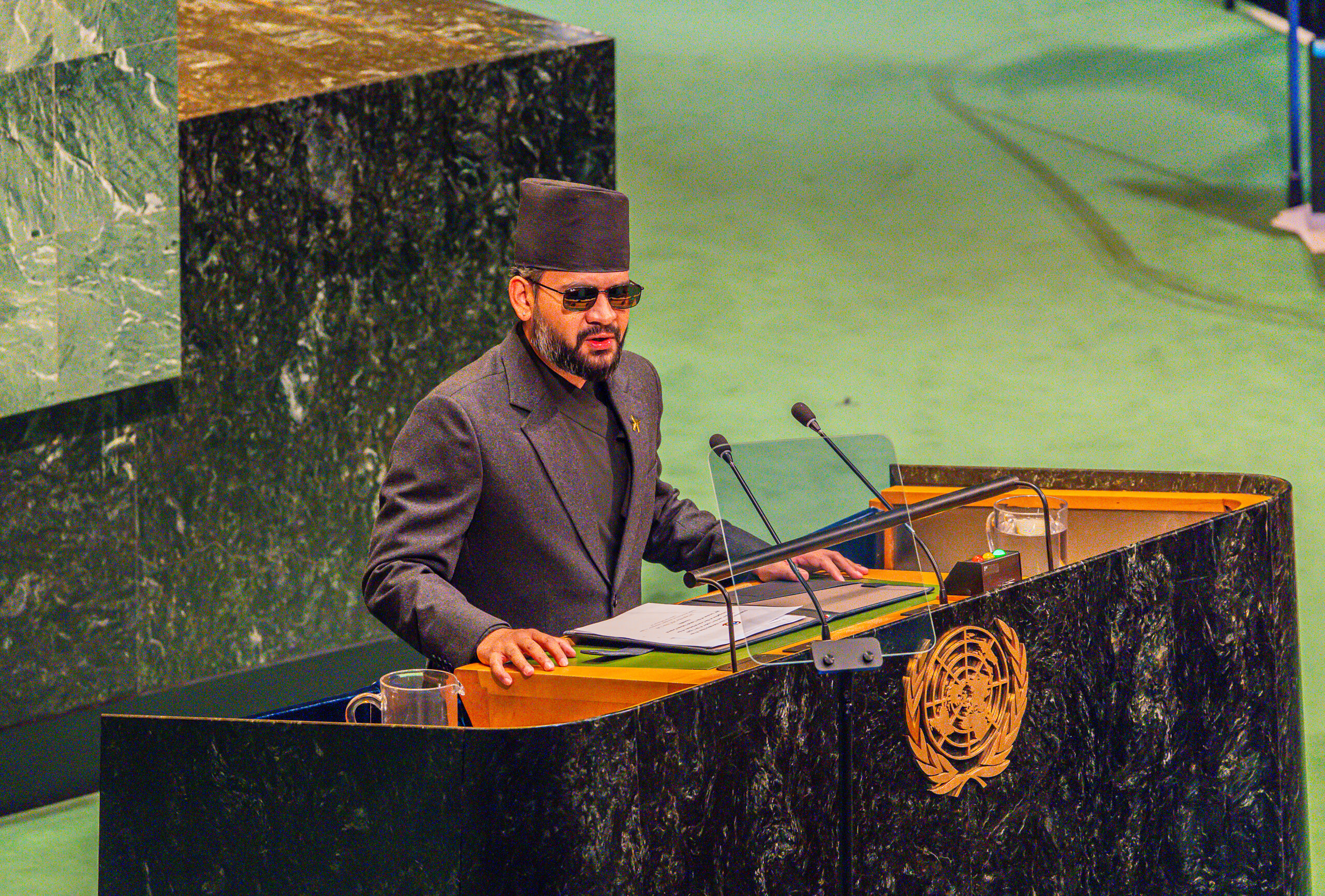
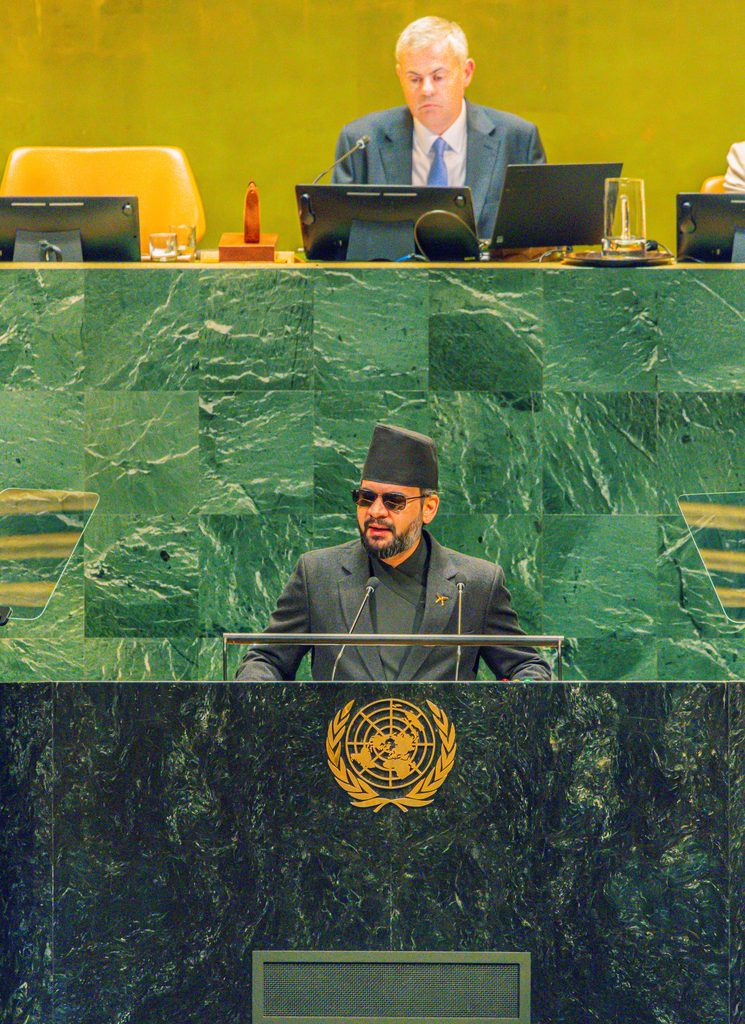
Kathmandu: Rt. Hon. Prime Minister Balendra Shah’s address to the 81st session of the United Nations General Assembly (UNGA) in New York on September 24 drew attention from world leaders, international media outlets and commentators alike. It was a clarion call from Nepal, a Himalayan nation, for greater climate justice and a fairer international order.
Prime Minister Shah was articulate and was widely heard, particularly as he was addressing the gathering of world leaders in the wake of the August 26 Bhotekoshi flood. Foreign commentators widely shared his metaphor of ‘weapons easily crossing global borders while basic goods such as fertiliser fail to reach farmers on time.’
PM Shah’s address was ‘short and sweet’. He spoke his mind and presented Nepal’s realities. Besides speaking on behalf of marginalised Nepali farmers, he presented Nepal’s stark situation following the Bhotekoshi flood, which took countless lives of Nepali as well as foreign nationals and destroyed homes and critical infrastructure like road and hydropower projects.
His proposal to establish a Himalayan Climate Resilience Mechanism, co-led by Nepal, India and China, attracted considerable interest. His address was also described as refreshingly “unfiltered” for a Gen Z leader speaking on climate justice.
There was particular interest in his journey as Nepal’s young prime minister and in his decision to take the country’s concerns to the global platform following the devastating flood.
It was also his first foreign visit after assuming office following the March 2026 election. Traditionally, Nepali prime ministers have made India their first foreign destination after assuming office.
For the record, Pushpa Kamal Dahal, then prime minister of Nepal, visited China first in 2008, breaking the tradition of making India the first destination.
PM Shah had not initially planned to visit any country immediately after assuming office. However, the Bhotekoshi disaster and its devastation led him to use the world stage to share Nepal’s plight as one of the countries most vulnerable to the consequences of the global climate crisis.
“I come before you from Nepal—a distant country in the Himalayas—carrying a close warning for humanity,” he said. “I wish I could stand here today simply to speak about development, democracy, peace and the hopes of a young nation. Instead, I must speak about death and destruction of epic proportions.”
He poignantly described the devastation, which claimed more than 1,400 lives and left more than 6,000 people missing. “Families waiting for loved ones who will never come home,” he said, describing a sombre situation. “Communities searching through mud, rocks and water for people whose bodies may never be recovered. And bridges, roads, schools, homes and livelihoods swept away in minutes. And about a country whose steady progress towards achieving the Sustainable Development Goals has been interrupted.”
As he was addressing the UNGA a month after that fateful morning when the world saw shocking images of catastrophic flash floods sweeping through Nepal’s mountain communities.
Warning to the world
PM Shah clearly stated that the Bhotekoshi-Trishuli disaster was not merely a local tragedy but a “warning to the world” and asked: “Have we really heard that warning?”
He recalled the visit of António Guterres, Secretary-General of the United Nations, to Nepal three years ago. Following his meeting with Guterres, then Prime Minister Pushpa Kamal Dahal had said the UN secretary-general expressed deep concern about the impacts of climate change and assured Nepal of support for adaptation and greater assistance in the future.
“Nearly three years ago, standing in the shadow of our Mount Everest, the Secretary-General of the United Nations warned humanity about the madness of an impending climate disaster,” PM Shah said, recalling Guterres’s visit to Nepal. “That cry from the rooftop of the world was not heard loudly enough. We in Nepal heard it. Our communities heard it. Scientists around the world heard it. They repeated it with evidence.”
The warning, however, went largely unheeded.
“But we, the political leaders of the world, have been negligent to translate those warnings into action at the speed and scale that vulnerable people require,” PM Shah said. “Last month, we saw the tragic consequences,” he said referring to August 26 death and devastation.
That was not the first warning.
In September 2009, then Prime Minister Madhav Kumar Nepal took Nepal’s climate message to the international stage. During his visit to New York for the 64th session of the United Nations General Assembly, he met US President Barack Obama and presented him with a piece of rock from Mount Everest as a symbol of the melting Himalayas.
According to Madhav Nepal, Obama thanked him and said the stone would remind him of the melting mountains.
On October 17, 2009, Maldives President Mohamed Nasheed and his cabinet held the world’s first underwater cabinet meeting. The meeting was held about 20 feet (6 metres) below the surface near Girifushi Island to highlight the existential threat posed by rising sea levels.
It was an extraordinary move intended to draw attention to the global climate crisis. Following the Maldives’ example, Nepal also held a cabinet meeting at Kala Patthar, one of the world’s highest locations.
On December 4, 2009, then Prime Minister Madhav Kumar Nepal led the historic cabinet meeting at Kala Patthar, at an altitude of 17,192 feet (5,242 metres) near Mount Everest.
“Maldives held the underwater cabinet meeting, and that inspired me,” former Prime Minister Nepal told The Diplomat Nepal. “We were affected by floods and landslides and by melting permafrost. So, to draw the world’s attention, we held that cabinet meeting at Kala Patthar.”
No visas for devastation
Coastal countries have long been raising their voices about the consequences of climate change. Nepal, meanwhile, has increasingly been at the forefront of efforts to draw attention to the fragility of the Himalayan ecosystem.
PM Shah warned that melting permafrost is fracturing mountain slopes beneath glaciers and increasing the risk of ice-rock avalanches, floods, landslides and other cascading hazards.
PM’s address to the UNGA came at a time when the world had witnessed the devastating consequences of the Bhotekoshi disaster only a month earlier. The disaster affected both Nepal and China, while floodwaters continued downstream towards India.
“This tells us something fundamental,” he said. “Climate change does not recognise borders. Glaciers and floods do not travel with a visa stamped on passports.”
The Prime Minister expressed gratitude to countries and organisations that came to Nepal’s aid in the aftermath of the disaster. Nepal’s immediate neighbours, India and China, offered prompt assistance. He also mentioned support from the UN system, humanitarian agencies, philanthropies and people around the world who stood with Nepal and thanked them on behalf of the Nepali people.
The task of rebuilding after the destruction is massive. Nepal was still dealing with the long-term consequences of the 2015 Gorkha earthquake when, just over a decade later, it faced another major disaster in the form of the Bhotekoshi flood.
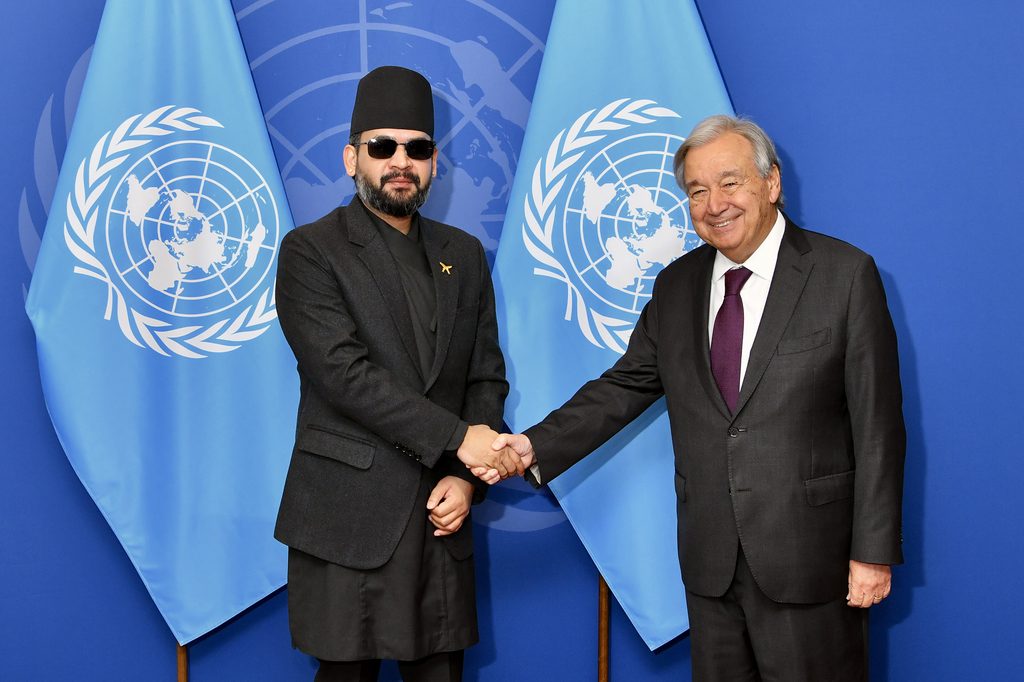
According to PM Shah, Nepal needs at least 10 percent of GDP to recover from the destruction.
“As in rebuilding after past disasters like the 2015 Gorkha earthquake, we count on your solidarity and support,” Shah said. “Nepal contributes less than 0.1 percent of global greenhouse-gas emissions. We did not create this crisis. Yet we are paying a colossal price for it.”
The Prime Minister aptly articulated the reality facing Nepal by stating that glaciers are retreating, mountain slopes are becoming unstable and rivers are becoming less predictable.
“Our glaciers are retreating. Our mountain slopes are becoming unstable. Our rivers are becoming less predictable. In addition, every major disaster threatens to erase years of development,” he said.
“For Nepal, climate catastrophe is not just a humanitarian event, but a development emergency,” he said. “It destroys roads, bridges, schools, homes, farms and livelihoods. It destroys the clean energy infrastructure that we need to fuel our future. And it forces a poor country to borrow money to repair damage it did not cause.”
Himalayan mechanism
PM Shah made clear that he was not at the UNGA to blame any country or continent. Nepal was not there to turn climate change into another geopolitical battlefield. Rather, it was asking the international community to recommit to shared responsibility and solidarity.
“Climate justice cannot just remain a beautiful phrase in a United Nations document,” he said. “People of our country must be allowed to build their future instead of constantly rebuilding their past.”
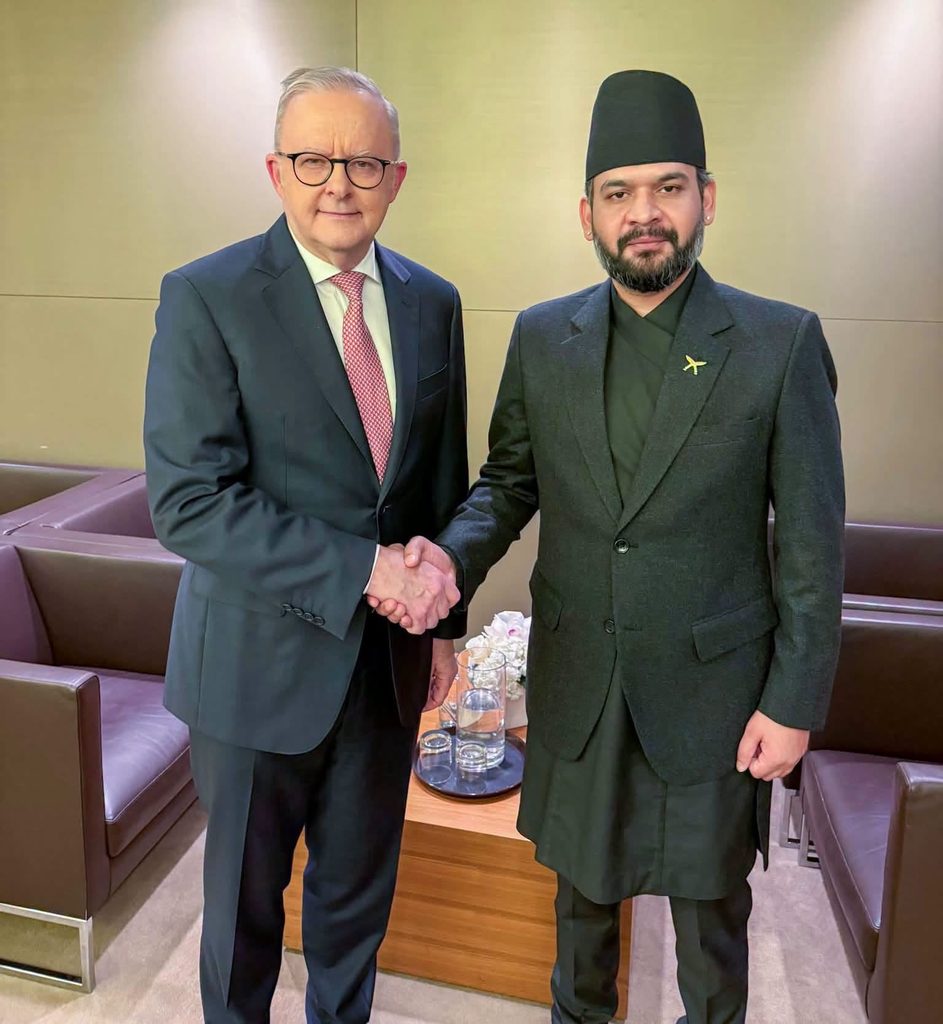
The Hindu Kush Himalayan region is home to nearly two billion people. Its mountains provide water, ecosystems, agricultural resources and livelihoods to populations across the region. The mountains are often described as the world’s water towers.
To protect this life-support system, Shah proposed establishing a Himalayan Climate Resilience Mechanism led by Nepal, India and China.
The mechanism would facilitate the sharing of satellite data and expertise, monitoring of dangerous glacial lakes, development of early-warning systems and coordinated cross-border assistance when disasters strike.
He called for the Himalayas to become a laboratory for international cooperation rather than a frontier of fragmented information.
Nepal’s forest cover is nearly half of the country’s total area. In such a situation, Nepal is already playing a role in global ecological protection that exceeds its share of global emissions. Forest conservation, clean energy and the adoption of electric vehicles are among the measures contributing to this effort.
Nepal’s proposal for a Himalayan Climate Resilience Mechanism has attracted international attention. Under the proposal, Nepal, India and China could jointly lead the mechanism while seeking support and participation from other countries.
PM Shah proposed an institutional framework, but its establishment will depend on whether other countries take the initiative seriously. There needs to be extensive follow-up to develop and institutionalise the proposed mechanism.
Nepal can play a vital role in this regard.
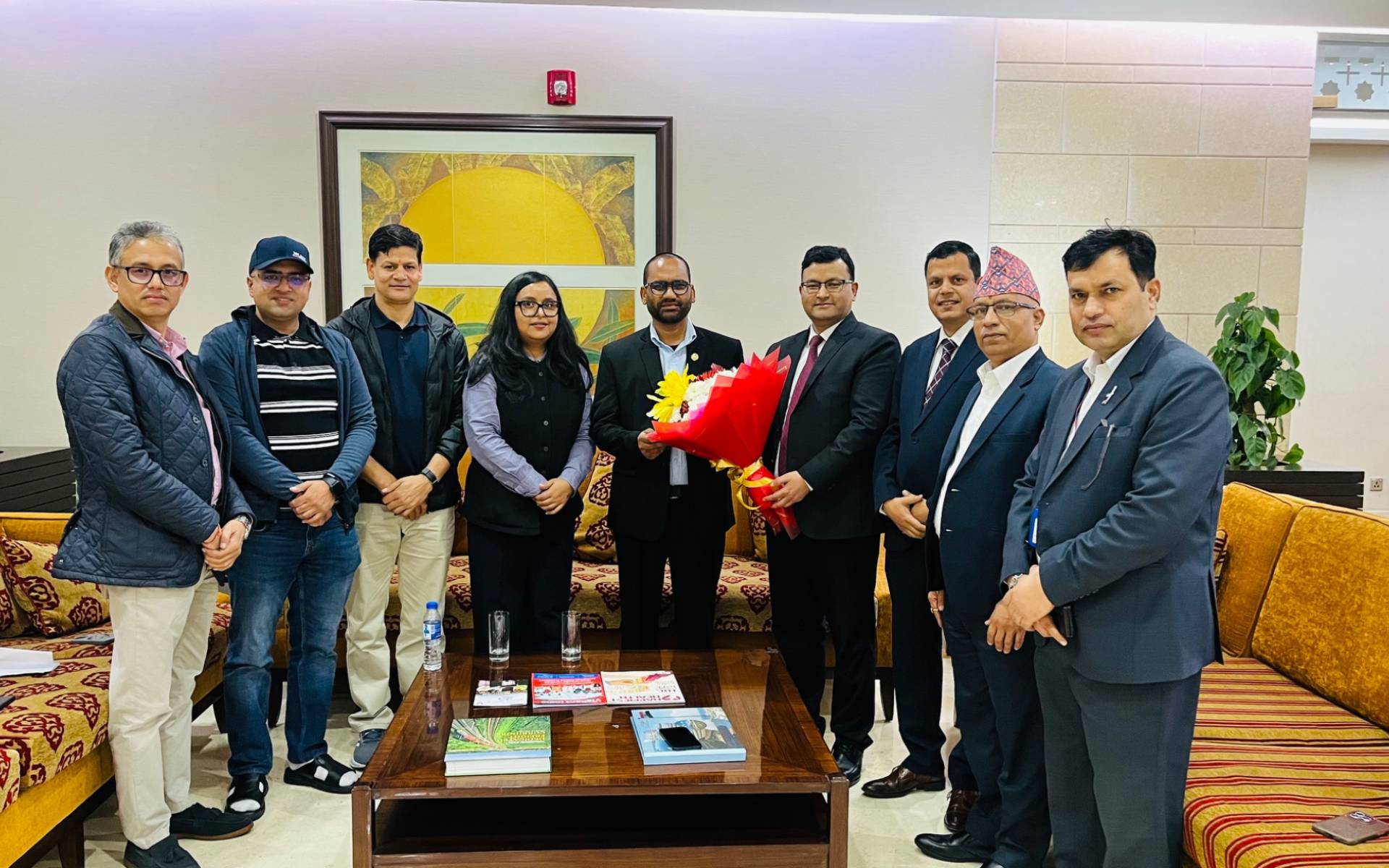
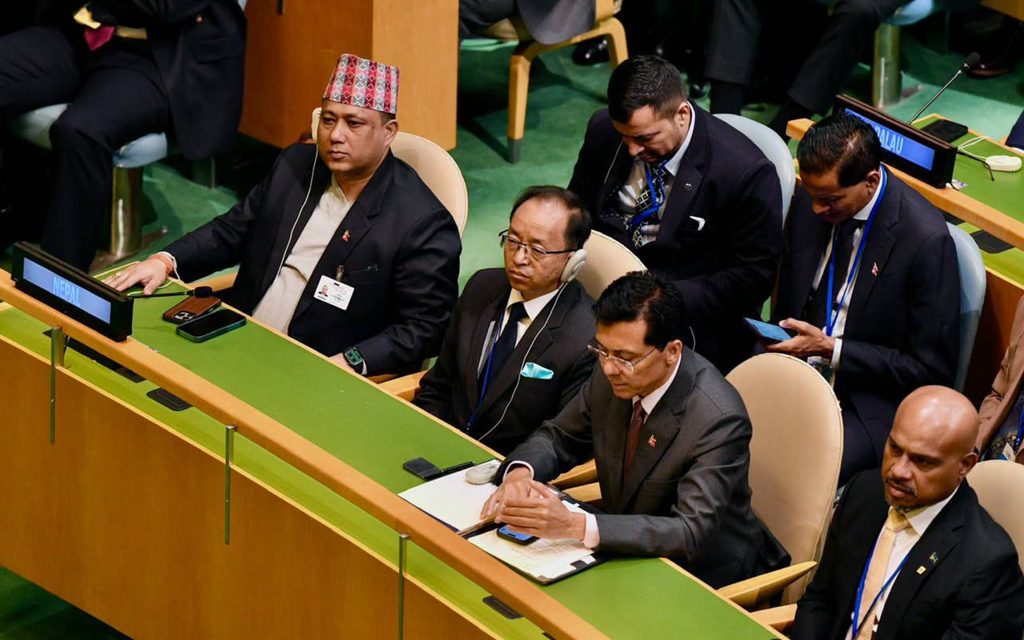
Foreign Minister Shisir Khanal participated in as many as 80 different meetings, where he used the term “Himalayan Tsunami” to describe the intensity of the Bhotekoshi-Trishuli disaster.
The country is keen to see what results the foreign minister’s marathon diplomatic engagements will produce.
Following PM Shah’s address and FM Khanal’s sideline meetings, observers have raised concerns regarding whether these diplomatic efforts will translate into concrete support for Nepal’s reconstruction.
“The number of meetings will be regarded as useful when they result in substantive support for Nepal’s reconstruction and translate into financial assistance,” former ambassador to the UN Jaya Raj Acharya told The Diplomat Nepal. “The prime minister’s speech itself is good. The next challenge is to mobilise international funding for our infrastructure.”
Call for justice
PM Shah’s address also raised questions about global governance in the aftermath of disasters.
Referring to the “6Rs”—relief, rehabilitation, reconstruction, responsibility, reparation and resilience—he called for greater responsibility from international organisations such as the UN.
“When a climate-driven disaster destroys the infrastructure of a poor country, the answer cannot simply be another mega loan or a patchwork of small grants,” he said. “We need adequate grant-based support from the world. The Loss and Damage Fund, the Global Environment Facility and other relevant financing mechanisms remain grossly inadequate. Climate finance must not become a bureaucratic maze through which vulnerable countries spend years proving that they need help.”
He drew the attention of the world leaders to the slow and difficult process of accessing climate finance.
“When the house is burning, we do not ask the family to complete fifty forms,” he said. “We act. That is what climate justice must mean.”
He also questioned the existing international order.
The UN was born after the horrors of two world wars. The international order was intended to uphold sovereignty, international law and the dignity of all human beings, including the weak and vulnerable, rather than allowing the powerful to dictate the terms.
“Today, that international system is under strain,” PM Shah said. “Too often, military and economic power determines whose voice is heard. Nepal believes we need a much fairer global economic order.”
It is not clear whether the powerful nations seriously heard the voice coming from the Himalayas but the international press and commentators took note of Nepal’s intervention.
“When a poor farmer in Nepal went to sow her seeds this monsoon, fertilisers didn’t reach her on time,” the PM said. “When we wanted to pave a new highway, there was no bitumen. When a family sat down for an evening meal, there was a shortage of cooking fuel.”
There are two interlinked problems: melting glaciers, failing harvests and floods arriving without warning on the one hand, and a global supply chain that leaves poorer countries vulnerable to disruptions beyond their control on the other.
PM Shah argued that small countries are not necessarily lagging behind because of their own choices or circumstances but because structural inequalities in the international system can constrain their development.
He said: “Inter-continental missiles arrive on time. Rifles and ammunition cross borders, clear every bottleneck, meet each deadline. But a peasant in Nepal cannot procure his fertiliser or fuel at market price at a time of need. We have built a world with flawless logistics for war and broken logistics for food.”
While Prime Minister Shah has received considerable appreciation for vocally articulating Nepal’s vulnerabilities, concerns remain about how effectively Nepal can follow through with concrete action at home.
“The speech used passionate language,” Jaya Raj Acharya said. “He said what Nepal’s prime minister should say. However, he needs to create a mechanism to materialise it. He has to mobilise his politicians and bureaucrats to achieve the result.”