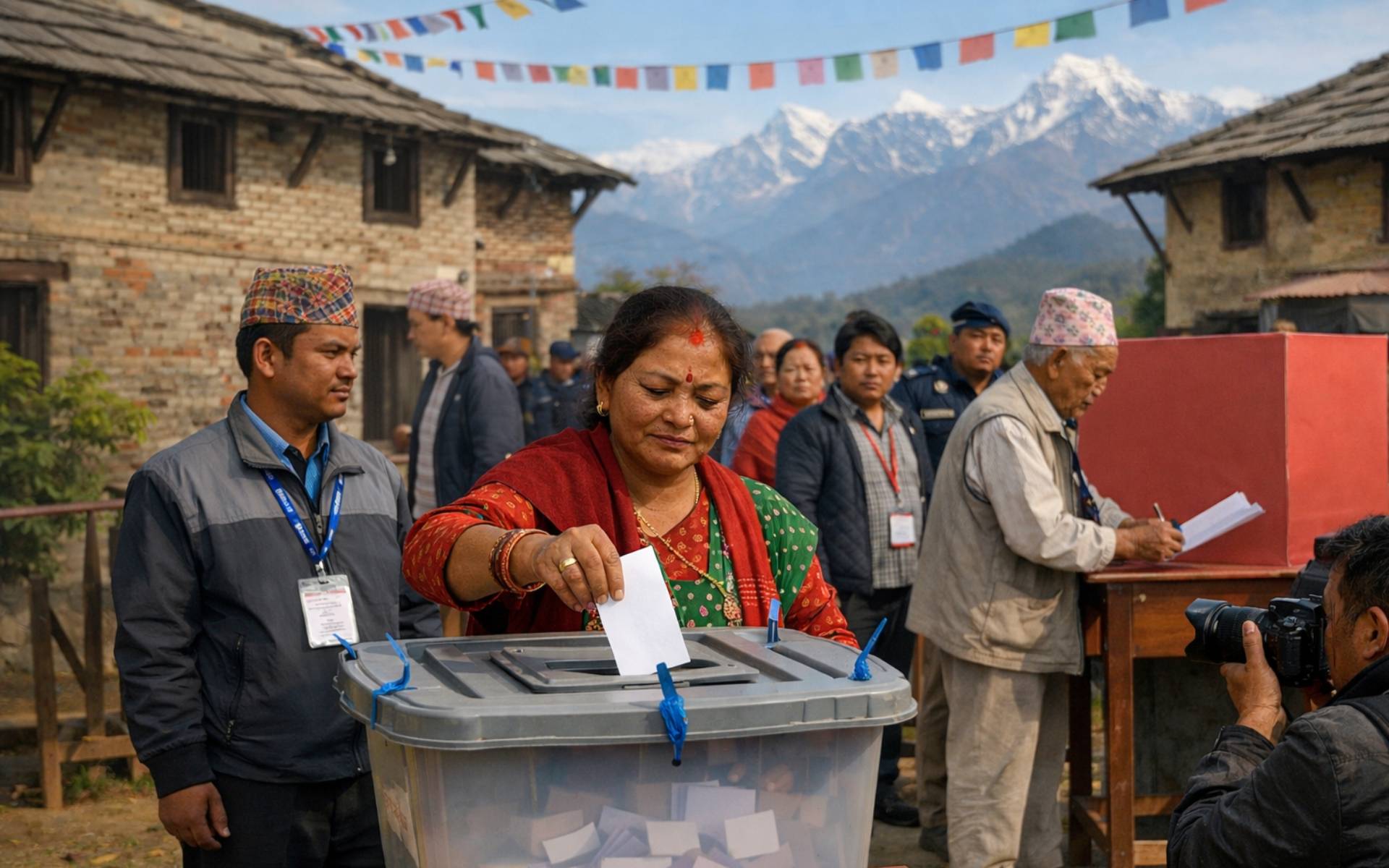
As Nepal heads toward the next general election, a familiar political script is returning to the national stage. Across rally platforms and social media feeds, politicians are once again wrapping themselves in the flag, presenting themselves as the ultimate defenders of the nation against foreign interference.
It is an emotionally powerful pitch. It appeals to national pride and public insecurity in equal measure. But too often, beneath this performance lies a troubling reality: nationalism is being used not to advance the national interest, but to distract from the absence of economic vision, governance reform, and long-term statecraft.
Nepal needs patriotism. It needs leaders who can defend the country’s dignity, territorial integrity, and strategic autonomy. But patriotism is not the same as performative outrage, and sovereignty is not strengthened by slogans alone. If we genuinely care about Nepal’s future, we must stop confusing nationalism with national interest.
The uncomfortable truth about independence
We need to begin with an uncomfortable truth: sovereignty in the twenty-first century is not exercised through isolation. It is exercised through intelligent engagement. Every country lives within networks of trade, finance, supply chains, migration, and strategic dependency. A wise state does not deny this reality; it manages it carefully and to its advantage.
The world’s most successful countries are not those that have tried to stand apart from everyone else. They are the ones that have used diplomacy, trade, and economic strategy to strengthen themselves. Singapore, for example, has protected its sovereignty while remaining deeply connected to global markets, investment, and supply chains. Its success did not come from isolation, but from disciplined realism and a relentless focus on national interest.
Critics may argue that comparisons with Singapore are misplaced. Nepal is landlocked, more vulnerable, and historically exposed to external pressure, including blockades and dependence on transit routes. That is true. But this is precisely why strategic diplomacy matters even more for Nepal. Geographic fragility is not an argument for isolation. It is an argument for greater pragmatism.
The yam and the empty plate
For Nepal, this lesson is not theoretical. It is existential. More than 250 years ago, Prithvi Narayan Shah described Nepal as “a yam between two boulders”. That image still captures our reality. We remain a landlocked country situated between two major powers and two enormous markets. Geography has not changed. The world around us has.
Today, trade flows, energy demand, labor migration, digital systems, and regional supply chains shape the daily lives of Nepalis far more directly than political rhetoric admits. The price of fuel, medicines, fertilizer, machinery, and many daily essentials is influenced by forces beyond our borders. Policy decisions in neighboring countries can quickly affect our markets and our households.
Yet many of our politicians continue to sell the fantasy of absolute, defiant independence. In doing so, they promise a fortress while building an economic prison.
We speak proudly of self-reliance, yet our economy remains heavily dependent on imports and on income earned abroad. Remittances remain a critical pillar of economic stability, built on the sacrifice of citizens who had to leave because opportunity at home was too limited. Nepal’s trade deficit also remains structurally large. This should force us to ask a serious question: can a country claim to be fully secure when so many of its people must leave home to survive, and when its economy remains so exposed to outside forces?
The cost of performative nationalism
This is where ultra-nationalism becomes dangerous. It offers emotional satisfaction while postponing the hard work of reform. It tells citizens to be angry instead of asking deeper questions: Why are decent jobs so scarce? Why is productive industry so weak? Why do so many young Nepalis still see migration as their only path forward? Why has Nepal struggled to turn its geography into economic leverage?
The September 2025 Gen-Z protests should be understood in that wider context. The immediate trigger may have been the government’s ban on major social media platforms, but the speed and intensity with which the protests spread showed that the anger ran much deeper. It reflected frustration over corruption, nepotism, shrinking trust in political leadership, and the lack of meaningful economic opportunity for young Nepalis.
That moment should have been a warning. When a generation feels unheard, excluded, and unable to build a dignified future at home, political anger will eventually find an outlet. If mainstream politics continues to answer youth frustration with slogans instead of solutions, it will only deepen the disconnect between state and society.
For a small state like Nepal, extreme nationalism can be especially costly. When every negotiation is portrayed as surrender and every compromise as treason, diplomacy becomes politically toxic. Governments lose the room they need to secure practical gains. Trade agreements become harder to pursue. Foreign investment becomes more difficult to attract. The language of sovereignty remains loud, but the substance of national power begins to weaken.
This does not mean Nepal should be naive. A small state must remain vigilant. Nepal does need strategic caution, strong institutions, and the confidence to resist external pressure when its core interests are at stake. But these are arguments for stronger institutions and clearer national priorities, not for retreat into theatrical nationalism.
Who actually protects sovereignty?
This brings us to the central political question: what truly protects a nation’s sovereignty?
The obvious answer is the state—its laws, institutions, diplomacy, and security forces. And that is partly true. But sovereignty is not sustained by state institutions alone. It is also sustained by the strength, confidence, and well-being of the people.
An army can guard a border post. A government can sign treaties and issue statements. But a country’s long-term resilience depends on whether its citizens are educated, employed, healthy, and able to imagine a future at home.
Hungry people do not experience sovereignty in the way elites describe it. For a family struggling with inflation, unemployment, and uncertainty, abstract speeches about national greatness ring hollow. If a young citizen from Butwal or Janakpur is forced to queue at Tribhuvan International Airport because they cannot build a life in Nepal, then the promise of sovereignty has already been weakened.
Sovereignty defended in rhetoric but undermined in everyday life is sovereignty in name more than in substance.
The pragmatic mandate
That is why the next government must redefine what patriotism means in practice.
The goal cannot be to isolate Nepal in the name of pride. The goal must be to use Nepal’s geopolitical position intelligently to enrich its people. We need leaders who understand that foreign policy is not only about symbolism. It is also a tool for domestic economic transformation.
Instead of viewing our neighbors only through suspicion, we must also see them as markets, transit partners, energy buyers, and strategic economic opportunities. If hydropower exports can generate revenue and strengthen national capacity, Nepal should pursue them with confidence. If foreign investment can build infrastructure, expand domestic industry, transfer skills, and create quality jobs under fair and transparent terms, Nepal should welcome it.
As voters, we should ask a simple question of every leader seeking office: who is offering outrage, and who is offering strategy?
The real test of national leadership is not who can sound the most defiant from a podium. It is who can make Nepal stronger in the lives of its people. A prosperous, educated, and economically secure population is the strongest foundation of sovereignty any country can have.
Nepal does not need less patriotism. It needs a better kind—one rooted not in noise, but in national interest; not in performance, but in results. In the end, a well-fed, confident, and forward-looking Nepali citizen is the strongest defender this nation could ever ask for.