Nepal’s development debate often seeks solutions from foreign nations. Yet, beyond the policy paper, the more pressing question is how countries implement their vision into systems. A recent Chinese Nepalese Youth Pioneer (CNYP) exchange program in China offered a closer look at the innovation and progress in industries.
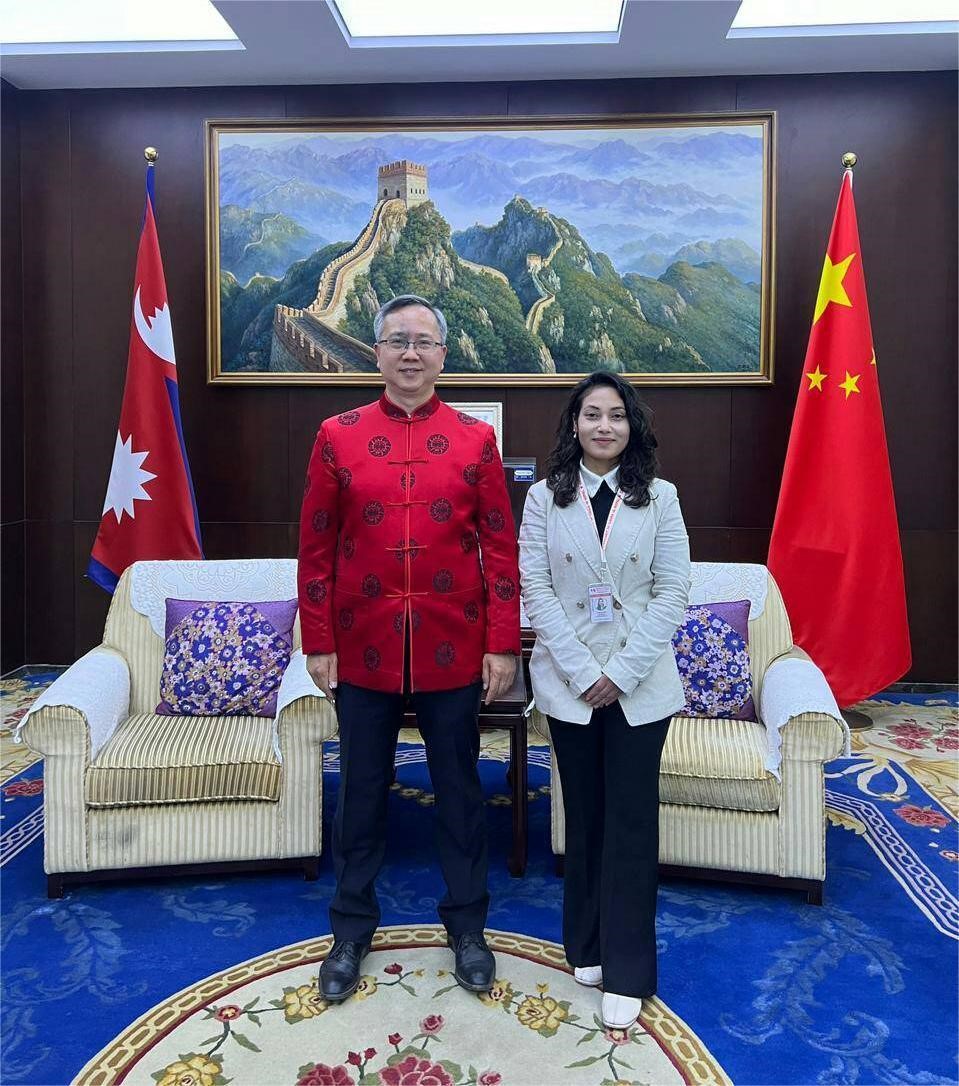
Across Nepal, youth are demanding structural reform, requiring huge opportunities to build skills in science, technology and policy. Yet the gap between aspiration and capacity remains wide, especially in the technical sector. In this context, international exchange programs are becoming meaningful platforms for exposure and learning. Chinese Nepalese Youth Pioneer (CNYP) is one among them, launched under the leadership of former Chinese Ambassador in Nepal H.E. Ambassador Mr. Chen Song.
I had the opportunity to visit China as part of the CNYP program. The purpose was to learn China’s development experience through the “youth exchange” program to bring global knowledge home to develop Nepal. It helped us to observe the rapid transformation of China and its global significance in sustainable development.
Real technological success exists in practical understanding, not in theory. The popular cities Guangzhou and Shenzhen demonstrated China’s technological advancements. These smart cities, along with 56% of the land being covered by vegetation, reflect balance between environmental management and industrial growth. We observed the modern sewage treatment facility, “Lijiao Sewage Treatment Plant,” in Guangzhou.
I asked a resident, Lee, 45, whether he had ever seen power outages and floods occurring in his area. He revealed a striking reality that “such events have never been seen throughout my life”. He also introduced the sewage purification process through bio-chemicals, reflecting how such technology works to uplift public life.
China’s innovation
China’s technical progress is fueled by clean energy and electric vehicles. Our visit to automobile companies GAC Aion introduced new energy vehicles, targeted to reduce carbon emission. Furthermore, our next visit to XAG company, introduced advanced agricultural drone technology, through a modern production system. It showed us how modern technology is beneficial in a country like Nepal, contributing to potential economic growth.
Shenzhen reflects endless possibilities in innovation and urban planning which can reshape modern city life. Our delegation visited Hi-Tech companies, including BYD headquarters. We learned about advanced electric mobility, battery safety, solar power, high speed railway and smart transportation systems. The tourist guide ‘Alan’ said that Shenzhen itself is “home to more than 120 parks” which shows China’s relentless effort to make the city livable with a broader urban vision. Public parks and technical services demonstrate how rapidly growing urbanization can be managed in people’s lives.
We had no idea that Huawei would be on the bucket list for travel. We observed profound live signals and early warning innovations there. Huawei is not limited to just cloud technology but also includes software and operating systems with strict cyber-security. It illustrates the horizon of the technological ecosystem.
Every country has a unique history, challenges, and realities. During the museum tour, we learned about the history of Shenzhen and China. That includes comparative progress, political history, and the story of people. Every single wall in the museum had a story to tell about how people and leaders struggled to make China prosperous.
Globally, health care services and resilience are crucial to everyone. At ‘Mindray’, we explored biomedical innovations that are improving patients’ lives, used in hospitals and laboratories across 190 nations. It provided significant telemedicine services during the outbreak of Covid- 19 pandemic. Also, it supplies instruments to the Chitwan Medical College, hospitals, and research center in Kathmandu. Thus, Chinese innovations are supporting the world in building significant healthcare services.
Recreation is the heart of the economy and the strength of China. From reputed automobile companies to biomedical innovation, China’s technological landscape reflects more than economic development. Chinese policy strictly controls digital technology. Social media platforms that prioritize their own innovation such as ‘Baidu’ and ‘We-chat’ ensure independent technology. One inspiring factor we found is practical education and investment in technology. The use of robotics and automation is creating huge job opportunities to empower citizens. This can be instructive for Nepal where youths are creative but opportunities are limited.
Learning lessons
Nepal’s development discussion must shift from observation to implementation. We observed China’s Proactive Hi-Tech companies. In Nepal, we need to pave practical pathways for development under the leadership of the current government. Kathmandu faces the problems of air pollution, drinking water crisis, environment management, public transport and infrastructure development.
The lessons from China offer meaningful direction to overcome these issues.
Economic growth requires more than ambition. Nepal should reform and implement the tax system. It should ensure political stability and economic growth through investing in tourism, renewable energy, infrastructure and information technology. The government should encourage co-operation between the private sectors and research institutions.
Strategic vision matters only when supported by execution. The Chinese model of development requires not only strategic vision but also clear execution plans and innovation, resulting in stronger economic and global reputation. Because of political instability and economic crisis, we see what is broken and we demand for a better future. Nepal should listen to youth, understand and build a system for technology.
China’s innovation model may not be something that can be directly copied in Nepal nor by any other country. But there is definitely something to learn from it. Transformation begins with vision. investment in the people and courage to think differently. In Nepal, the issue is not whether to imitate others, but how to apply global lessons to local realities that empower future generations.