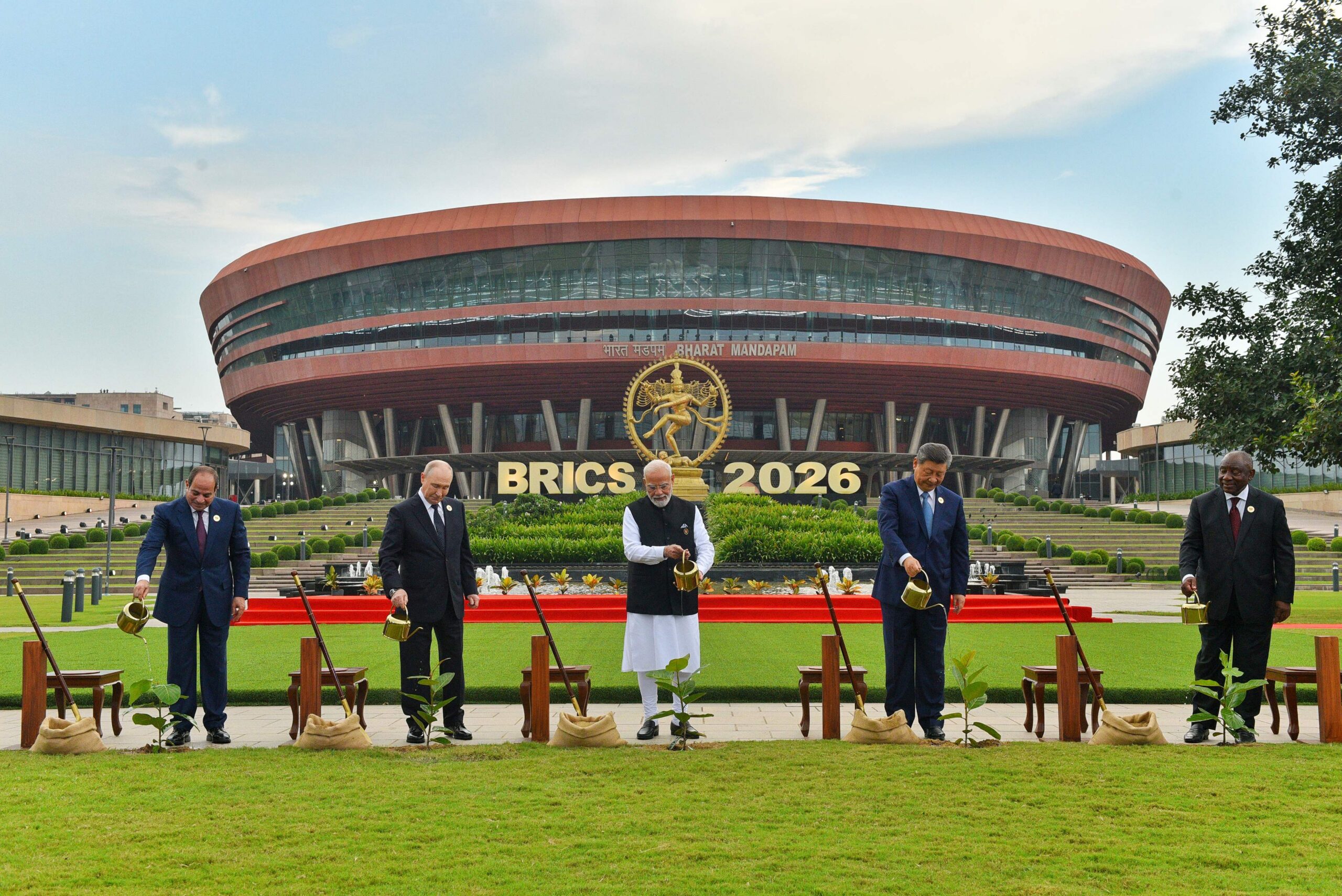
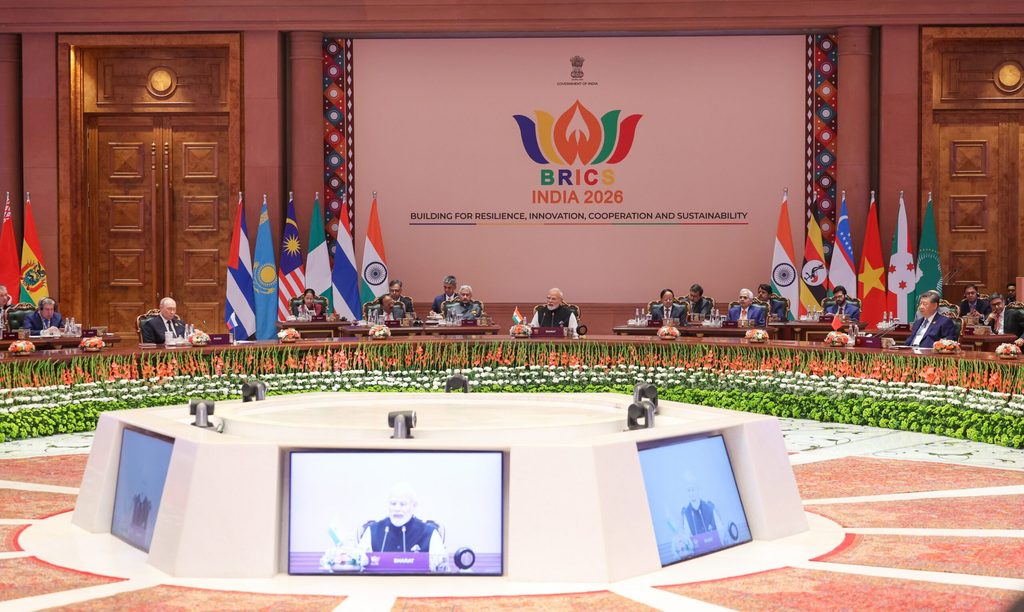
Kathmandu: India hosted the 18th BRICS Summit on September 12–13, 2026, at Bharat Mandapam in New Delhi. Held under the theme “Building for Resilience, Innovation, Cooperation and Sustainability,” the summit brought together leaders of BRICS member and partner countries, along with outreach invitees.
During India’s 2026 presidency, more than 400 meetings and engagements involving ministers, parliamentarians, officials, experts, businesses and civil society were held in 30 cities across India. These engagements sought to strengthen the BRICS strategic partnership through its three pillars: political and security cooperation, economic and financial cooperation, and cultural and people-to-people exchanges.
BRICS now brings together 11 major emerging markets and developing countries: Brazil, China, Egypt, Ethiopia, India, Indonesia, Iran, Russia, Saudi Arabia, South Africa and the United Arab Emirates. The grouping has developed into a platform for consultation and cooperation on issues of global and regional significance, including international political and economic governance.
The BRIC grouping was formalised at the first meeting of BRIC foreign ministers on the sidelines of the United Nations General Assembly in New York in 2006. The first BRIC Summit was held in Yekaterinburg, Russia, in 2009. South Africa’s inclusion was agreed at a BRIC foreign ministers’ meeting in New York in 2010, and it attended the third BRICS Summit in Sanya, China, in 2011.
Egypt, Ethiopia, Iran and the United Arab Emirates became full members in January 2024, while Indonesia joined in January 2025.
The BRICS partner-country category was established at the 2024 Kazan Summit. Belarus, Bolivia, Kazakhstan, Cuba, Malaysia, Nigeria, Thailand, Uganda and Uzbekistan became partner countries in 2025, followed by Vietnam in June that year, bringing the number of partner countries to 10.
The New Delhi Declaration, adopted on September 12, marked the 20th anniversary of BRICS. The members reiterated their commitment to reforming global governance and to ensuring greater and more meaningful participation and representation of emerging markets and developing countries, as well as Least Developed Countries, in global decision-making processes and structures.
For a country like Nepal, that language is particularly relevant. The declaration specifically calls for greater participation and representation of LDCs, especially from Asia, Africa and Latin America and the Caribbean, in global decision-making.
The 140-point New Delhi Declaration also contains several provisions directly relevant to Nepal. Point 20 reaffirms support for reform of the World Trade Organization and for a rules-based multilateral trading system, including Special and Differential Treatment for developing members, particularly LDCs. Point 57 calls for strengthening the health workforce in developing countries and LDCs through cooperation in capacity building, training and research.
Another provision is particularly pertinent to Nepal in the aftermath of the August 26 disaster. Point 82 acknowledges the growing complexity of disaster risks, including those related to climate change, particularly in the Global South. It commits BRICS countries to improving disaster-risk reduction systems and capacities, sharing traditional, indigenous and local knowledge, strengthening preparedness and self-reliance, and mobilising adequate, predictable and accessible financing for infrastructure development.
The August 26 disaster was triggered by a massive rock-and-ice avalanche and subsequent debris and flash flooding in the Rasuwa of Nepal. Scientific assessments released after the disaster have identified human-induced warming and permafrost degradation as contributing factors, alongside geological processes and the region’s complex hazard environment.
The declaration also contains language on climate change that could be significant for Nepal. Point 107 recognises the disproportionate burden of climate change on developing countries and reaffirms the importance of adaptation, loss and damage and the provision of means of implementation to developing countries, while Point 110 calls for additional, adequate, predictable and accessible financial resources, capacity building and technology transfer for adaptation.
In Nepal, voices were raised that the country should seek to benefit from the emerging cooperation between China and India. Former Prime Minister Dr. Baburam Bhattarai said Nepal, as a least developed country situated between two major neighbours and emerging from a prolonged political transition, should seek to derive maximum benefit from the changing regional environment.
“We must fully grasp the implications of the Chinese President’s words during the bilateral talks—specifically regarding ‘both sides keeping in mind the long-term development of bilateral relations from a strategic perspective’—as well as the multidimensional direction outlined in the comprehensive resolution adopted by consensus under India’s leadership,” Bhattarai wrote on social media. His comments followed the September 12 meeting between Chinese President Xi Jinping and Indian Prime Minister Narendra Modi on the sidelines of the BRICS Summit.
“It is imperative that we capitalize on the potential ‘competitive cooperation’ between China and India in the days ahead. Through adept diplomatic efforts, we must immediately initiate a planned process to transform Nepal into a ‘dynamic bridge’ between its two neighbors and, ultimately, into a ‘nation of peace,’” he said.
Nepal’s absence from the New Delhi summit also prompted discussion in Kathmandu.
“Imagine the space Nepal would have had if we had been invited to the BRICS Summit—the cross-regional grouping of emerging and developing economies,” said Baburam Bishwakarma, a geopolitical commentator and the author of the book Bhurajnitiko Bhar (Burden of Geopolitics).
Nepal could use platforms such as the UN and BRICS to amplify its voice on climate justice, he argued.
“Sadly, this great gathering of emerging economies was taking place in New Delhi, barely an hour’s flight from Kathmandu, at a time when Nepal was reeling from a devastating disaster. Yet nobody talked about it, and Nepal was not represented in the summit,” he said.
Forums such as BRICS can help Nepal strengthen its voice and enhance its standing in global affairs, he said. “For a country like Nepal, such groupings are important because they provide platforms to raise our concerns and make our voices heard. I would be happy to see Nepal represented in the next summit, at least as an invitee.”