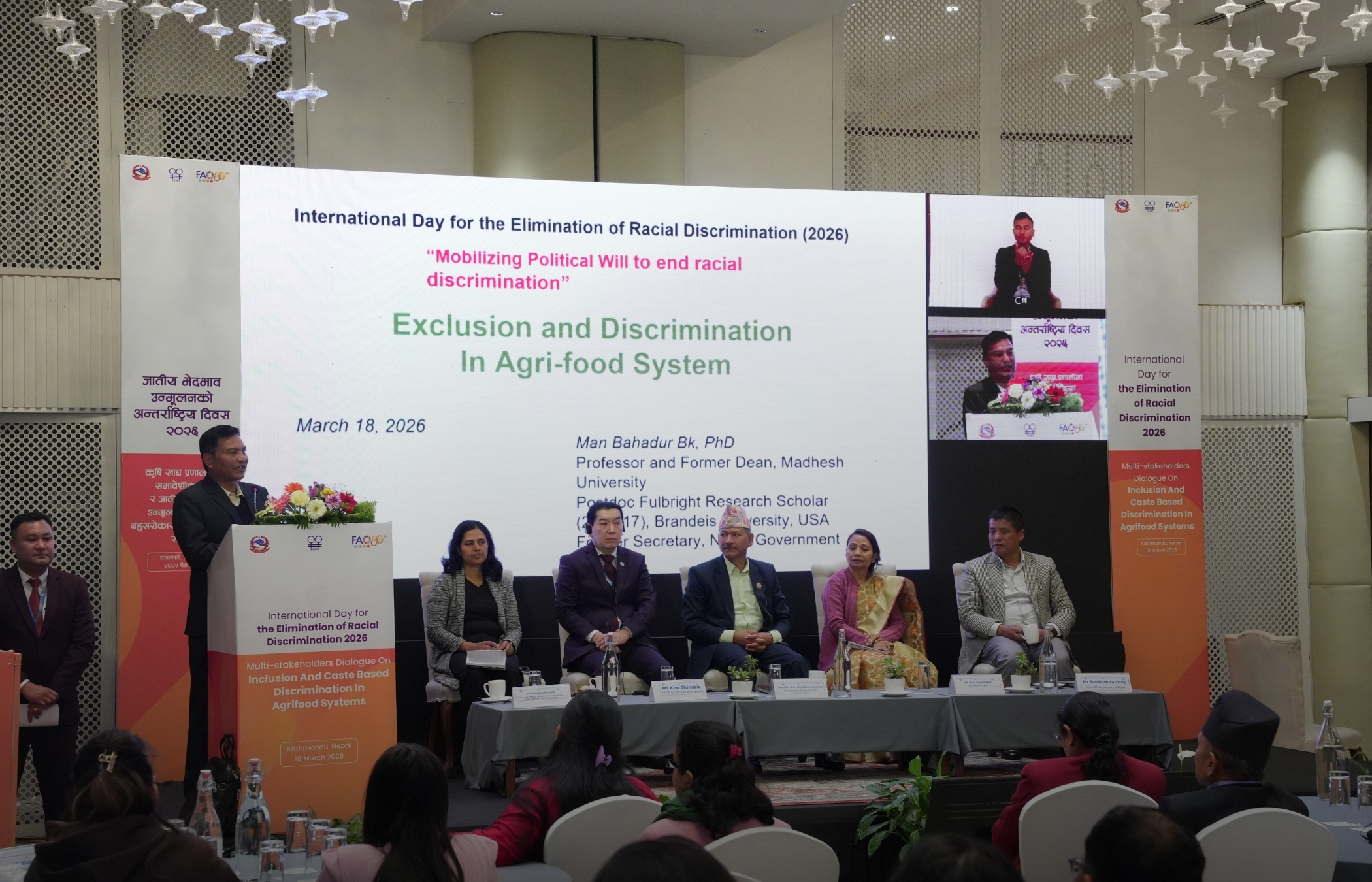
Kathmandu: The “Multistakeholder Dialogue on Caste-Based Discrimination in the Agrifood System” program was organized in Kathmandu. The press release stated the Food and Agriculture Organization of the United Nations in Nepal, in partnership with the National Dalit Commission and the Feminist Dalit Organization, marked the International Day for the Elimination of All Forms of Racial Discrimination by convening a high-level multistakeholder dialogue on caste-based discrimination and inclusion in Nepal’s agrifood systems.
The dialogue brought together representatives from government institutions, civil society, academia, Indigenous and Dalit communities, private sectors, and development partners. The event created a shared platform to examine persistent structural inequalities and identify practical, collaborative solutions to make Nepal’s agrifood systems more inclusive and equitable.
FAO Representative for Bhutan and Nepal, Ken Shimizu, opened the dialogue by drawing attention to the systemic discrimination that continues to shape the lived realities of Dalit communities. Although Dalits comprise 13.4 percent of the country’s population, their representation in higher-level civil service roles remains below 2 percent, reflecting deep-rooted exclusion that also restricts their access to land, markets, credit, agricultural inputs and extension services.
He reaffirmed FAO Nepal’s commitment through programmes such as FFF, FANSEP, and BRCRN to support inclusive agrifood systems where marginalized communities can participate with dignity. He further emphasized that ending untouchability and caste-based discrimination is a national responsibility, one that echoes Nepal’s constitutional promise of equality.
Presenting his paper on “Exclusion and Discrimination in Agrifood Systems,” researcher Dr Man Bahadur Bishwakarma described how discrimination frequently begins within the household, affecting food distribution, mobility and access to opportunities. He noted that 80 percent of Dalits live in disaster-prone areas and face severe food insecurity, particularly in the Terai. Despite national poverty reduction, exclusion among Dalit communities remains disproportionately high. Many Dalits are confined to informal agricultural labour with limited access to land or formal employment. He concluded that caste-based discrimination continues to be a major structural barrier to equitable agrifood development.
Ms Kala Swarnakar, Chairperson of FEDO, highlighted that discrimination continues even within agriculture and livestock initiatives, noting that Dalits are often unable to access land for leasehold farming due to mistrust. She emphasized the need for low‑interest loans, better market access and stronger awareness programmes to shift long-standing social attitudes.
The discussion also brought attention to the multiple and intersecting forms of discrimination faced by Dalits with disabilities, who often remain among the most excluded in both social and economic spheres. While Nepal has established progressive legal and policy frameworks to address caste-based discrimination, panelists noted that gaps in implementation continue to hinder meaningful progress on the ground.
To address these challenges, panelists called for stronger community-led and locally driven initiatives, increased representation of Dalit communities within agrifood institutions and decision-making bodies, and the allocation of targeted budgets to support inclusive development. They further emphasized the need for deeper research and understanding of how caste-based discrimination shapes food consumption patterns, nutrition outcomes, and labour dynamics across Nepal’s diverse agrifood systems—highlighting that inclusive transformation requires both structural reforms and sustained collective action.
Arun GC, Assistant FAOR Programme, expressed appreciation for the stories and insights shared by participants, noting that the dialogue provided an important platform for understanding the root causes of discrimination in agrifood systems. While acknowledging that Nepal’s journey toward inclusion is still evolving, he emphasized that the event marks a meaningful starting point for deeper collaboration. The dialogue concluded with a reaffirmation of FAO Nepal’s commitment to advancing inclusive, resilient and equitable agrifood systems, reflecting the shared Nepali aspiration for a society where all individuals can live with dignity, fairness and opportunity.