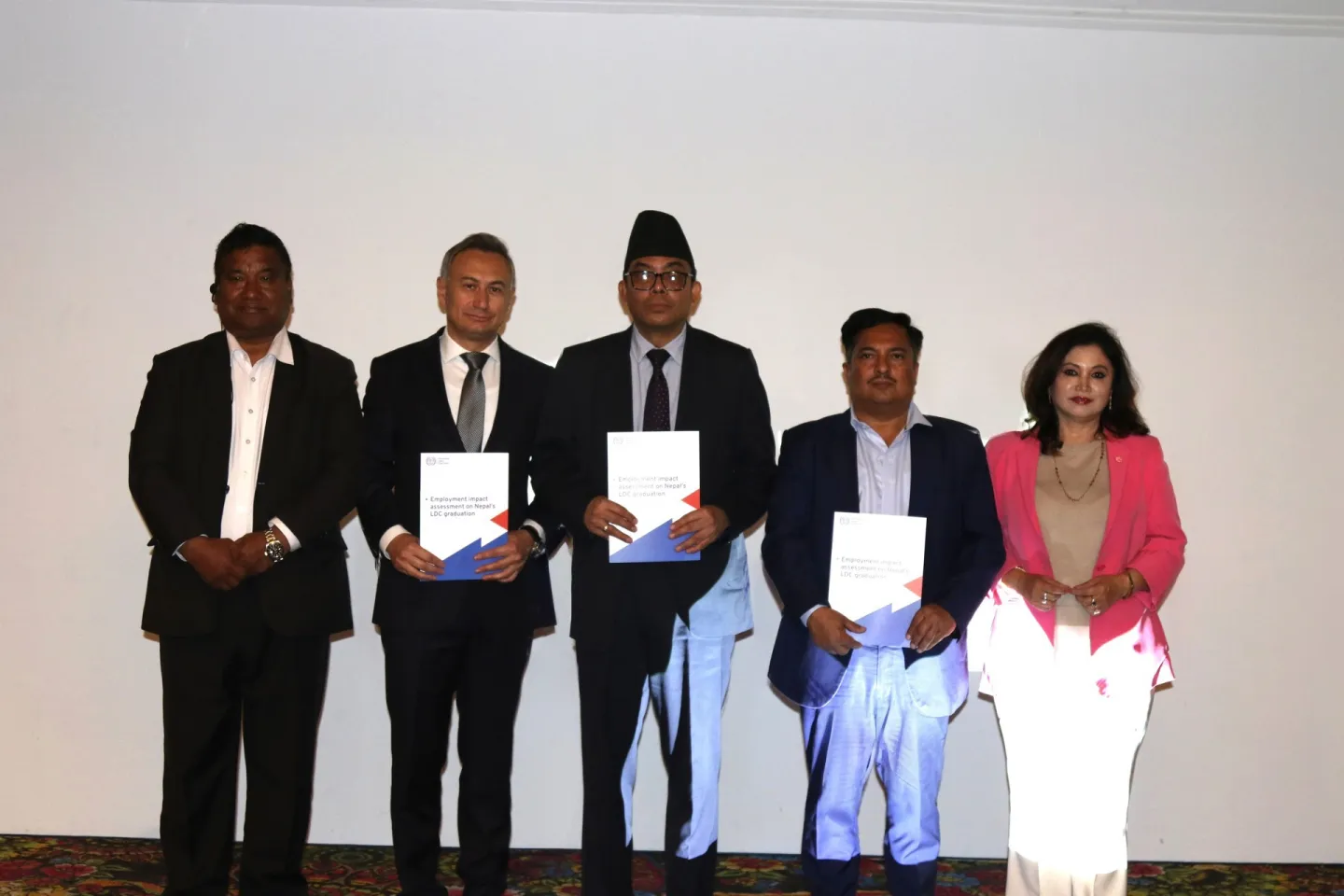
Kathmandu: As Nepal prepares to graduate from LDC status in November 2026, an Employment Impact Assessment highlights both the opportunities and employment risks linked to this historic transition.
Launched jointly by the ILO Nepal and the National Planning Commission (NPC) on March 16, the report Employment Impact Assessment on Nepal’s LDC Graduation provides an evidence-based analysis of how LDC graduation may affect Nepal’s economy and labour market between 2026 and 2030. While graduation reflects development progress and opens doors for deeper global integration, it also means the gradual loss of trade preferences, exposing key export sectors such as garment and textiles to higher tariffs, stricter compliance requirements, and increased competition.

Key findings:
Using economy-wide modelling and stakeholder consultations, the study projects that Nepal’s export losses could range from 2.5 to 4.3 per cent of total exports following graduation from LDC status. Sectors such as apparel and textiles are expected to be most affected, particularly in exports to major international markets. After graduation, Nepal’s average tariffs are also projected to increase, especially for products such as vegetable goods and cereals.
Given existing structural challenges, high production costs, limited access to capital, and a fragile manufacturing base, these shifts could intensify pressures on export-oriented industries.
The report stresses that the impacts will not be gender-neutral. Women and informal workers, who are concentrated in vulnerable sectors, are likely to face disproportionate risks.
Speaking at the launch event, Numan Özcan, ILO Country Director for Nepal, highlighted: “Graduation is not an end. It is a transition into a more competitive environment, with fewer international support measures and higher expectations. With this report, we wanted to put forward evidence which calls for early action if we are to protect jobs. The real test is how Nepal can translate graduation into better jobs, stronger enterprises, and greater economic security for everyone.”
Risks and opportunities
Beyond identifying short-term shocks, the assessment underscores that graduation can serve as a catalyst for transformation. Simulated policy measures in trade facilitation, tourism, and ICT show potential to mitigate adverse effects, strengthen competitiveness, and generate new jobs.
The study calls for urgent action to address supply-side constraints, including improving productivity, labour rights compliance, upgrading skills, strengthening value chains, and preparing for stricter trade requirements such as those under Generalised Scheme of Preferences Plus (GSP+). While some temporary trade preferences may continue, these have clear expiration timelines, making early preparation essential.
Dr Prakash Kumar Shrestha, Honourable Vice-Chairperson of the National Planning Commission (NPC) shared, “The NPC was directly and indirectly involved to ensure that the report is consistent with Nepal’s 16th Plan which emphasizes employment creation. As Nepal prepares to graduate from the LDC category this November, we are approaching a historic milestone. This report is timely in helping us understand how to mitigate potential impacts, such as possible export losses and how to strengthen domestic employment. Achieving a successful transition will require coordinated efforts across all levels of government and strong partnerships with the private sector, workers’ and employers’ organizations, and development partners.”
A Call for Coordinated Action
The report emphasizes the need for strong tripartite collaboration – government, employers, and workers’ organizations to manage the transition effectively.
The launch event presented key findings on export and employment impacts, shared projections on GDP and labour market outcomes, and fostered coordinated, evidence-based policy dialogue to safeguard jobs and enterprises and enhance resilience in the post-LDC context.
Supported by the ILO in close collaboration with the National Planning Commission, the assessment is intended to guide just transition through inclusive policy responses.
At the event, Krishna Prasad Sapkota, Joint Secretary, Ministry of Labour, Employment and Social Security (MoLESS), “As Nepal transitions to a developed-country category, we have been granted a grace period until 2030. If we manage this period well, particularly in areas such as employment—we can minimize the potential losses. The ILO is supporting us, particularly in the development of a 10-year strategy focused on employment creation, strengthening employment service centers and improving employment management. Achieving these goals cannot be done by one institution alone, it requires collective effort.”
Similarly, Binod Shrestha, President, Joint Trade Union Coordination Centre (JTUCC), emphasized, “Only when workers are treated with dignity and respect can sustainable progress be achieved. In this process, both the role of workers and necessary policy reforms are crucial.”
Echoing the importance of a sustainable transition, Ms Jyotsna Shrestha, Chairperson, Employers’ Council and Vice Chair of the Federation of Nepalese Chambers of Commerce and Industry (FNCCI) noted, “For the private sector, our goal is clear: we want Nepal’s graduation to succeed, but it must also be sustainable—protecting existing jobs while creating new opportunities for the future workforce.”
Ensuring just transition
The central message of the report is clear: LDC graduation must be accompanied by proactive and inclusive policies that protect vulnerable workers while boosting productivity and competitiveness.
With timely preparation and targeted reforms, Nepal’s graduation can become a steppingstone toward resilient labour markets, sustainable growth, and shared prosperity.
The ILO reaffirms its commitment to supporting the Government of Nepal and social partners to ensure that economic progress is built on just transition and translates into decent work for the workers.