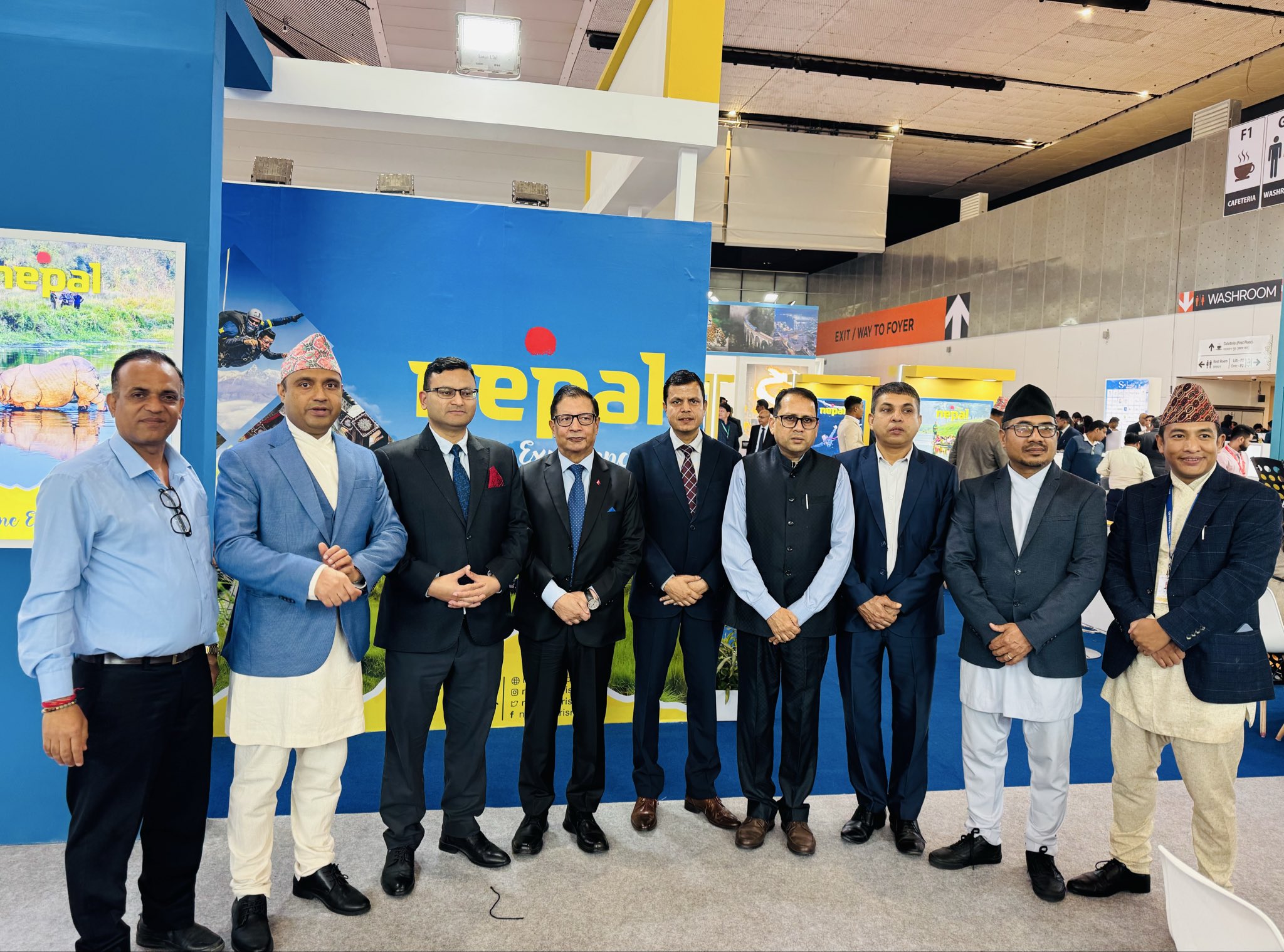
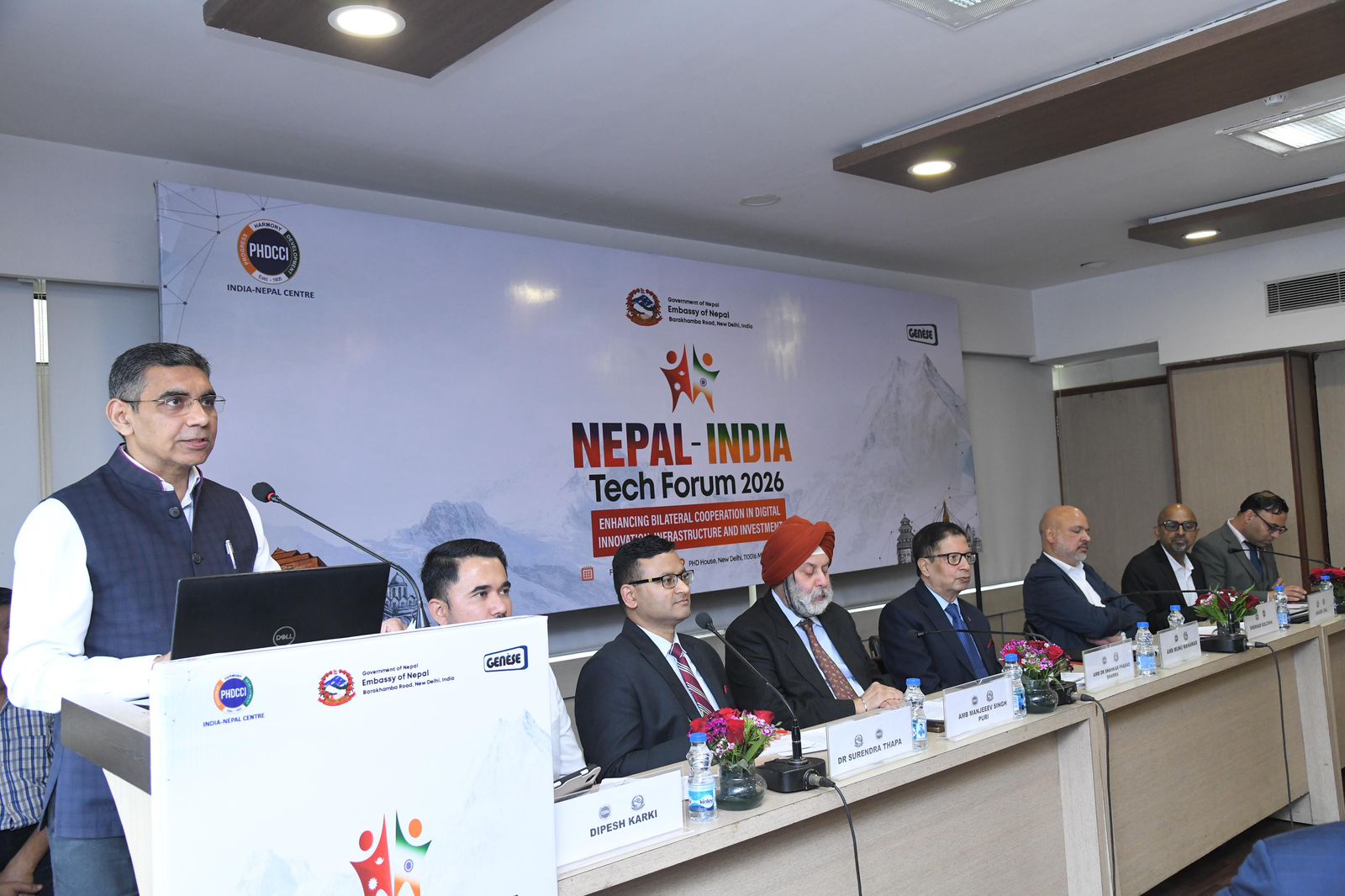
Kathmandu: Under the aegis of its India-Nepal Centre, and in association with the Embassy of Nepal in India and Genese Solution, the PHD Chamber of Commerce and Industry (PHDCCI) organised “Nepal-India Tech Forum 2026” on 27 February 2026 at New Delhi, India. The forum brought together a distinguished gathering of policymakers and industry leaders to advance the dialogue on deepening Nepal-India ties in the digital and technology space.
Speaking on the occasion as the “Chief Guest & Keynote Speaker”, Dr Shankar Prasad Sharma, Ambassador of Nepal to India, set the tone for strengthening India-Nepal bilateral cooperationwith a tech upgrade in relationship. Counting it as an important frontier where an aspirational Nepal and a rising India can further collaborate and deepen the bilateral ties. He called for the Indian IT giants to look towards India, citing Nepal’s strong credentials as a promissing investment destination. He said, “Nepal’s digital journey has evolved significantly — from its first IT Policy in 2000 to the National AI Policy 2025 and an “IT Decade Vision.The government has built meaningful Digital Public Infrastructure, including data centers, digital payment systems, and citizen platforms, with support from India, ADB, and the World Bank. Nepal produces over 10,000 ICT graduates annually, though talent retention remains a challenge, with professionals often moving abroad after just two years.
The government’s FASG Framework — covering Foundation, Access, Skills, and Growth — provides a structured roadmap for inclusive digital transformation, with AI Excellence Centers planned across four provinces. While policy frameworks are in place, implementation and private-sector collaboration remain critical. Indian firms like Infosys already operate in Nepal’s banking sector, and opportunities abound in cloud, FinTech, cyber security, and AI. With shared policy vision and strong bilateral foundations, technology can become a defining pillar of Nepal–India partnership.”
Munu Mahawar, Additional Secretary (North), Ministry of External Affairs, Government of India, joined as “Guest of Honour”, underscored the Government of India’s commitment to fosterdeeper tech-driven ties with Nepal. He lauded the initiatives of PHDCCI India-Nepal Centre for boosting India-Nepal economic cooperation with remarkable sets of activities in India and Nepal. He also appreciated the initiatives of the Embassy of Nepal in India. He reflected how India-Nepal border regions have seen the positive infrastructural drives like Integrated Check Posts (ICPs), petroleum pipelines, improved transits and trade facilitations and their multiplied impact on economies both sides. He reassured India’s commitment for shared peace and prosperity with Nepal. He added, “Technology sits at the heart of deepening Nepal–India cooperation. India prioritizes sharing its technological capabilities with neighbors, recognizing that Global South challenges demand scalable, common solutions.
UPI-Nepal payment integration, operational since 2024, has already processed over a million transactions, with peer-to-peer remittances nearing launch. In the startup space, many Nepalese startups participated in an IIT-based program, with nine receiving investment and incubation offers. Digital solutions are now being layered across trade facilitation, rail, agriculture, health, and energy sectors, with technology embedded in virtually every bilateral MoU. Deep educational exchanges further strengthen this partnership, building shared human capital for long-term digital collaboration.”
Manjeev Singh Puri, Chair, India-Nepal Centre, PHDCCI & India’s former Ambassador to Nepal, said ““India’s rising global stature in AI and advanced technology presents a significant opportunity for Nepal. Nepalis hold a unique advantage — deep cultural familiarity, personal networks, and a growing presence in India’s tech hubs like Bangalore and Hyderabad. In today’s AI era, success depends not on scale alone, but on language, data, and innovation. Nepal’s size is no disadvantage — quality talent and the right ideas level the playing field, as demonstrated by Nepali professionals who contributed to the US pandemic response from Kathmandu.”
Shekhar Golchha, Former President, Federation of Nepalese Chambers of Commerce and Industry (FNCCI) and Chairman & Managing Director, Golchha Group said, “Nepal’s macroeconomic fundamentals are stronger than often perceived—with foreign reserves covering nearly 20 months of imports, inflation between 3–4%, interest rates as low as 5.2%, and a stable currency. Yet a critical structural challenge persists: insufficient job creation is driving talented youth abroad. This is precisely where technology presents a transformational opportunity. Nepal is on track to become power-surplus, offering natural advantages for energy-efficient data center infrastructure. With a growing base of IT graduates and professionals excelling globally, Nepal is well-positioned to become a serious digital economy—not merely a consumer of technology, but a creator and host of it.
The private sector has set an ambitious target of reaching a $100 billion economy by 2030, achievable through good governance, structural reform, and deeper India–Nepal collaboration. With 70% of Nepal’s trade tied to India, the partnership is indispensable. A bold symbol of this ambition: if IIT can open in Dubai, why not IIT Kathmandu? An IIT in Nepal would go beyond education — it would represent true 21st-century integration, built not on cultural affinity alone, but on institutions, innovation, and intellectual collaboration, forging a shared technological future far deeper than open borders or Bollywood ever could. From expanding digital payment corridors to building world-class institutions, Nepal’s message is clear—it seeks to be recognized as a hub of leadership, innovation, and technology. And it is ready to take off.”
Addressing the delegates at the forum virtually, Sushil Gyewali, CEO, Investment Board Nepal (IBN) stated, “Nepal is extending a clear invitation to technology operators, AI investors, Indian IT majors, cloud providers, and data centreleaders — not for short-term transactions, but enduring partnerships. Powered by renewable hydropower, Nepal offers a unique advantage as a clean-energy digital infrastructure destination in South Asia. The goal is to shift from migration-driven growth to innovation-driven employment, and from connectivity to genuine capability.”
Anand Jha, Vice President (Head of Government Engagement: India & South Asia), Visa Inc said, “Visa has been working closely with PHDCCI and is has deepened its presence in Nepal — conducting workshops across all seven provinces, bringing in global experts on AI, cyber security, and e-commerce. We believe in Nepal’s potential. Looking ahead, three priorities stand out. First, a regulator-led cross-border payment corridor between NRB and RBI — covering remittances, tourism, and small trade — replacing expensive, cash-heavy systems with secure, interoperable alternatives. Second, adopting India’s Digital Public Infrastructure as a ready template, customizing it for Nepal’s scale rather than starting from scratch. Third, digitizing small merchants and SMEs — a POS device costs just $8, yet most tourist hubs remain cash-based. This is an awareness gap, not a technology gap.” AnjaniPhuyal, CEO, Genese Solution made a detailed presentation from Genese Solution on dwelt theme; Dipesh Karki, Co-Founder & CTO, Lenden Clubshared his entrepreneurial journey in India.
Dr Jatinder Singh, Deputy Secretary General, PHDCCI delivered the welcome address. The Roundtable Discussion was moderated by Atul K Thakur, Senior Secretary, India-Nepal Centre, PHDCCI; among others, the speakers’ who addressed the forum were: Amar Jha, Managing Partner, Skills Oxygen LLP; Amitabh Ranjan, Registrar, Indian Institute of Public Administration (IIPA), Government of India; Satya Narayanan R, Chairman, CL Educate Ltd; R Balachander, Audit Committee Chair/Independent Director, Asset Reconstruction Company of India Ltd (Formerly: Independent Director, SMFG India Credit Co Ltd.; Retired Partner & National Leader Accounting Reporting & Compliance, EY); AnukoolBhatnagar, Adviser, India–Nepal Centre, PHDCCI & Partner, Sustain Edge ESG LLP (Formerly: CGM, SBI; MD & CEO, Nepal SBI Bank Ltd); Dushyant Thakor, Deputy Executive Director, World Association of Investment Promotion ASgencies (WAIPA); ShivamShekhawat, Junior Fellow (Strategic Studies Programme), Observer Research Foundation (ORF); Poshak Poudel, CEO, Citizen Life Insurance &President, Nepal Insurance Association; SanjibSubba, Founder, Kathmandu FinTek; Vineet Nahata, Chair, Economic Affairs Committee, PHDCCI (& MD, Power Gilt Treasuries Inc and Trustee, Central Board of EPFO, Ministry of Labour and Employment, Government of India); Bikalp Raj Pokharel, Vice President, ECAN; Asish Thakur, Chairman, GlocalPvt Ltd; Shashvat Singh, Senior Fellow, India Foundation; Atul Koirala, Board Member, BP KoiralaIndia–Nepal Foundation (BPKF) & Tech Entrepreneur; Dr Kazem Samandari, Veteran Economist (& Executive Chairman, L’Opéra; President, KCSH & Associates and Terra Firma International); Dr Bhuvnesh Shrivastava – Lead (Government Affairs), AstraZeneca Pharma India Ltd.
Among the notable dignitaries present on the occasion were: Dr Surendra Thapa, Deputy Chief of Mission, Embassy of Nepal India; Tara NathAdhikari, Minister (Economic), Embassy of Nepal in India; Rabindra Jung Thapa, Counsellor (Economic), Embassy of Nepal in India; Tusharanshu Sharma, Deputy Secretary (Northern Division: Nepal-Economic), Ministry of External Affairs, Government of India.