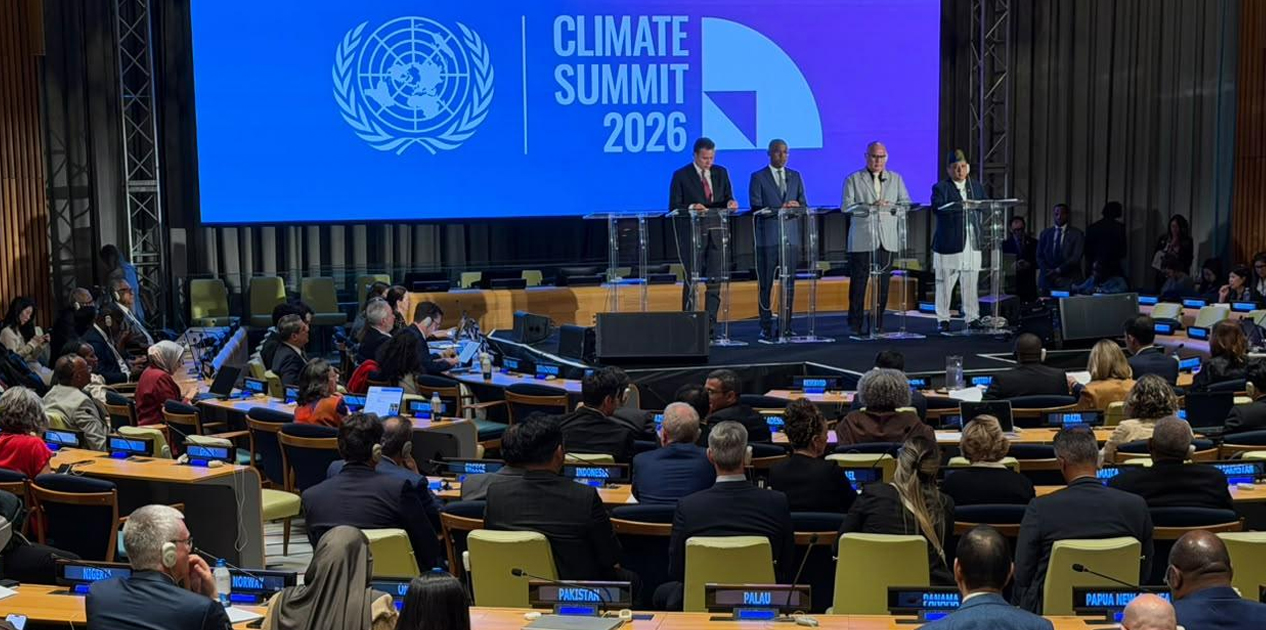
Rt. Hon. Prime Minister Balendra Shah’s address to the United Nations General Assembly (UNGA) amplified the voices of the nations highly affected by the devastating climate crisis. Just a month after the unprecedented Bhotekoshi-Trishuli floods and landslides, he stood in front of the world to share the plights of Nepal, Nepali people and the countries facing similar fate.
Nepal had raised alarms about the continuing climate crisis in the past, too. Those voices often went unheard probably because the world had not fully realised the scale and seriousness of the threat. PM Shah’s UNGA address on September 24 in New York brought Nepal’s concerns to international attention. The extensive coverage of the PM’s UNGA address in the international media and words of appreciation for him from the different quarters indicate this.
Many leaders of national as well as global repute have used the stage of the United Nations General Assembly to draw attention to the pressing issues. Several prime ministers of Nepal have also delivered their messages from the UNGA over the years. Nepal’s climate concerns have been a recurring theme in those addresses, including those delivered in UN COPs, particularly since the late 2000s.
Then Prime Minister Pushpa Kamal Dahal, for example, stated unequivocally at COP28: “Our message is clear: mountains are tortured by rising temperatures. Save them first!”
Nepal’s former prime ministers have repeatedly raised climate vulnerability and climate justice in international forums. At the 64th UNGA in 2009, Madhav Kumar Nepal highlighted the risks posed by melting Himalayan snow, glacial lake outburst floods and increasingly destructive flash floods, while stressing the need for adaptation financing and the principle of historical responsibility.
At the 66th UNGA in 2011, Baburam Bhattarai drew attention to glacier melt, its implications for water sources in South Asia and the greater responsibility of developed countries for climate change. Sher Bahadur Deuba, too, raised Nepal’s climate vulnerability internationally, including at the COP26 World Leaders’ Summit in Glasgow in 2021, where he called for international action on loss and damage. At the 79th UNGA in 2024, KP Sharma Oli highlighted the rapid melting of the Himalayas, changing monsoon patterns and the increasing frequency of floods and landslides, while calling for climate justice.
Without doubt, these were commendable steps. But Prime Minister Balendra Shah’s address to the UNGA this year stood out for three reasons–timing, context and presentation of Nepal’s case. He spoke in the immediate aftermath of a devastating disaster that had unfolded in the Himalayas. He linked the disaster to the destabilisation of the fragile Himalayan ecology under a warming climate, pointing to melting permafrost, ice-rock avalanches, floods, landslides and other cascading hazards. As the Prime Minister dealing with the immediate consequences of the catastrophe, he was able to speak with particular immediacy about its human and national costs.
On October 11,Nepal witnessed another deadly flood in the Budhi Gandaki River. Preliminary studies have linked the disaster to the collapse of a glacier or a large mass of ice in the high Himalayas. On October 22, the Fund for Responding to Loss and Damage (FRLD) approved $20 million in support for Nepal to assist relief, rehabilitation and reconstruction in communities devastated by floods in the Bhotekoshi–Trishuli region.
These two developments are stark reminders that climate-induced disasters are no longer isolated events and that sustained international support is vital to help Nepal withstand and recover from their devastating impacts.
While it is upon Nepal and its leaders to continue to draw the attention of the world to address the climate crisis, it is upon the world not to forget the message Nepal’s Prime Minister delivered through the UNGA on September 24: We contribute the least to the climate crisis but we are among those facing its most devastating consequences.