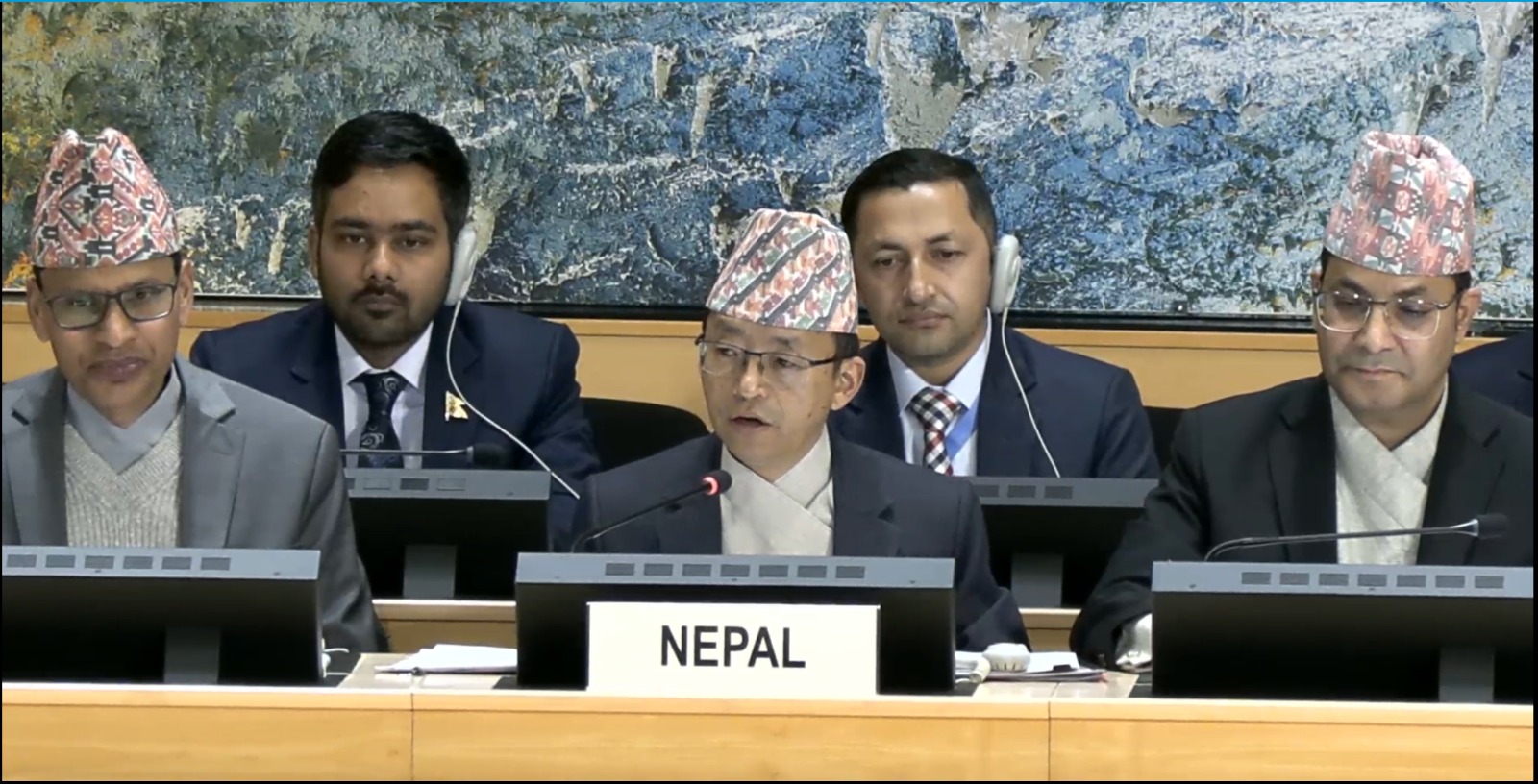
Nepal attaches high importance to the Universal Periodic Review as an inclusive, cooperative, transparent, and non-selective mechanism. More than just a reporting exercise, we consider UPR as a constructive platform for states to engage in interactive dialogue on an equal footing, learn from the best practices, and receive recommendations to improve human rights situation in the country.
Nepal remains firmly committed to upholding the principles of the UN Charter, international human rights law and the spirit of constructive dialogue that underpins this mechanism. Since the last review in 2021, Nepal has made notable progress in implementing international human rights instruments, strengthening democratic institutions, and advancing human rights within the framework of our Constitution.
The Constitution enshrines a broad range of civil, political, economic, social, and cultural rights, including the rights of women, children, persons with disabilities, senior citizens, indigenous peoples, Madhesi, Dalit, and other communities. The constitution guarantees fundamental rights, equality before the law, and access to justice.
Protection and promotion of human rights is one of the major priorities of Nepal. We have undertaken legislative and policy reform aimed at promoting inclusion, social justice, and good governance. Independent constitutional bodies, including the National Human Rights Commission, continue to play a vital role in safeguarding and advancing human rights in the country.
In early September 2025, while this report was getting its final shape, Nepal witnessed a powerful Gen-Z movement which expressed the aspirations of Nepali youth for more accountable, responsive and transparent governance.
The movement resulted in the formation of an interim government under the leadership of Prime Minister Rt. Hon. Mrs. Sushila Karki, first woman to hold the office, on 12 September 2025. The House of Representatives has been dissolved, and the date for fresh election is scheduled for 5th of March 2026.
An independent Inquiry Commission has been established to investigate the incidents of violations of human rights during the movement. The Government of Nepal is committed to holding the election in the given date, investigating the cases of violation of human rights, and delivering good governance in the spirit of the Gen-Z movement.
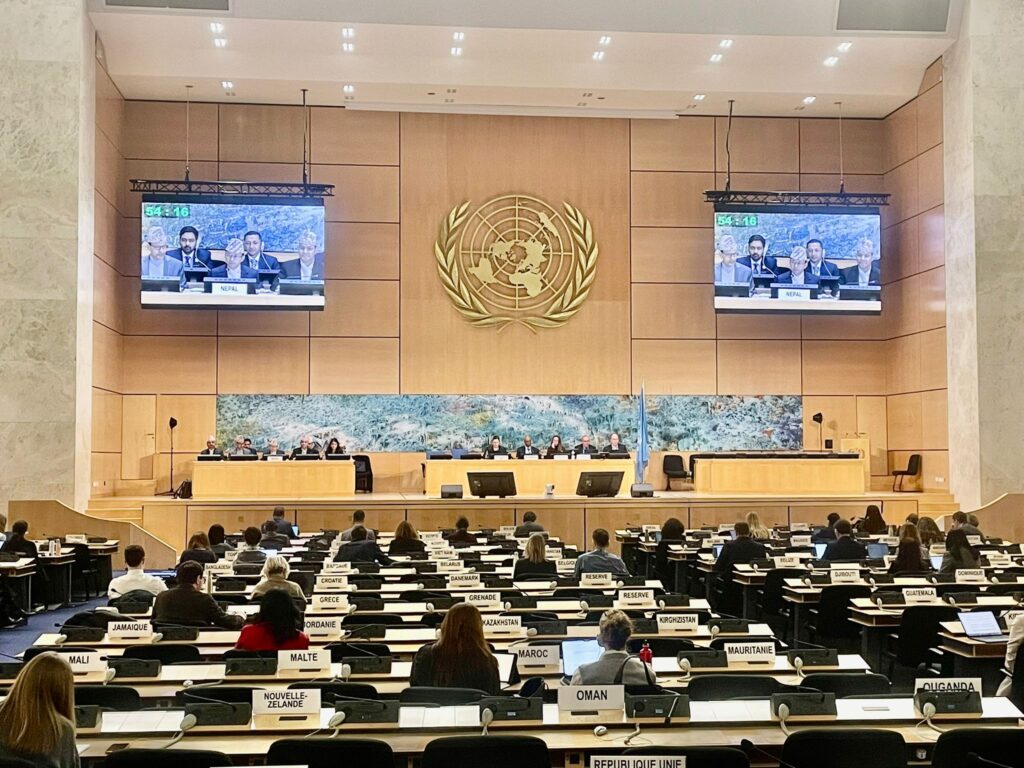
This national report was prepared in consultations with various stakeholders ranging from government to civil society organizations. The series of consultations have ensured inclusive and participatory involvement of government agencies, civil society organizations, national human rights institutions, human rights defenders, media, and other stakeholders.
This report provides a genuine assessment of our progress, priorities and challenges as well as the measures taken to implement the recommendations accepted during the previous cycle. Nepal firmly believes in the universality of human rights. We are party to twenty-four human rights instruments including seven core human rights conventions, eleven ILO conventions, four Geneva Conventions on International Humanitarian Law, and two regional conventions. We uphold the values enshrined in these instruments.
Nepal accepted 196 and took note of 37 out of a total of 233 recommendations received during the third cycle of UPR in 2021. Most of the recommendations have now been substantially implemented with the support of all stakeholders. A dedicated mechanism at the Office of the Prime Minister and the Council of Ministers continues to monitor the implementation.
We have effectively implemented our 5th National Human Rights Action Plan along with the 3rd Cycle UPR Implementation Action Plan. We have already initiated the 6th National Human Rights Action Plan for the next phase. In addition, the Protection of Human Rights Defenders’ Directive 2020 is being implemented and effectively monitored.
Nepal continues to engage constructively with the United Nations human rights system through the exchange of visits and cooperation. The UN Secretary-General H. E. Mr. António Guterres visited Nepal from 29 October to 1 November 2023. The Special Rapporteur on minority issues Mr. Nicolas Levrat concluded his visit to Nepal in December 2025. We have invited the Special Rapporteur on truth, justice and reparation Mr. Bernard Duhaime, for a country visit in March 2026.
As an independent constitutional body, we have National Human Rights Commission. The Commission carries out investigatory, supervisory, directive, and recommendatory functions to protect and promote human rights in the country.
The Commission complies with the Paris Principles and has been continuously accredited with “A” status by the GANHRI. Its work is complemented by other six independent thematic Constitutional Commissions— on Women, Dalit, Indigenous Nationalities, Madheshi, Tharu, and the Muslim. Nepal’s independent judiciary acts as the guardian of fundamental rights and freedoms. The Supreme Court exercises judicial review over legislation at all levels. The landmark judgments made by the judiciary have enriched and expanded the country’s human rights jurisprudence.
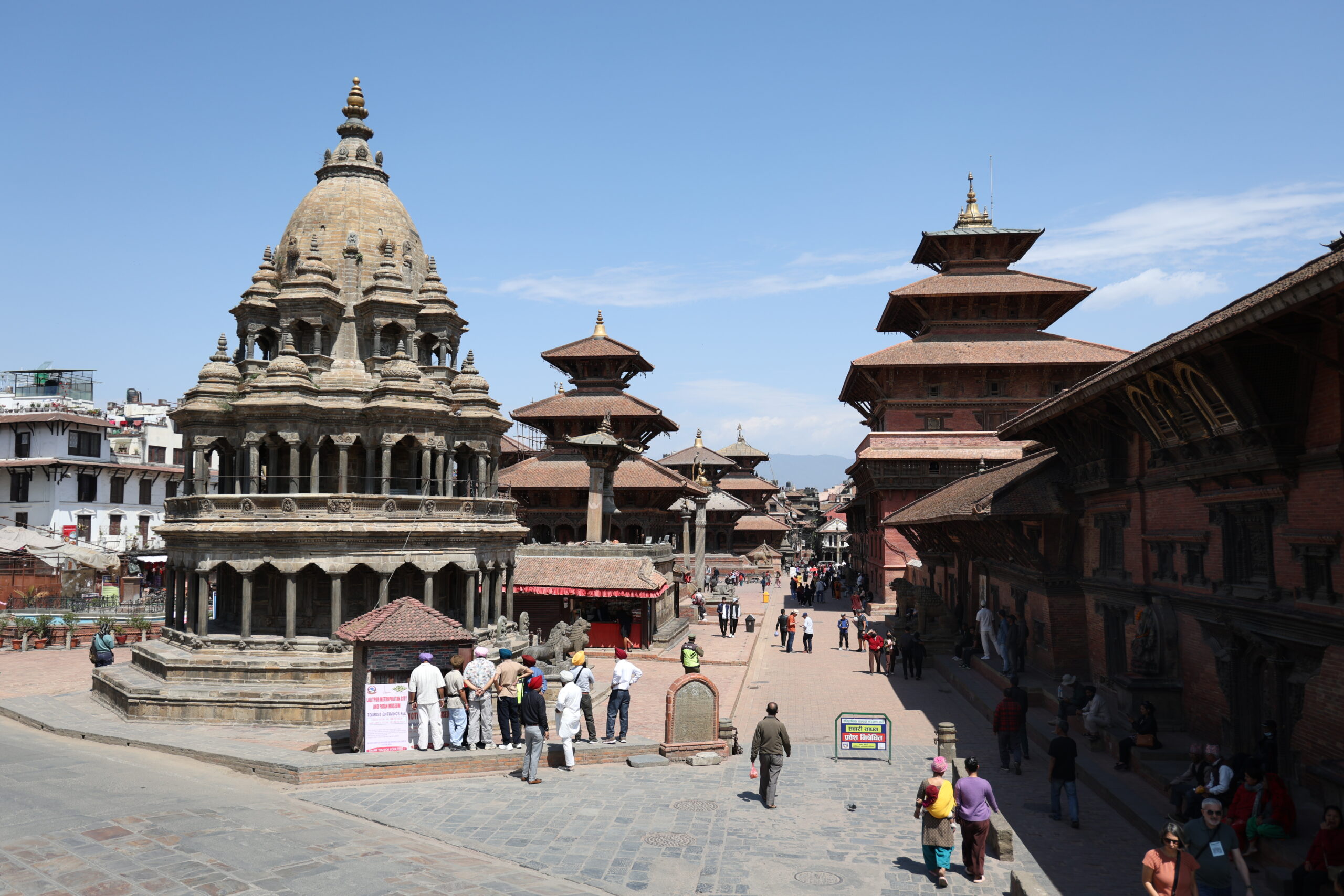
The Constitution of Nepal guarantees an expanded set of fundamental rights, including the right to live in a clean and healthy environment, the right to food, the right to social security, and specific rights for senior citizens and children. It ensures eliminating all forms of discrimination and promotes economic equality, shared prosperity, and social justice. Unity in diversity is a beauty of Nepali society. We have diverse cultures, languages, religions, and ethnicities. We respect each other, live in peace, and strive together for shared goals.
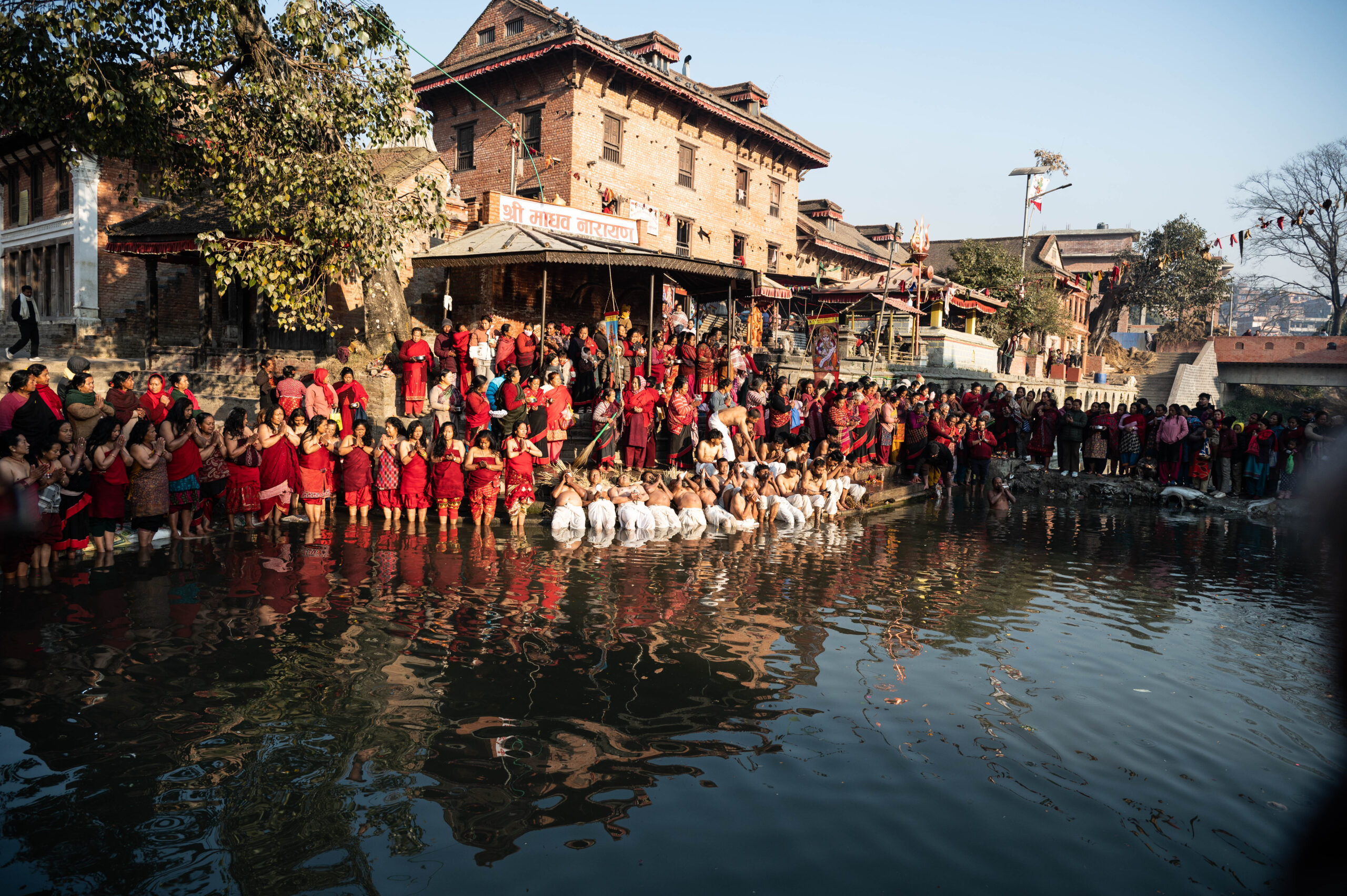
Nepal’s Constitution guarantees freedom of religion as a fundamental right. Nepal is a secular country. Nepali people practice different religions freely, and the Government of Nepal protects their freedom. Social and cultural harmony is a longstanding tradition of Nepali society. The Penal Code criminalizes hate speech, attacks on religious sites, and acts intended to incite religious discord.
Respecting women and girls is our proud tradition. We have taken all possible measures to protect and promote women rights as human rights. We have National Women Commission as an independent constitutional body. The Commission is dedicated to safeguard and advance the women and girls’ rights. It operates a toll-free helpline 1145 twenty-four hours to provide immediate assistance to women and girls in need.
We have criminalized violence and discrimination against women. The Acid and other Harmful Chemical Materials (Regulation) Act 2022 has been enacted to prevent and address gender-based violence caused by acid attacks.
A total of 94 hospital-based One-Stop Crisis Management Centers operate across all 77 districts providing substantial support to victims. Safe-shelters have been established in ten trafficking-prone districts in collaboration with civil society organizations.
Nepal Police operate safe houses in most district centers for victims of violence against women and girls. We have Gender-Based Violence Elimination Fund operating at all three levels of government. The Gender Responsive Budget has increased substantially in fiscal year 2024/25. In recent years, we have resolved almost all the cases of violence against women and girls that were reported.
Nepal is committed to enhancing meaningful participation of women in public and political life. For this, we have legal provisions for reservation and affirmative actions. The Constitution ensures one-third of seats for women in the Federal Parliament and State Assembly, and forty percent seats in Local Levels for women. We have seen a progressive rise in the participation of women, various disadvantaged groups in Nepal’s civil service, judiciary, police and armed forces, teaching, banking and financial sectors.
Recent amendment of the Citizenship Act and its Regulations have simplified the constitutional right of obtaining Nepali citizenship by children of Nepali mother in the name of their mother. Nepal has incorporated a human rights-based approach to development. Sustainable and participatory development is our national priority. We have internalized and mainstreamed SDGs in our national policies and programs. We have made remarkable progress in the achievement of SDGs. Nepal’s Voluntary National Review 2024 showed that a significant proportion of assessed indicators exceeded targets while others showed positive progress.
Fighting climate change is our urgent necessity and priority. We have a climate change framework and the National Adaptation Plan (2021-2050). We have presented third Nationally Determined Contribution, committing to achieve net-zero emissions by 2045. Nepal hosted the first edition of Sagarmatha Sambaad (Mt. Everest Dialogue) under the theme of ‘Climate Change, Mountains and Future of Humanity’ in May 2025. The Sambaad called for concrete and concerted climate actions.
Despite contributing nominally to global greenhouse gas emissions, Nepal faces severe impacts of climate change. Recent disasters, including glacial lake outburst and flash floods caused harm to lives and livelihoods as well as critical infrastructure exposing country’s vulnerability. Nepal has made notable progress in the areas of environmental protection. Over 46 precent of Nepal’s land is under forest cover, with community forestry programs recognized globally as a model of participatory management.
Nepal’s Constitution guarantees the right to life with dignity and prohibits the death penalty. We have taken measures to protect life, liberty and security of people. Nepal police and armed police force personnel have been trained on UN Principles on the Use of Force and International Humanitarian Law. The Constitution ensures the right to fair trial under the right to justice by a competent court in criminal prosecution. The police are required to produce the arrested person before adjudicating authority within twenty-four hours of arrest.
Nepal has adopted the Integrated Legal Aid Policy, 2019 to ensure access to justice for all. District Legal Aid Officers provide free legal aid in 74 out of 77 districts. New prison facilities have been constructed and old ones improved, thousands of detainees receive skill training, and prisoners are granted voting rights. Increasing digitalization is one of the defining features of Nepali society. Nepal’s ‘IT Decade’ aims to modernize the digital landscape while balancing rights to information with privacy and security concerns. The National Cyber Security Policy, 2023 and related guidelines are in operation.
The Constitution guarantees rights to employment and fair labor practices as a fundamental right. Nepal has ratified eleven ILO Conventions and enacted various laws to enact them. We are expanding social security coverage not only in formal but also in informal sectors. The Contributions-Based Social Security Act, 2017 allows informal sector workers and self-employed person to participate in the scheme, with over two million individuals benefiting in fiscal year 2024/25.
Employment Service Centers are in operation in all 753 local governments across the country. The National Employment Promotion Program generated jobs for over fifty thousand and conducted skill training for over two thousand people. The Constitution provides the right to social security. Nepal has been providing eighty-seven types of social security scheme to various segments of population. Over 3.8 million people have received it. Nepal’s Constitution and the Right to Food and Food Sovereignty Act, 2018 ensures every citizen’s right to food and food security. Over ninety thousand households and small-holder farmers have benefited from agricultural production programs for self-reliance.
The Government constructed and handed over thousands of homes to the families from marginalized communities under Janata Awas and Safe Citizen Housing program. Nepal is committed to achieving Universal Health Coverage. We have made notable progress in enhancing access to healthcare through hundreds of hospitals, primary healthcare centers, and thousands of health posts nationwide.
Antenatal, postnatal and delivery healthcare services are provided free of cost at public healthcare facilities. Efforts are underway to achieve 100 percent immunization for mothers and children. The Constitution guarantees every citizen the right to education. As of 2023, 62 districts out of 77 districts have been declared literate. In academic year 2024/25, the total number of schools in the country was 35,447 with the enrollment mix of 48 percent girls and 52 percent boys.
The Constitution guarantees the rights of children, with supplementary laws in place. Juvenile benches operate in all seventy-seven District Courts, and a dedicated Juvenile court has been established in Bhaktapur district. There are nine child reform homes in operation to manage the children in conflict with the law. Nepal’s Constitution ensures the rights of persons with disabilities as fundamental rights. Nepal has ratified the Convention on the Rights of Persons with Disabilities and its Optional Protocol. An accessibility audit of federal ministries has been completed. Local governments are providing supporting equipment such as wheelchairs, artificial legs and arms, hearing aids, white canes and Braille books for people with disabilities.
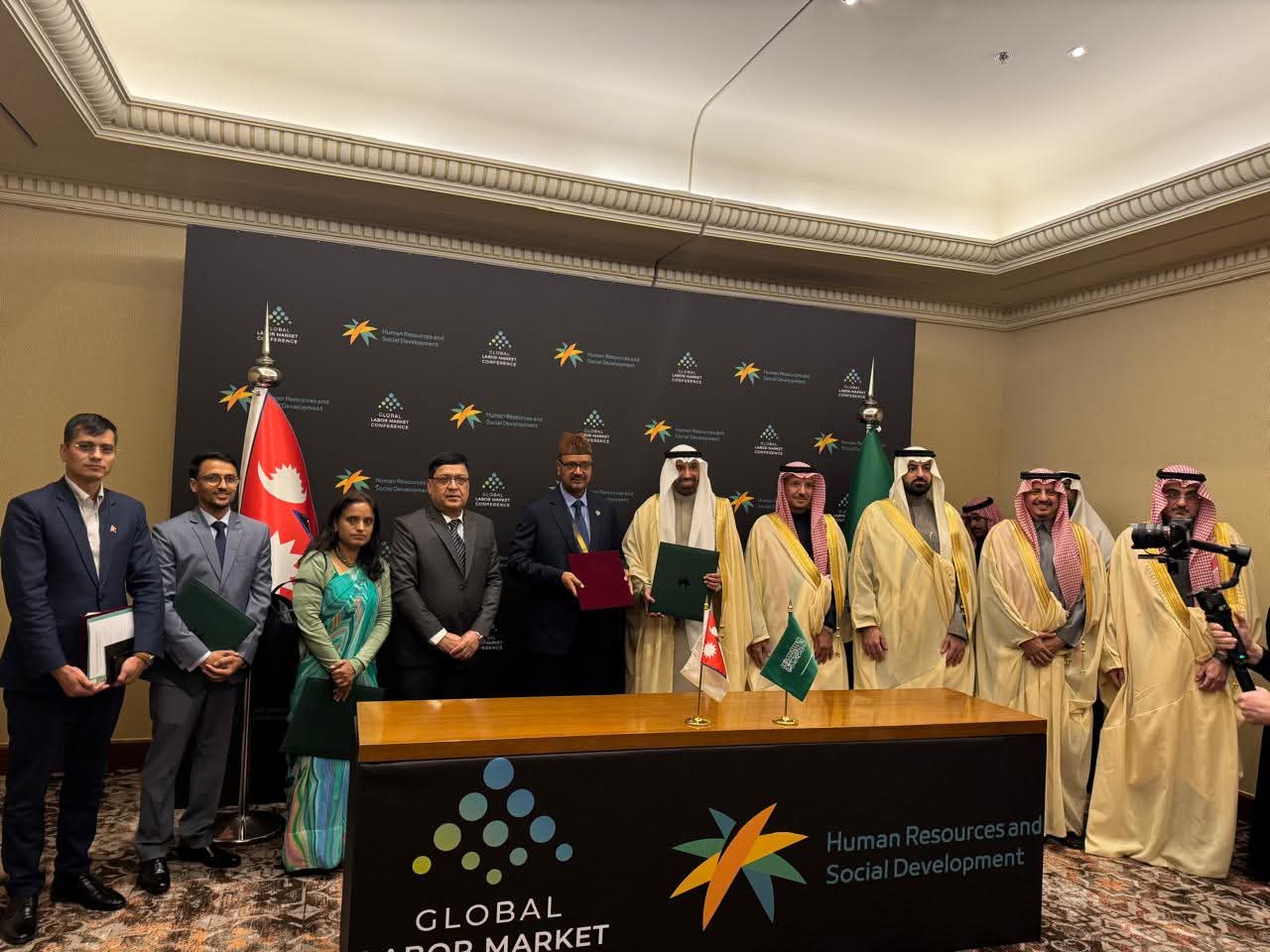
Nepal stands out for its progressive legal stance on LGBTIQA++ rights, reinforced by the Constitutional protections and landmark Supreme Court rulings. The LGBTIQA++ communities have been recognized through provisions in identity documents and their right to live with dignity is honored. The Government has introduced National Action Plan on Business and Human Rights (2024–2028) and online services to facilitate migrant workers. We have signed Bilateral Labour Migration Agreements with twelve countries with the aim of facilitating ethical recruitment, safer migration, and decent employment.
Nepal has taken important steps towards addressing conflict-era violations. The Federal parliament passed the bill to amend the Enforced Disappearances Enquiry, Truth and Reconciliation Commission Act in August 2024.
The amendment has introduced transformative provisions, classifying armed conflict incidents as human rights violations and serious human rights violations. It defines gross violations as rape or gross sexual violence, and systematic acts including arbitrary killings, enforced disappearance, and inhumane or cruel torture.
More importantly, the amendment outlawed exemption from prosecution for perpetrators of gross human rights violations.
The amended Act incorporates provisions for truth-seeking, identifying root causes of conflict and human rights violations, and establishes a reparation fund for victims. It mandates establishing a three-member Special Court in consultation with the Judicial Commission. The handbook for Local Investigation Teams is in the final stage, while the Regulation on Investigation of Disappeared Persons, Truth Verification,
and Operation of the Reconciliation Fund is being prepared. Consultations on the Truth and Reconciliation Commission Regulation are underway.
The Government has reconstituted the Truth and Reconciliation Commission and the Commission of Investigation on Enforced Disappeared Persons in May 2025. This represents a significant step in advancing Nepal’s transitional justice process and reflects the Government’s commitment to addressing conflict-era cases of violations of human rights through credible and accountable institutions. The Commissions invited and registered complaints nationwide through a three-month public call. Nepal’s comprehensive anti-corruption framework reflects our constitutional commitment to good governance. We have Commission for the Investigation of Abuse of Authority (CIAA) as an independent constitutional body to control corruption.
As a party to the United Nations Convention Against Corruption, Nepal submitted self-assessment reports for the first and second cycle peer reviews to the United Nations Office on Drugs and Crime and developed the Second Anti-Corruption Strategy and Action Plan. The 16th Periodic Plan targets a corruption control index of 0.4 and corruption reduction feelings index of 43 by fiscal year 2028/29. The Constitution ensures good governance through fair, competent, impartial, transparent, corruption-free, accountable, and participatory public governance. Nepal has strengthened Public Procurement Monitoring Office, Department of Money Laundering Investigation, Department of Revenue Investigation, Office of the Auditor General, National Vigilance Center and other related institutions to effectively combat corruption. Most of the recommendations received during the 3rd cycle have been implemented. Yet challenges remain. We have limited resources and inadequate institutions. In this context, international cooperation, particularly financial resources, will support our commitment to protect and promote all dimensions of human rights including economic, social, and cultural rights. The present government is committed to deliver good governance, combat corruption, and promote accountability to ensure the constitutional rights of the people.
Recently, Nepal has served as a member of the Human Rights Council for two consecutive terms from 2018 to 2023. We have placed our candidacy for membership of the Human Rights Council for the 2027–2029 term, as part of our enduring commitment to the promotion and protection of human rights, both domestically and internationally. I take this opportunity to request the Member States to support our candidature.
In conclusion, Nepal is firmly committed to protecting and promoting human rights. The country has made significant progress in implementing UPR recommendations. We approach this review with humility and openness.
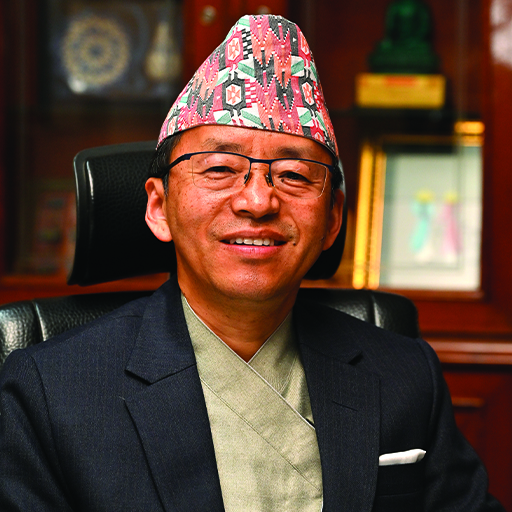
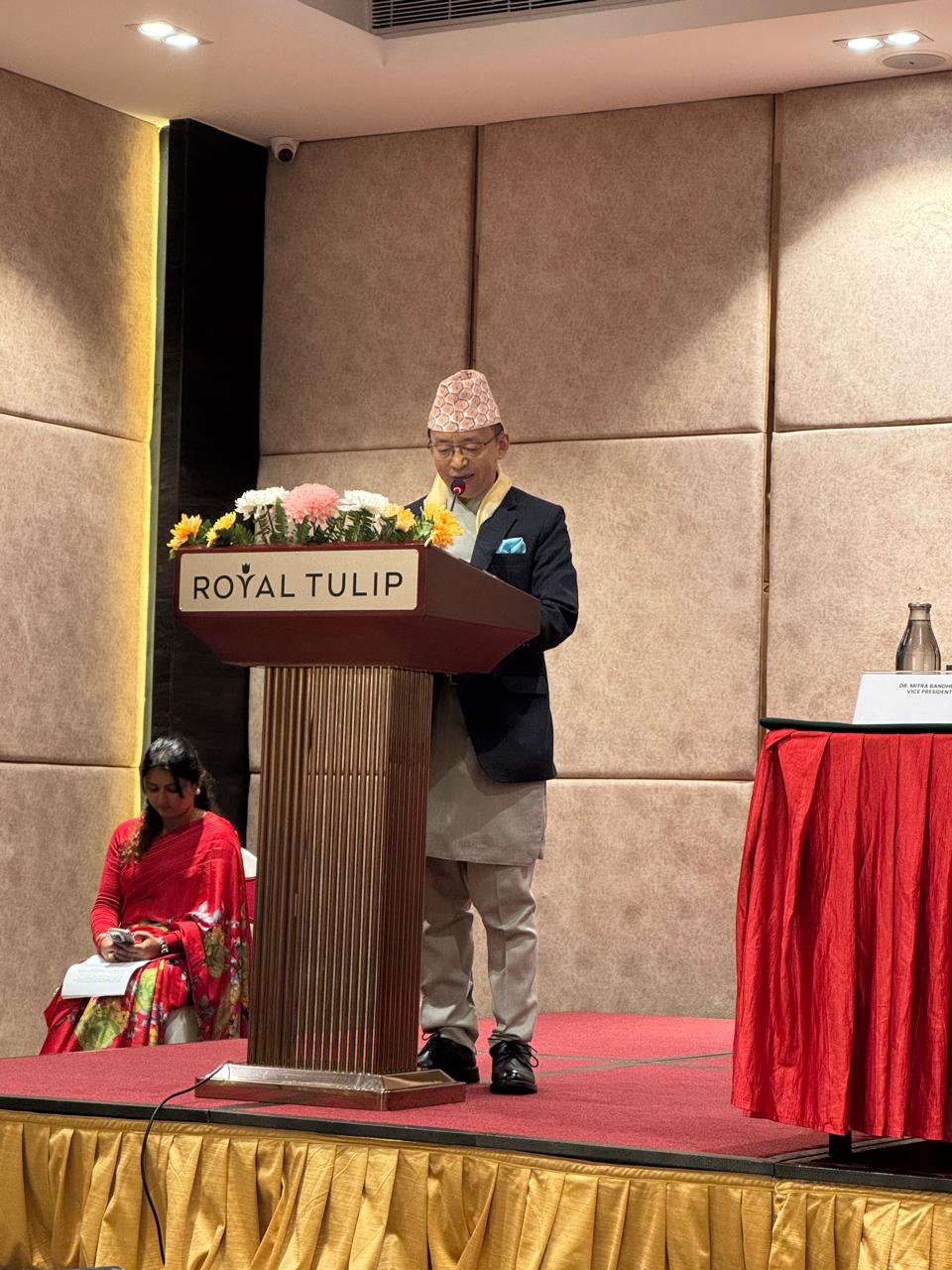
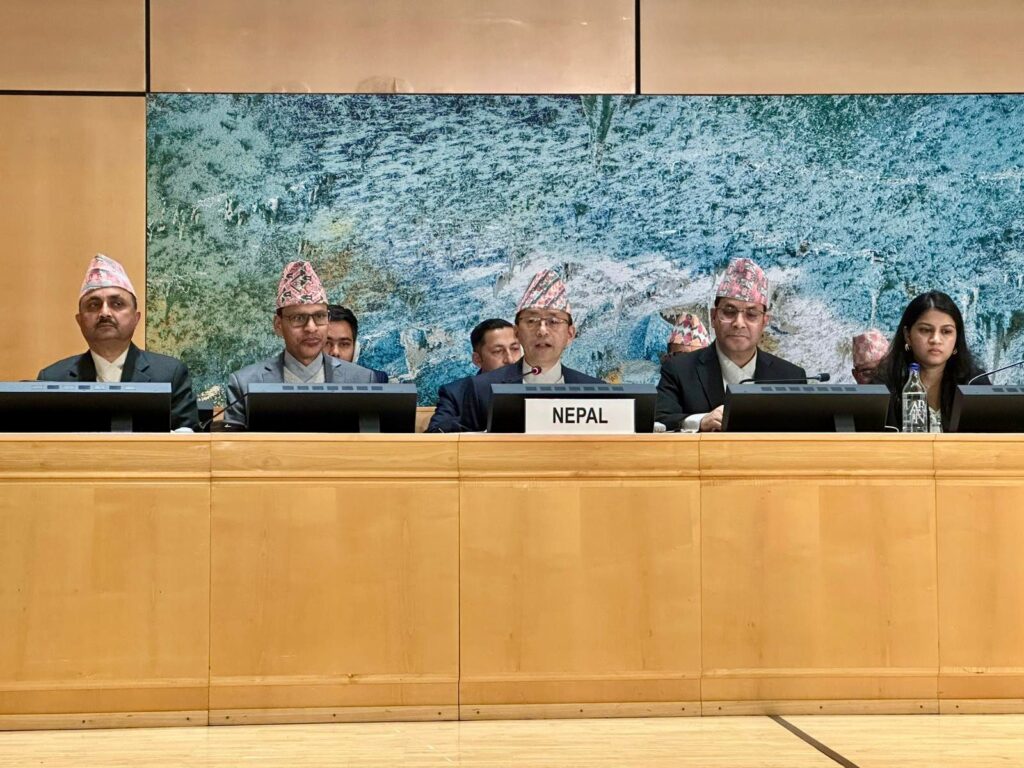
(The article is an edited version of the opening statement delivered by Nepal’s Foreign Secretary, Amrit Bahadur Rai, who also led the Nepali delegation to the 51st Session of the Human Rights Council Working Group on the Universal Periodic Review (UPR) in Geneva on January 21, 2026.)