
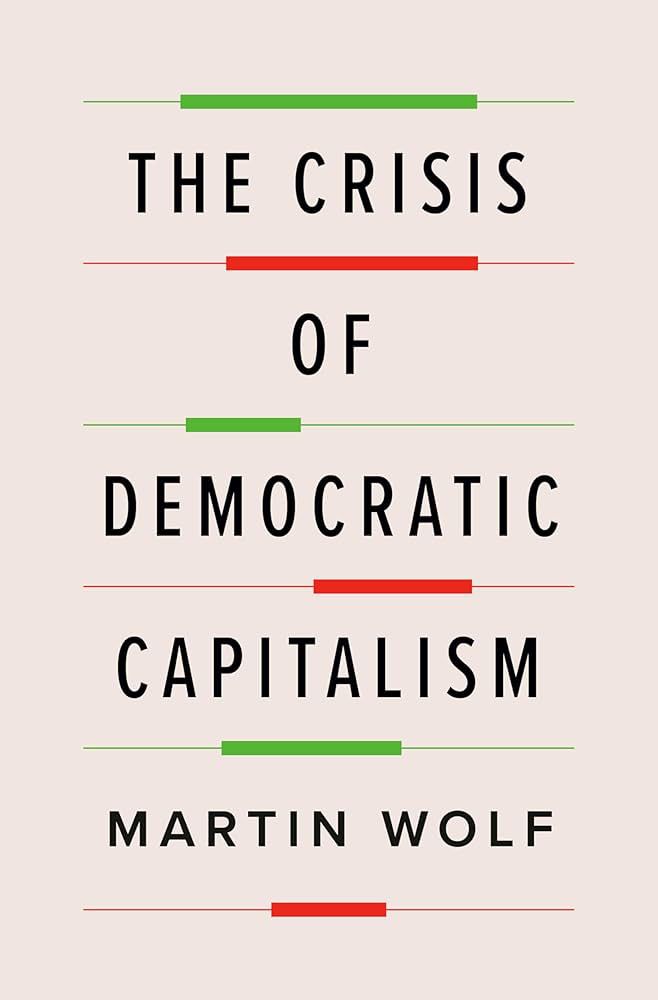
Martin Wolf’s book “The Crisis of Democratic Capitalism” deals with a pertinent question of our time: Can liberal democracy survive in a world defined by growing economic insecurity, persistent inequality, technological changes, and increasing authoritarianism?
Wolf, one of today’s most influential political commentators, offers both a diagnosis and a warning. His core argument is that the bond between democracy and capitalism, which has historically shaped the political and economic landscape in the West, is in serious jeopardy. He acknowledges capitalism’s contribution to wealth creation and innovation, but also discusses the deep social and political divisions the system has created, which have undermined the democratic legitimacy essential to stable capitalist systems.
Wolf emphasizes that democratic capitalism has always faced inherent tensions. Capitalism thrives on competition, wealth accumulation, and unequal outcomes. Democracy, on the other hand, relies on political equality, inclusion, and the ability of ordinary citizens to influence decisions. During much of the post-World War II era, especially in Western Europe and North America, society managed this tension through rising living standards, welfare programs, organized labor, and trust in liberal institutions. However, Wolf suggests that this balance has now collapsed. In recent decades, the benefits of globalization and market liberalization have not been shared evenly. Many workers have seen stagnant wages, slower social mobility, and a decline in trust toward institutions. This situation has caused economic discontent and a crisis in its democratic legitimacy.
Wolf effectively illustrates how economic inequality poses a political threat. He does not view inequality merely as a moral issue. He presents it as a structural risk to democracy. When citizens believe the system favors the wealthy, they are more likely to turn to populist leaders who promise to challenge the establishment, even at the cost of constitutional norms. In this way, the book offers a compelling explanation for the rise of populism in the United States and Europe. Wolf connects this populist surge to how mainstream parties have failed to protect ordinary people from the effects of globalization, deindustrialization, and technological changes. He identifies poor leadership as a cause of democratic decline, but emphasizes that the social effects of economic policies are the core tenet of this backslide.
The book’s biggest strength is the historical and comparative view. The author places today’s crisis within a broader history of capitalism, reminding readers that this system has always needed political oversight. Free markets do not ensure their own stability. They depend on a mirage of factors such as laws, norms, institutions, and a widespread belief in fairness. When those supporting conditions fail, markets can produce not stability but backlash. This historical context reminds readers that the current situation is not an outlier. It is part of a recurring cycle in modern political economy: excessive economic power often leads to political backlash.
Wolf also addresses technology and changes in the workforce. He notes that digitalization, automation, and global supply chains have reshaped labor markets in ways that heighten insecurity. Many workers now face unstable jobs, weakened bargaining power, and an uncertain future. Meanwhile, digital platforms and global finance have concentrated wealth in a few firms and individuals. Wolf argues these changes have deepened social divisions and made it harder for democratic states to respond effectively. This is an important contribution because it links broad economic trends to the everyday experiences of people who are losing faith in democracy.
Another major strength of the book is its clarity. Wolf writes in a straightforward and engaging style without sacrificing depth. He is not a narrow academic theorist but a clear interpreter of political economy. Readers can easily follow his arguments across economics, history, and politics. The book is particularly valuable for those seeking a broad understanding of the crisis facing liberal capitalism without being bogged down by technical jargon. Wolf successfully makes a complex subject accessible without oversimplifying it.
However, the book has its limitations. At times, Wolf’s analysis feels more diagnostic than transformative. He provides a strong description of the crisis, yet his proposed solutions are somewhat cautious and familiar. These include stronger social protections, better education, more accountable capitalism, institutional reform, and a renewed commitment to civic values. While these suggestions are reasonable, they may not fully address the scale of the structural crisis he identifies. If capitalism itself is a source of democratic instability, then gradual reform may not suffice. The book sometimes falls short of questioning whether the current form of capitalism can genuinely align with democratic equality over the long term.
Another criticism is that Wolf’s framework is largely rooted in the experiences of Western liberal democracies, particularly the United States and Europe. This focus is understandable since those regions are central to democratic capitalism, yet it can limit the book’s scope. The Global South receives less attention, even though the tensions between economic liberalization and democratic governance are often particularly pressing there. In many developing nations, the challenge is not just inequality. It spreads to weak state capacity, corruption, informality, and dependence on foreign markets and capital. A broader comparative lens could have strengthened Wolf’s argument and made it more relevant worldwide.
Nonetheless, the book’s main insight is powerful: democracy cannot thrive if many citizens believe capitalism only benefits the elite. Wolf reminds us that markets need to be integrated into a political system that citizens view as legitimate. When that sense of legitimacy fades, economic grievances can turn into resentment, division, and authoritarianism. This makes the book significant not only for economists and political scientists but also for anyone trying to grasp today’s governance crisis.
“The Crisis of Democratic Capitalism” is a thoughtful, timely, and intellectually valuable book. It doesn’t provide easy solutions or pretend the current crisis has a simple fix. Its strength lies in its insistence that economic and political systems are intertwined. If democracy is to survive, capitalism must align with social justice, broad participation, and trust in institutions. Wolf’s work is a sobering reminder that we can no longer take this connection for granted. It offers a strong, reflective look at the factors that have made liberal democracy fragile and deserves close attention for both its analysis and its warnings.