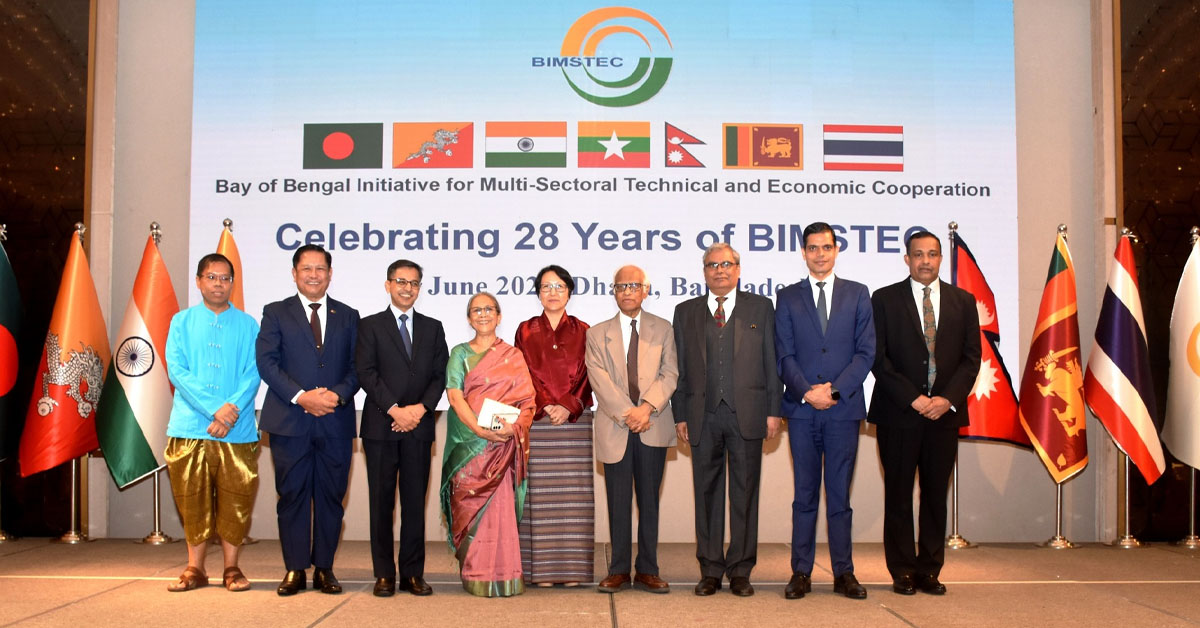
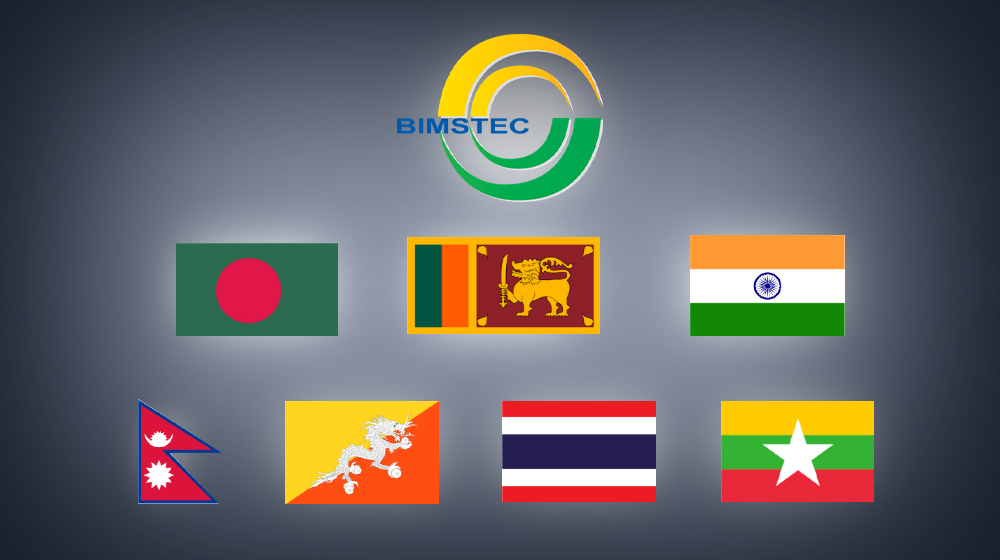
The Bay of Bengal Initiatives for Multi-Sectoral Technical and Economic Cooperation (BIMSTEC) is a bridge between South Asia and Southeast Asia. The organization, which was established in 1997, has gained momentum after 23 years of waiting for the adoption of the Charter. The BIMSTEC Charter was signed and adopted during the fifth BIMSTEC Summit held virtually in Colombo, Sri Lanka, on 30 March, 2022.
“Adopting the Charter has accelerated the organization more than before. The BIMSTEC has been an active regional organization for the last few years, and we all need to work together according to the Charter for the benefit of all the countries and their people,” said N.P. Saud, the former Foreign Minister of Nepal.
BIMSTEC is essential for regional cooperation. It was formed in 1997 with countries of the Bay of Bengal, Bangladesh, India, Sri Lanka and Thailand. Later it included Myanmar, Bhutan and Nepal as members to foster regional ties and prosperity. In 1998 Nepal joined BIMSTEC as an observer and became an active member in 2004. Since then Nepal has been successfully holding and participating in BIMSTEC summits and other minister-level and official-level programs.
BIMSTEC members work together for regional cooperation in sectors such as sustainable development, economic cooperation, energy cooperation, climate change, technology, innovation, cultural exchanges, historical ties, disaster management, humanitarian crisis, maritime security and cross-border security.
The BIMSTEC streamlined its framework of regional collaboration by consolidating its 14 priority areas into seven core sectors, in efforts to enhance effectiveness and coordination among member states. The decision was endorsed during the fifth BIMSTEC Summit. Under the revised structure, the seven core sectors are supported by 14 sub-sectors, with a member country leading each of the sectors.
According to the document, the Trade, Investment and Development sector, led by Bangladesh, includes the sub-sector of Blue Economy, emphasizing sustainable use of ocean and marine resources. Environment and Climate Change, led by Bhutan, includes the Mountain Economy sub-sector, unique ecological and economic concerns of mountainous regions.
Myanmar leads the Agriculture and Food Security sector, which comprises two sub-sectors: Agriculture, and Fisheries and Livestock, focusing on food sustainability and rural livelihoods. Nepal heads the People-to-People Contact sector, the most diverse, encompassing four sub-sectors—Culture, Tourism, Poverty Alleviation, and People-to-People Contact Forums—to strengthen social and cultural ties across the region.
The Security sector is led by India and covers three sub-sectors: Energy, Disaster Management, and Counter Terrorism and Transnational Crime, underscoring collective responses to shared regional challenges. Sri Lanka is the lead country for Science, Technology and Innovation, which includes Technology, Health, and Human Resource Development as key sub-sectors.
Finally, Connectivity, a critical pillar for regional integration, is led by Thailand, focusing on improving physical, digital, and institutional linkages among BIMSTEC member states, the document reads.
Former Foreign Minister Saud added, “In the past, we have worked together to cope with problems in this region and we need to collaborate more effectively in future in the designated sectors. The Bay of Bengal is one of the important regions in this world. So collaboration and regional integration are vital.”
The latest 6th BIMSTEC summit was held on 4 April, 2025, in Bangkok under the theme “Prosperous, Resilient, and Open BIMSTEC”, focusing on promoting collaboration among the member states to address shared security and developmental challenges. Muhammad Yunus, Chief Adviser of Bangladesh; Dasho Tshering Tobgay, Prime Minister of Bhutan; Narendra Modi, Prime Minister of India; Min Aung Hlaing, Prime Minister of Myanmar; KP Sharma Oli, then Prime Minister of Nepal; Harini Amarasuriya, Prime Minister of Sri Lanka; and Paetongtarn Shinawatra, then Prime Minister of Thailand attended the summit that was chaired by Thailand.
According to the charter, the summit should be held every two years and Bangladesh will be chairing the upcoming summit.
The BIMSTEC has 14 institutional mechanisms: BIMSTEC Summit, Ministerial Meeting, BIMSTEC Sectoral Ministerial Meeting, Senior Officials’ Meeting, BIMSTEC Permanent Working Committee, BIMSTEC Secretariat, BIMSTEC Business Forum and Economic Forum, People-to-People Contact Sector, Trade, Investment and Development, Environment and Climate Change, Agriculture and Food Security, and Security.
The BIMSTEC Summit is the highest policymaking body in the BIMSTEC process and is composed of Heads of State or Government of Member States. There have been five summits so far: 2004 (Bangkok), 2008 (New Delhi), 2014 (Nay Pyi Taw), 2018 (Kathmandu), 2022 (Colombo), and 2025 (Bangkok) respectively.
According to the Charter, the Ministerial Meeting is another key policy-making body of BIMSTEC, comprising the External or Foreign Ministers of the member states. The BIMSTEC Sectoral Ministerial Meeting brings together the relevant line ministers who are mandated to carry out regional cooperation activities in their respective sectors. The Senior Officials’ Meeting precedes the Ministerial Meeting and is represented by Senior Officials (Foreign Secretaries, Secretaries or appropriate officials) as nominated by the Member States and is held annually. The BIMSTEC Permanent Working Committee is a body of National Focal Points (Joint Secretaries or Director-General of the Ministry of Foreign Affairs) at an appropriate senior level of Member States.
The BIMSTEC Secretariat is an administrative body responsible for overall coordination related to the activities of the organization. Each institution’s mechanism carries their duties respectively.
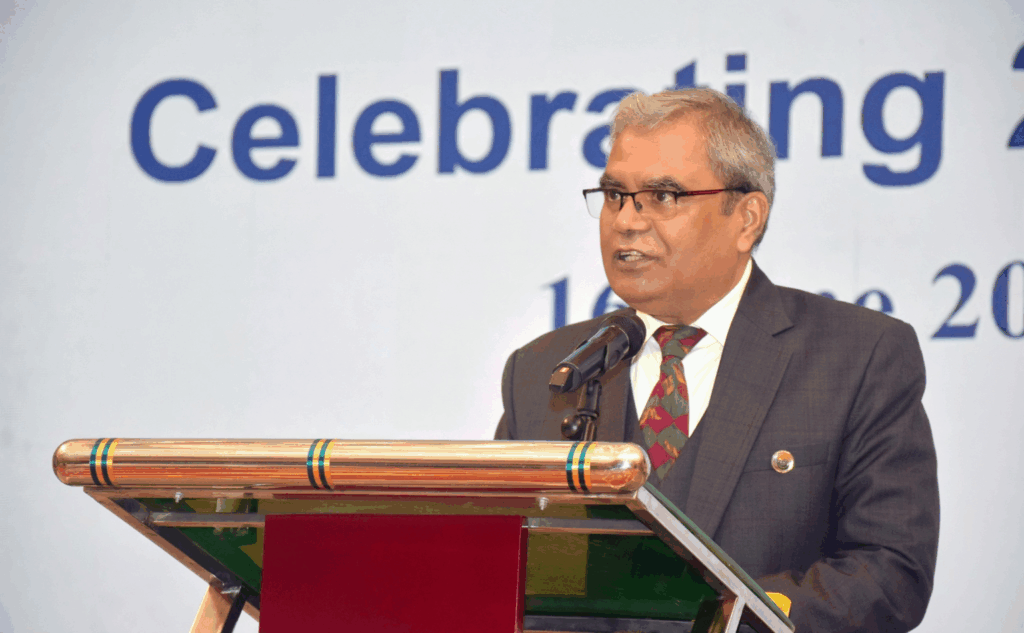
Secretary General of BIMSTEC, Indra Mani Pandey, stated that the 6th BIMSTEC Summit of the Heads of State or Government of the member States of BIMSTEC was focused on fostering collaboration among the member States to address their shared security and developmental challenges. He also added that the Summit provided a new impetus to realize the goal of a “Prosperous, Resilient and Open BIMSTEC”.
The key outcomes of the 6th Summit are: adoption of the 6th BIMSTEC Summit Declaration and the BIMSTEC Bangkok Vision 2030; the Agreement on Maritime Transport Cooperation and Memoranda of Understanding with the Indian Ocean Rim Association and the UN Office on Drugs and Crime. Secretary General Pandey said, “The Summit also adopted the Rules of Procedure for various BIMSTEC mechanisms and endorsed the Report of the Eminent Persons Group on the Future Direction of BIMSTEC. Leaders reaffirmed their commitment to strengthening BIMSTEC and proposed concrete actions to advance regional trade, connectivity, climate action, food security, disaster management, tourism, and security cooperation. In today’s complex geopolitical and economic environment, the Summit reaffirmed BIMSTEC’s vital role in shaping a cooperative and resilient Bay of Bengal region.”
Pandey also said BIMTEC is an intergovernmental organization, aimed at fostering economic and technical cooperation among member States, and has focused on assisting its member states in realising SDG’s Agenda 2030, as reflected in its vast and diverse agenda. He added, “Please note that we have always attached a high priority to cooperation in economic, technical, and climate change.”
As a legally binding Charter and well-established decision-making structures, including Summits, Ministerial and Senior Officials’ Meetings, the Permanent Working Committee, and various sectoral Working and Expert Groups, BIMSTEC is well-positioned to become a dynamic and vibrant regional organization.
By deepening cooperation across these areas, BIMSTEC can help member states tackle their shared security, development, and climate change-related challenges. BIMSTEC is poised to grow into a vibrant platform for advancing peace, prosperity, and resilience in the Bay of Bengal region.