How Nepal can secure recovery finance, pursue climate justice and shape a new Himalayan diplomacy.
The most important question after a catastrophe is often not what was destroyed, but what it reveals.
Nepal’s latest Himalayan disaster has revealed much: the growing instability of a warming mountain system, the limits of national preparedness, the enormous financial burden climate shocks impose on vulnerable countries and the dangerous consequences of environmental risks that do not stop at political borders.
But it has also revealed something less immediately visible: a changing Himalaya is becoming a question of diplomacy.
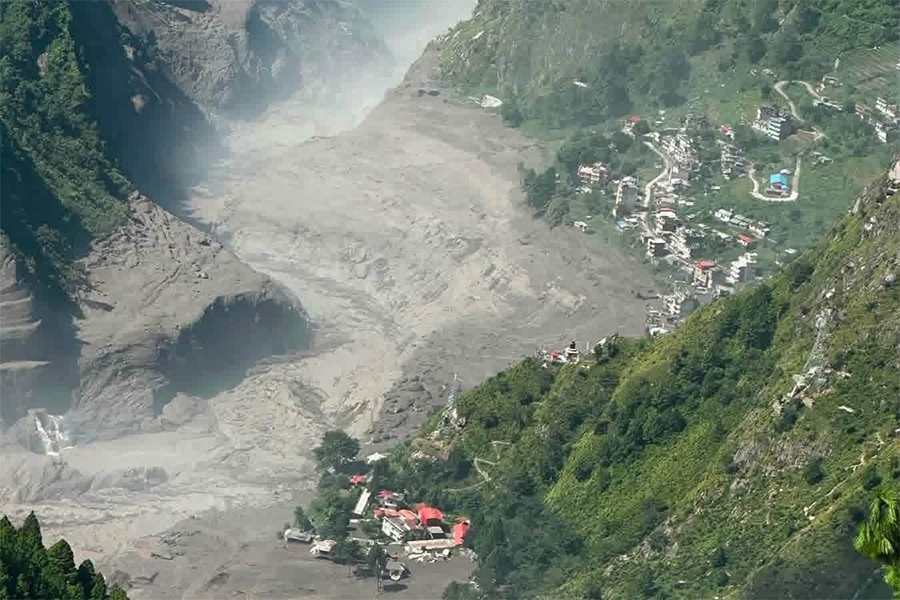
Nepal’s latest catastrophe illustrates the scale of that challenge starkly. On 26 August 2026, a glacier collapse above the Nepal-Tibet border sent ice, rock and debris down the Bhotekoshi-Trishuli river system, devastating communities across the region. More than 1,300 people are confirmed dead, thousands remain missing, and roughly 84,000 people across seventeen municipalities have been affected. Reconstruction needs are estimated at $4–5 billion-nearly a tenth of Nepal’s economy-while bridges, roads and hydropower infrastructure have been severely damaged.
The catastrophe did not emerge from a single geography or affect a single political space. Its origins, consequences and implications crossed borders, connecting Tibet, Nepal and India, while drawing the attention of a wider international community struggling to respond to accelerating climate risks. What happened in the mountains was therefore more than a national disaster. It was a warning from one of the world’s most consequential ecological systems.
The immediate priority is unquestionably relief, recovery and reconstruction. Yet catastrophes of this scale also create political moments. For Nepal, the challenge is not only how to rebuild what has been lost, but whether it can use this moment to reshape how the world understands the Himalayas-and Nepal’s place within them.
The Himalaya is warming, destabilising and generating increasingly complex risks. Melting ice, changing precipitation, weakening mountain slopes and cascading hazards are no longer merely environmental concerns. They are becoming questions of economic security, infrastructure, human survival, regional stability and international responsibility.
Nepal has spent years warning the world about climate vulnerability. The latest catastrophe has given those warnings devastating new urgency. But vulnerability alone does not create influence, and moral legitimacy does not automatically translate into money. The diplomatic challenge is to convert vulnerability into agency-and agency into negotiating leverage.
Justice and reality
Nepal’s claim to climate justice is compelling. It has contributed little to the accumulation of global greenhouse gases but faces increasingly severe consequences of a warming planet. Climate disasters destroy homes and livelihoods, disrupt education and essential services, damage infrastructure and divert scarce public resources away from development towards repeated reconstruction. For countries with limited fiscal capacity, the cycle can become brutally familiar: disaster, destruction, reconstruction, debt and renewed vulnerability.
Climate justice challenges this inequality. Its foundations connect climate change with human rights, inequality, historical responsibility and the rights of vulnerable communities and future generations. The essential question is straightforward: why should those who contributed least to a global crisis bear a disproportionate share of its consequences?
For Nepal, therefore, the question is not simply who should reduce future emissions. It is also who should bear the cost when climate impacts arrive today.
But moral clarity alone does not rebuild homes, bridges or livelihoods.
On 1 September, Nepal filed an emergency request with the Fund for Responding to Loss and Damage outside its normal cycle. It was an important step, but the limitations of the emerging international architecture must also be recognised. The Fund is new and heavily oversubscribed. Its initial funding round received close to 180 requests seeking around $2.8 billion against available resources of only $300 million, with start-up allocations expected to be only a fraction of the needs of countries facing major disasters.
For a recovery estimated at $4–5 billion, Loss and Damage finance can therefore be an important component-but not the principal or immediate source of reconstruction finance at the scale Nepal requires.
That is why Nepal’s strategy must operate on two tracks. It should intensify efforts to access and help shape the emerging Loss and Damage architecture while simultaneously mobilising finance from every available channel: humanitarian assistance, bilateral partnerships, multilateral institutions, development banks, philanthropy and climate-related finance.
The principle should remain clear: Nepal should not allow the limitations of existing mechanisms to determine the scale of either its recovery needs or its claim to justice.
Finance must come first for communities waiting to rebuild. Climate justice must continue in parallel.
Nepal should not pay twice-first through the impacts of a crisis it did little to cause, and again through debt-financed reconstruction.
Claims and cooperation
This creates a genuine diplomatic dilemma.
The language of compensation and reparation carries enormous moral force. The argument that major historical and contemporary emitters bear responsibility for the consequences of climate change in vulnerable countries is increasingly difficult to dismiss. Nepal is justified in keeping that question alive, particularly as the gap between responsibility and suffering becomes more visible.
But moral argument and diplomatic negotiation do not always operate in the same register.
Potential partners in recovery and reconstruction are unlikely to enter formal negotiations framed primarily around admissions of guilt or legal liability. If Nepal reduces its entire diplomatic strategy to a single vocabulary, it risks narrowing the coalition needed to support recovery.
That does not mean abandoning justice.
Nepal can continue speaking clearly about responsibility, compensation and reparation in international political discourse while approaching governments and institutions through a broader language of solidarity, shared risk and global responsibility. Advocacy and negotiation can serve different functions.
The immediate needs of devastated communities should not become hostage to the political difficulty of securing international agreement on liability. Nepal must secure recovery wherever support can be mobilised while continuing the longer struggle for accountability.
This is not a retreat from climate justice. It is diplomacy with a longer horizon.
Rights and redress
The catastrophe also exposes the artificial separation between environmental policy and human rights. When floods destroy homes, interrupt children’s education, eliminate livelihoods and displace communities, environmental damage becomes a human rights crisis.
The rights to life, health, housing, food, water and a clean and healthy environment are inseparable from climate impacts. Framing the crisis in this way broadens Nepal’s international claim beyond charity or disaster assistance. It introduces questions of rights, accountability and redress.
But moral authority will not sustain a diplomatic campaign without evidence.
A credible and independently verified assessment of economic and non-economic losses should become the foundation of Nepal’s international engagement. Pakistan’s post-flood recovery conference in Geneva in 2023 generated pledges of more than $9 billion against assessed needs of over $16 billion. Following Cyclones Idai and Kenneth, Mozambique mobilised $1.2 billion in pledges against reconstruction needs of $3.2 billion. Neither appeal met the full cost of recovery, but both demonstrated the value of a credible, government-led assessment that international partners could fund against.
Nepal needs the same clarity: a credible recovery framework that identifies priorities, quantifies losses and demonstrates how resources will be used.
Evidence is not merely technical infrastructure. In climate diplomacy, it is diplomatic infrastructure.
Nepal’s strongest claim will combine moral authority with scientific credibility, reliable data and a coherent national strategy.
From vulnerability to leverage
The disaster has exposed something larger than Nepal’s financial vulnerability. It has revealed the strategic significance of the Himalaya itself.
This catastrophe unfolded within a shared mountain geography whose consequences crossed political boundaries. China was affected on the Tibetan side, Nepal suffered devastating impacts downstream, and India remains deeply connected through shared river systems, infrastructure, hydropower and the wider ecological stability of the region.
The Himalaya is politically divided but ecologically interconnected. Glaciers, rivers and cascading hazards do not conform to political boundaries, even though the governance of Himalayan risks remains fragmented by them.
That disconnect creates an opportunity for Nepal.
Vulnerability is not, by itself, a source of power. But it can become diplomatic capital when combined with knowledge, strategic geography, moral authority and the ability to build coalitions.
With China, shared exposure across the mountain frontier creates a basis for deeper cooperation on scientific research, risk monitoring, data sharing and early warning. With India, shared rivers, downstream risks, hydropower and economic interdependence make Himalayan resilience a matter of common interest.
Nepal’s position between India and China has traditionally been understood through the language of geopolitical competition. Climate change offers another way of reading the same geography: as a shared ecological space whose instability creates common risks even where political interests diverge.
Nepal cannot change its location. But it can change what it draws from it.
Its diplomacy must also extend beyond its immediate neighbours. The United States, Europe, Japan and other international partners may not share Nepal’s geography, but they are connected to its climate future through finance, technology, historical emissions and influence within global institutions.
A small country confronting a crisis of this magnitude requires diversified partnerships, not a single benefactor. Nepal’s geography may be regional, but its climate diplomacy must be global.
Voice and value
Nepal should not allow climate vulnerability to become its permanent international identity. Sympathy may generate attention, but sympathy is rarely a durable source of influence.
Small states seldom shape international politics through military or economic power. Their influence often comes from specialised knowledge, credibility and leadership around issues where they possess moral authority or strategic relevance.
The Himalaya is such an issue.
Its glaciers, rivers and ecosystems sustain hundreds of millions of people across Asia, while their environmental stability has implications for water, food, energy and human security far beyond Nepal’s borders. Yet mountain systems have occupied far less political space in global climate diplomacy than oceans, forests or low-lying islands.
Nepal is well positioned to help change that.
It does not need to begin from scratch. Nepal’s earlier efforts, including Sagarmatha Sambad, reflected an important recognition that its geography could become a source of international voice, not only vulnerability.
A country that approaches international forums solely as a recipient seeks assistance. A country that helps define problems, convene actors, produce knowledge and shape agendas develops influence.
Nepal must learn to do both.
Third Pole diplomacy
The longer-term opportunity is to develop a more distinctive diplomatic architecture around the Himalaya itself.
The Hindu Kush Himalaya, often described as the Third Pole because of its vast reserves of ice and snow, is one of the world’s most consequential ecological systems. Its rivers support enormous populations downstream, while climate change is transforming glaciers, water systems and mountain landscapes across national borders.
Yet ecological interconnectedness has not been matched by an equally coherent political architecture for cooperation.
The region does not lack scientific institutions, research networks or technical expertise. What it lacks is a stronger bridge between knowledge and diplomacy-a mechanism capable of translating shared evidence into sustained political dialogue, negotiated cooperation and collective action.
Scientific institutions and research networks can remain central to generating knowledge, monitoring risks and supporting regional cooperation. But science alone cannot negotiate agreements between governments. A warning system, however sophisticated, ultimately depends on political decisions about who shares information, when and under what obligations.
That gap points towards a larger institutional conversation.
Nepal could begin advocating for a government-backed Himalayan cooperation platform-an umbrella mechanism that brings together science, diplomacy and political decision-making. It need not begin as a formal treaty organisation or a new regional bureaucracy. It could evolve gradually through regular ministerial dialogue, technical working groups and agreed protocols on transboundary risks.
Such a platform could focus initially on areas where cooperation is both urgent and politically feasible: real-time data sharing, early warning, glacier and mountain monitoring, disaster preparedness and coordinated response. Over time, it could expand into climate finance, water security and a stronger collective voice for mountain regions in global forums.
Nepal’s role would not be to dominate such a mechanism, but to convene and champion it.
This is where Nepal’s geography becomes diplomatic value. Positioned between India and China and at the heart of the Hindu Kush Himalaya, Nepal can create spaces where ecological necessity encourages cooperation even when wider geopolitics makes it difficult.
That is the basis of what Nepal could begin to develop as Third Pole diplomacy.
This is not neutrality as passivity. It is neutrality as convening capacity.
Over time, Nepal could develop an international identity not merely as one of the world’s most climate-vulnerable countries, but as a credible convenor of Himalayan dialogue and cooperation-connecting science with diplomacy, vulnerability with agency and regional risk with collective action.
Future and fairness
Nepal’s strategy should operate across three horizons.
The immediate task is to stabilise affected communities, document the full scale of loss and mobilise the largest and fastest possible recovery finance. The medium-term task is to negotiate stronger arrangements for transboundary data-sharing, early warning, climate-resilient reconstruction and regional risk cooperation. The longer-term task is to institutionalise Nepal’s relevance: helping build a political architecture for Himalayan cooperation and establishing Kathmandu as a credible convening space for regional dialogue and cooperation.
The first requires money. The second requires cooperation. The third requires vision and leadership.
At the same time, international responsibility cannot become an excuse for failures at home. Climate justice abroad must be accompanied by domestic responsibility. Recovery should strengthen institutions, improve risk-sensitive planning and ensure that reconstruction does not reproduce vulnerabilities created by weak enforcement, poor decisions or outdated assumptions about a rapidly changing mountain environment.
The Himalaya in which Nepal is rebuilding is not the Himalaya of the past. Reconstructing yesterday’s infrastructure for tomorrow’s climate would simply rebuild vulnerability.
The floodwaters will eventually recede from international headlines. Political attention will move elsewhere. What Nepal does while the world’s attention remains focused on the Himalaya may determine whether this catastrophe becomes another chapter in a familiar history of vulnerability-or the beginning of a different diplomatic future.
Perhaps that is what this catastrophe ultimately reveals.
The Himalayas are not only changing; they are changing the questions Nepal must ask of the world-and of itself. Climate change is no longer simply an environmental challenge to be managed through national policy or discussed at international conferences. It is reshaping geography, security, development, finance and relations between states.
The catastrophe is therefore more than a disaster demanding reconstruction. It is a herald from the Himalayas.
The question is whether Nepal will merely receive its warning-or carry its message to the world.
And whether, in doing so, it can turn vulnerability into voice, voice into leverage, and leverage into a lasting role in shaping the future of the Third Pole.