Kathmandu: The Ministry of Culture, Tourism and Civil Aviation (MoCTCA), with support from UNESCO, has launched a six-day community-based workshop under the programme “Development of Inventory of Intangible Cultural Heritage Covering All Seven Provinces of Nepal.” The workshop marks an important step towards participatory approaches in documenting Nepal’s living heritage, with communities at the centre of the process.
The workshop brought together 40 participants, including 16 women and 24 men, with youth making up 30 per cent of the group. Participants represented Newa, Tamang, Chepang, Thami, Gurung and Siyar Indigenous communities from Bagmati and Gandaki provinces, along with representatives from municipalities and the Ministry of Culture, Tourism and Civil Aviation.
Opening the workshop, Dr Suresh Suras Shrestha, Joint Secretary at the Ministry, highlighted Nepal’s national policies and legal frameworks for safeguarding intangible cultural heritage. He also reaffirmed the Government’s commitment to working with UNESCO to advance this initiative.
Dr Suresh Suras Shrestha, Joint Secretary at MoCTCA, said, “This workshop will add more Intangible Cultural Heritage (ICH) elements to the National Inventory. The inclusion of youth and the emphasis on community validation ensure that the project promotes sustainable practices and provides a roadmap for other communities to begin their own journey of ICH inventorying for an inclusive future.”
The workshop is the first in a series of three six-day community-based workshops guided by the 2003 Convention for the Safeguarding of the Intangible Cultural Heritage. Participants explored Nepal’s responsibilities under the Convention and how inventories can support safeguarding when they are developed through participation, reflection and community leadership. The training focused not only on documenting cultural practices, but also on supporting communities to continue transmitting their heritage from one generation to the next.
Jaco du Toit, UNESCO Representative to Nepal, said, “At UNESCO, we deeply value the knowledge, skills, languages, stories, rituals, food, music and ways of life of Indigenous communities. This knowledge has been passed from generation to generation. It helps communities stay strong, connected and proud of who they are. Our shared goal is simple: to help communities record, protect and pass on Nepal’s living heritage. Through this project, we aim to document at least 20 Intangible Cultural Heritage elements from 17 Indigenous communities across all seven provinces in Nepal.”
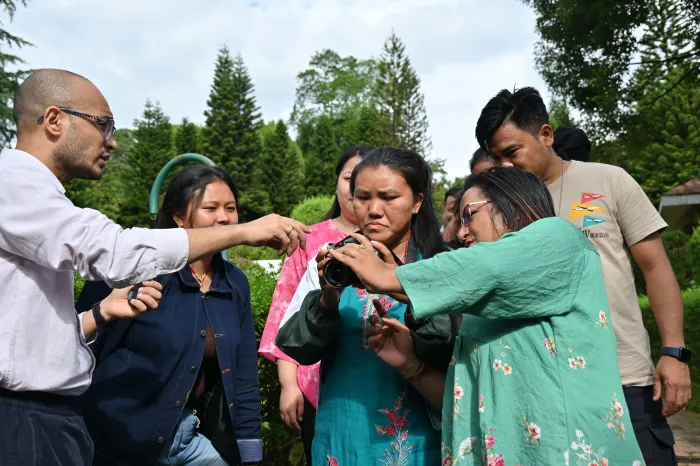
The workshop moved from the training room to the field with a hands-on practicum in Bhaktapur, facilitated by representatives from Ward 9 and Newa Dey Daboo. Participants observed and documented Gathamuga, a post-harvest Newa festival, gaining first-hand experience of how living heritage is practiced, shared and remembered by communities. The group was welcomed at the Ward Office in Dattatraya by local government representatives, underscoring the important role of municipalities in supporting community-led safeguarding efforts.
“Digital archiving makes it easier for us to preserve and practice our heritage, while unlocking economic opportunities for young people to actively engage. Following this six-day workshop, I feel confident about our path forward. Once I return to our community, we will prioritize key steps to select a cultural element, register it nationally this year, and ultimately take it to the international stage,” says Yajju Maharjan, a participant from the workshop.
By the end of the workshop, participants had strengthened their skills to support community-led documentation and safeguarding of intangible cultural heritage. With UNESCO’s technical support, the training encouraged participants to be trusted partners with communities through ethical, field-based engagements. A key message was that consent is not a one-time formality, but an ongoing process of shared decision-making built on trust and genuine participation. Equipped with practical tools and a stronger understanding of the 2003 Convention, participants are now better prepared to help communities validate, maintain and pass on their living heritage.