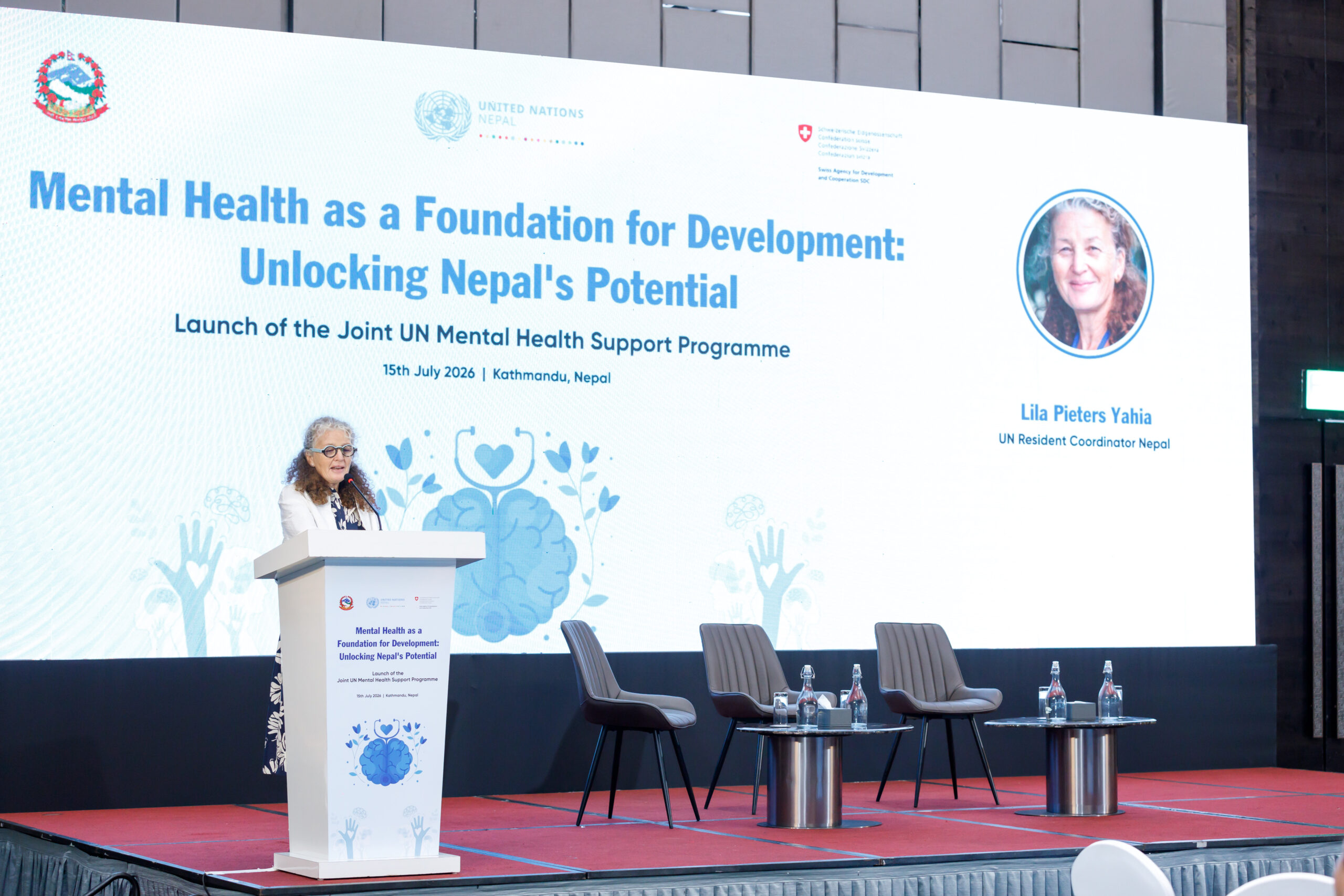
Kathmandu: The Government of Nepal (GoN) and the United Nations (UN) launched the Joint UN Mental Health Support Programme (2025–2028), a three-year initiative to strengthen Nepal’s mental health system and expand access to quality mental health and psychosocial support services across federal, provincial and local levels on July 15.
The Programme is funded by the Government of Switzerland through the Swiss Agency for Development and Cooperation (SDC) and implemented jointly by the United Nations Resident Coordinator Office (RCO), the United Nations Population Fund (UNFPA), the United Nations Children’s Fund (UNICEF) and the World Health Organization (WHO). It will be implemented in Karnali, Lumbini and Madhesh Provinces, working closely with government institutions to strengthen policies, improve services, build workforce capacity, and promote innovation in mental health care. The programme will also support key national-level activities, including reviewing and updating mental health strategies and policies, and establishing online training infrastructure and resource centres, and work with private sector partners for the provisions and delivery of mental health services.
Bringing together senior government officials, development partners, civil society, the private sector, youth representatives, people with lived experiences, and the diplomatic community, the launch event highlighted that investing in mental health is not only essential for improving health outcomes, but also for advancing education, productivity, social inclusion, and Nepal’s long-term economic development.
The Programme responds to an urgent and growing need for mental health services in Nepal. The NMICS 2024–25 (Nepal Multiple Indicator Cluster Survey) reveals that 9.3% young people aged 15-24 years reported symptoms of depression or anxiety, with females twice as likely as males to experience mental distress. Despite important policy advances, including the National Mental Health Strategy and Action Plan (2020–2025), services remain fragmented, concentrated in urban areas and constrained by a shortage of trained personnel.
The case for investing in mental health is both social and economic. Evidence from Prevention and Management of Mental Health Conditions in Nepal: The Case for Investment, 2025 authored by MoHFS, WHO & UNDP shows that investing in mental health could save nearly 17,000 lives and generate almost one million healthy life years in Nepal over the next two decades. Every rupee invested in mental health returns nearly six rupees in economic and health gains, a multiplier effect that makes the case for action compelling.
Realizing these benefits will require collaboration across sectors. A distinctive feature of the Programme is its focus on developing and piloting public-private partnerships for mental health, opening new avenues for collaboration between public institutions and private actors to strengthen service delivery, innovation and access to care.
“Today’s launch marks an important milestone in our collective efforts to improve mental health and well-being in Nepal. We are highly appreciative of the continued support of the Government of Switzerland, together with UNFPA, UNICEF, and WHO, working alongside the Government of Nepal to strengthen mental health services. I want to reinforce the Government of Nepal’s commitment to working closely with all partners to ensure that quality mental health services are accessible to all who need them,” Dr. Dr Shree Krishna Shrestha, Additional Health Secretary, Ministry of Health and Food Safety.
“In Nepal, mental illness costs nearly 18.7 billion rupees a year, which is about close to half percent of the GDP. Investing in mental health is not a cost; it is an investment in human capital, a more productive workforce, stronger family, and more prosperous Nepal,” Lila Peters Yahia, the UN Resident Coordinator expressed on the shared vision between the Government of Nepal and the UN system, and the case for treating mental health as a development investment.
The Programme will reach approximately 54,000 individuals and support policy reform, capacity building and service innovation, and will contribute to the Nepal Health Sector Strategic Plan (2022–2030) and the United Nations Sustainable Development Cooperation Framework. It builds on Nepal’s 100-Point Governance Reform Agenda, announced in March 2026, which includes explicit commitments to mental health and psychosocial well-being alongside broader health reforms.
“Mental health is not only a health issue, it is a human rights issue, it is a development issue, it is investment in human capital. The Government of Nepal has recognized mental health as a national priority and as an essential foundation for inclusive and sustainable development. So this provides a unique opportunity to move from fragmented interventions toward a stronger, nationally owned psychosocial support delivery system, and this program reflects exactly that vision,” said Her Excellency Dr. Danielle Meuwly, Ambassador of Switzerland.
Going forward, the Programme will work with federal, provincial and local authorities, as well as the private sector to advance integrated, rights-based mental health and psychosocial support services across the three target regions.
“On behalf of the Ministry of Health and Food Safety, the Department of Health Services, and the Epidemiology and Disease Control Division, we will advance this program with full partnership and complete ownership,” said Dr Anuj Bhattachan, Acting Director General, Department of Health Services, Ministry of Health and Food Safety.