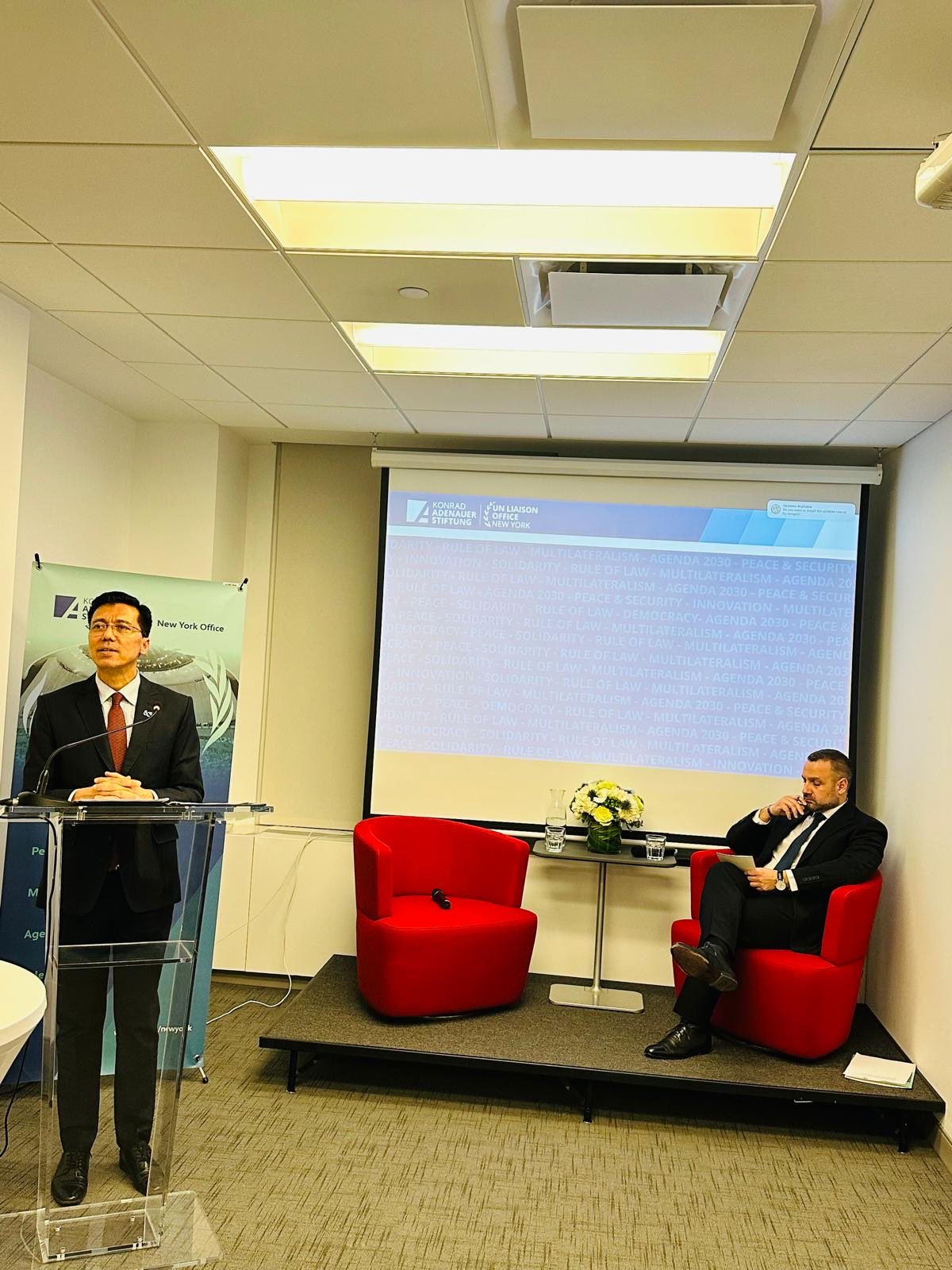
Kathmandu: The President of the United Nations Economic and Social Council (ECOSOC) Lok Bahadur Thapa has underscored the urgent need for renewed trust, stronger partnerships, and results-oriented multilateralism, saying global cooperation must “deliver better” for people worldwide.
Delivering the keynote address at the KAS NY Annual Adenauer Address organized by the Konrad Adenauer Foundation, ECOSOC President Thapa reflected on two historic milestones—the 80th anniversary of ECOSOC and the 150th birth anniversary of Konrad Adenauer—noting that both anniversaries highlight the enduring value of cooperation among nations.
Thapa said Adenauer’s legacy remains deeply relevant today, emphasizing that the multilateral system was created not merely for coexistence but to actively deliver stability, development, and human dignity through sustained cooperation.
Addressing growing global uncertainty, rising geopolitical tensions, and widening gaps between global commitments and realities on the ground, ECOSOC President Thapa stressed that multilateralism proves its worth not through symbolism but through practical action that improves lives and restores hope.
“Multilateralism must do more than convene—it must deliver inclusive progress that leaves no one behind,” President Thapa said, reaffirming that “Delivering Better” is the guiding principle of the ECOSOC presidency.
Highlighting the challenges facing the global development landscape—including shrinking fiscal space, rising debt, climate vulnerability, and the narrowing window to achieve the 2030 Agenda—the President called for a multilateral system that functions as an ecosystem of collaboration, linking global ambition with national implementation.
The address outlined four key ECOSOC priorities aimed at making a measurable impact: transforming agrifood systems and reducing inequality; accelerating digital inclusion and youth entrepreneurship; advancing climate action and resilience; and strengthening financing for development through a fairer international financial architecture, including implementation of the Sevilla Commitment.
Special emphasis was placed on supporting countries in special situations—Least Developed Countries, Landlocked Developing Countries, and Small Island Developing States—alongside a strong commitment to gender equality, youth engagement, civil society participation, and data-driven policymaking.
Drawing parallels between Adenauer’s belief in dialogue and ECOSOC’s inclusive platform, President Thapa said the best way to honor his legacy is through bridge-building, partnership, and cooperation that puts people first. “If the world is losing faith in multilateralism, the solution is not less cooperation—but better cooperation,” President Thapa said.
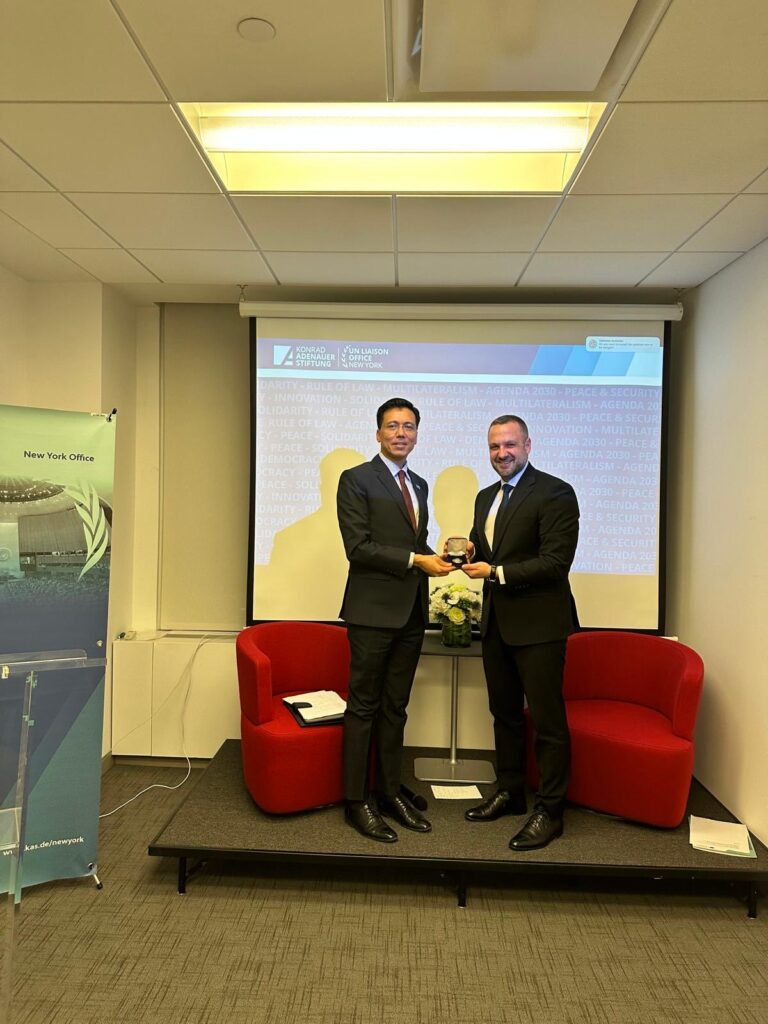
Concluding the address, ECOSOC President Thapa reaffirmed commitment to working closely with the President of the General Assembly and all stakeholders to ensure ECOSOC remains responsive to global challenges and aspirations. “This is the promise of ECOSOC at 80. This is the legacy of Konrad Adenauer at 150. And this is our shared commitment to delivering better,” President Thapa said.