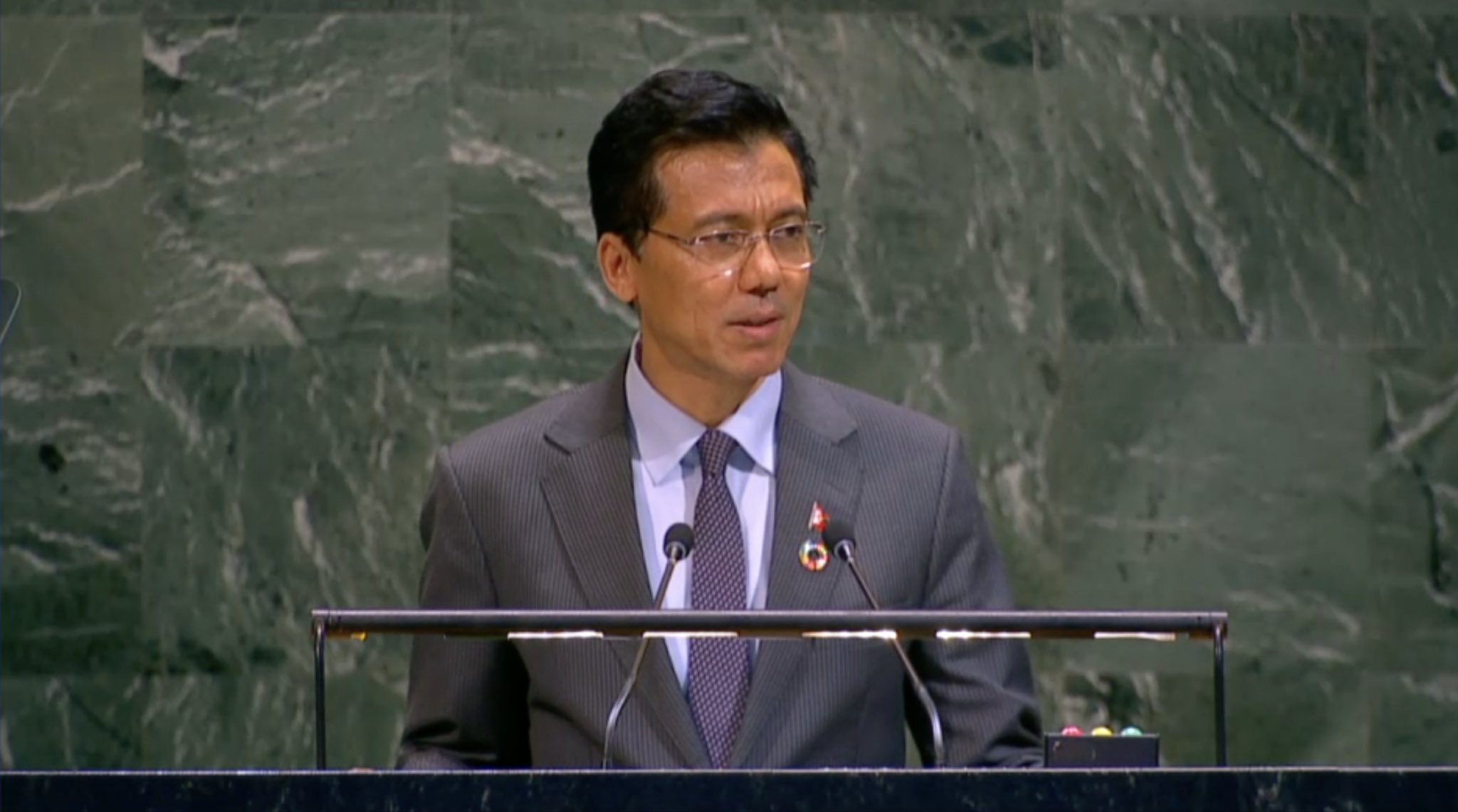
Kathmandu: Amb. Lok Bahadur Thapa, President of the United Nations Economic and Social Council (ECOSOC), has emphasized the urgent need to strengthen access to justice for women and girls worldwide, stating that global progress toward gender equality remains “far too slow.”
Speaking at the opening of the 70th session of the Commission on the Status of Women (CSW) at the UN Headquarters in New York on March 9, Thapa highlighted that despite decades of international commitments, women globally still enjoy only about two-thirds of the legal rights available to men.
Addressing ministers, diplomats, and delegates gathered in the General Assembly Hall, Thapa said that adopting laws alone is not sufficient to achieve gender equality. He stressed that justice systems must function effectively so that women and girls can truly exercise their rights.
“Equality is not achieved simply by adopting laws alone. It is achieved when justice systems work in practice—for every woman and every girl,” he said.
Thapa noted that this year’s priority theme of the Commission—ensuring access to justice for all women and girls—is fundamental to protecting human rights, expanding opportunities, and strengthening accountability. Inclusive and responsive justice systems, he said, enable women to claim their rights and fully participate in society, thereby unlocking the potential of entire communities.
He also linked gender equality with the global development agenda, stating that improving justice systems for women would help accelerate progress toward the United Nations’s Sustainable Development Goals (SDGs), which aim to leave no one behind.
Thapa underscored the critical role of the Commission on the Status of Women as a subsidiary body of ECOSOC that brings together governments, civil society organizations, and UN agencies to advance gender equality and women’s empowerment. The outcomes of the 70th session, he said, will inform discussions at the 2026 High-Level Political Forum on Sustainable Development and help shape preparations for the 2027 SDG Summit.
The session also marks an important milestone for the Commission following a recent ECOSOC resolution aimed at revitalizing its work. The reforms are intended to strengthen the Commission’s effectiveness, inclusivity, and impact in addressing global gender equality challenges.
Reflecting on his background, Thapa said that coming from Nepal—a country with diverse communities and resilient women—reminds him that real progress toward equality is driven not only by global commitments but also by the determination of women and girls in communities around the world.
In his concluding remarks, the ECOSOC President called on governments and institutions to ensure that justice is accessible to every woman and girl, regardless of where she lives or her circumstances.
“Without justice, rights remain abstract, and dignity and opportunity remain unfulfilled,” he said, urging the international community to keep gender equality at the center of efforts to achieve sustainable development.