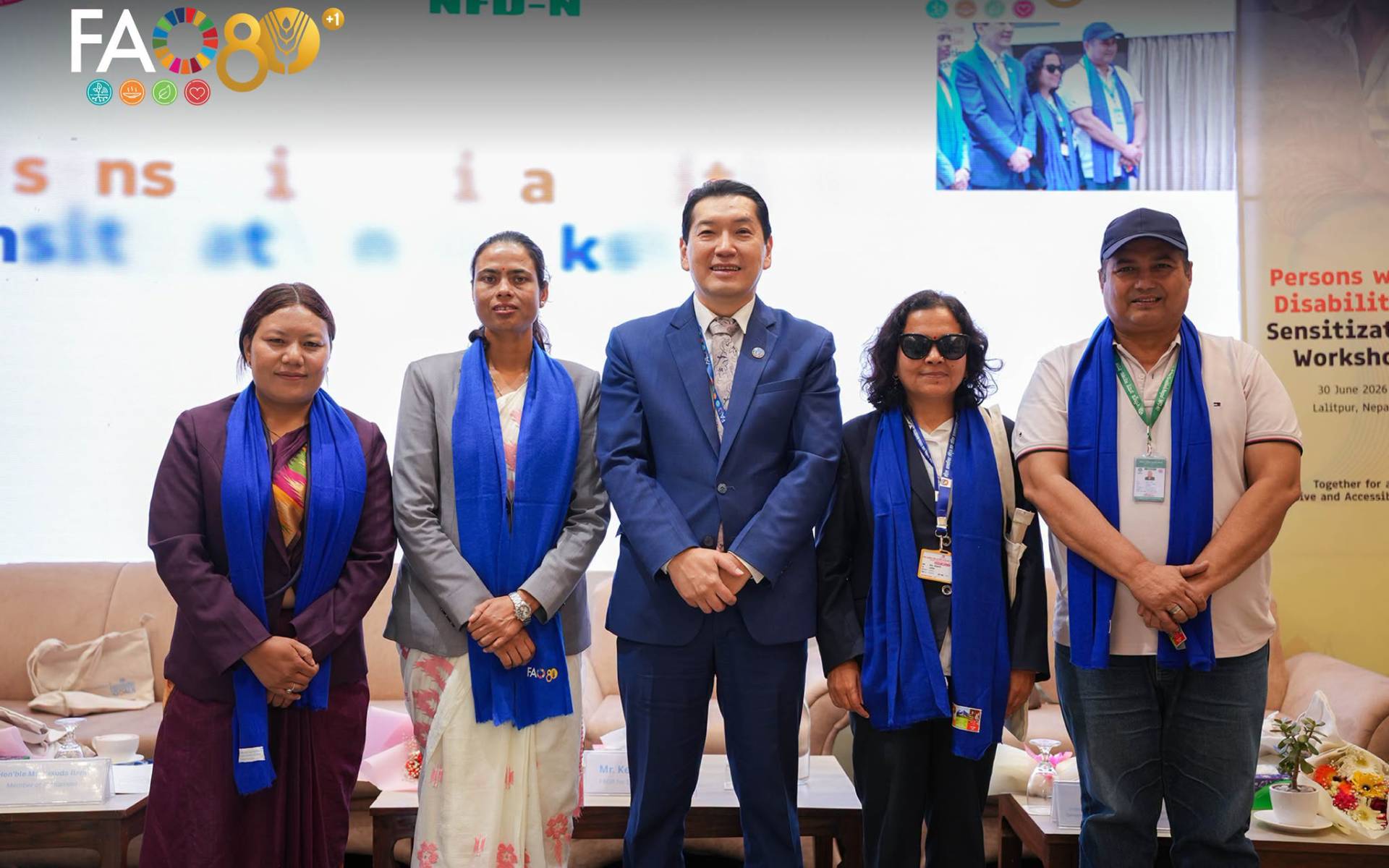
Kathmandu: FAO Nepal, in collaboration with the National Federation of the Disabled Nepal (NFDN) and the Government of Nepal (GoN), convened a dialogue on disability inclusion to strengthen institutional practices, promote inclusive communication, and advance the integration of key frameworks such as the UN Disability Inclusion Strategy (UNDIS) and FAO’s Disability Inclusion Marker across its programmes and operations.
Addressing the dialogue, Ken Shimizu, FAO Representative for Bhutan and Nepal, stated that a transformed agrifood system must be accessible to all. “Disability inclusion is not just a commitment – it is a responsibility we must embed in everything we do to ensure no one is left behind,” he said.
Neera Adhikari, Under Secretary of the Ministry of Women, Children, Gender and Sexual Minorities, and Social Security, highlighted the need for greater accessibility and inclusion to break barriers faced by persons with disabilities, while the Members of the Parliament, Hon. Yasuda Baral and Hon. Ganga Chhantyal, emphasized the importance of stronger policies, equal opportunities, and greater recognition of the rights, contributions, and leadership of persons with disabilities in agrifood systems.
As resource persons for the technical sessions, Manoj Gohiwar, Head of Program at NFDN, emphasized that disability is shaped by environmental barriers and attitudes, highlighting the importance of creating more inclusive environments, while Jileshan Saha, Lecturer in Inclusive Education at Kathmandu University, underscored that food security cannot be achieved unless persons with disabilities are fully included in agrifood systems and livelihood opportunities.
Guided by the Do No Harm principle and proactive twin-track approach, FAO Nepal stated that they continue to translate global commitments into meaningful local action, recognizing that sustainable and resilient agrifood systems must be accessible, inclusive, and responsive to the needs of persons with disabilities.