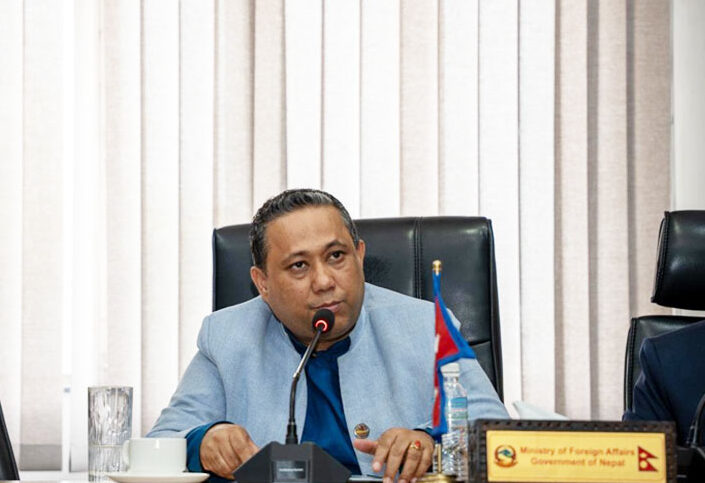
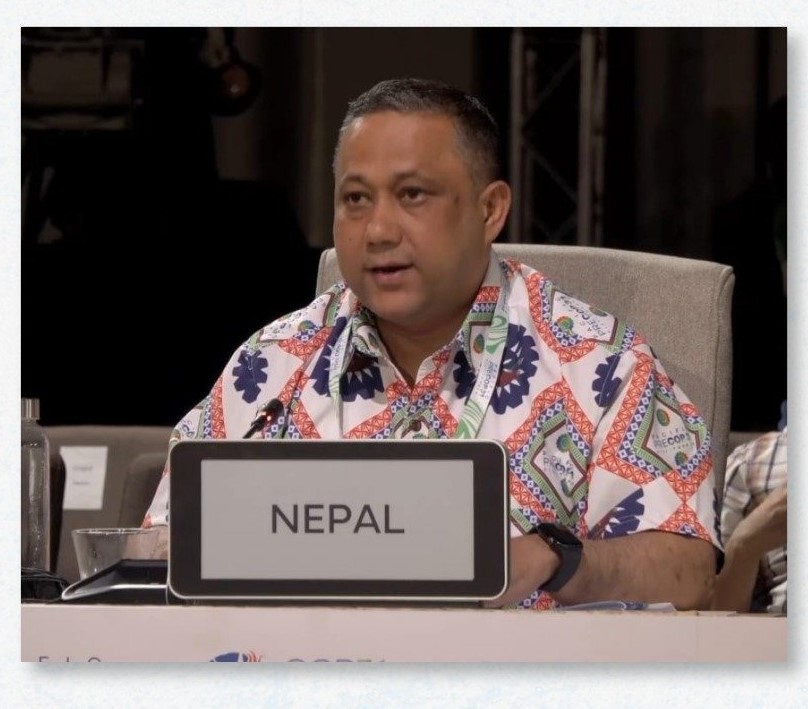
Kathmandu: Hon. Foreign Minister Shisir Khanal has called for stronger cooperation between Himalayan and Pacific island nations to address the shared impacts of climate change, urging global leaders to turn common climate vulnerability into collective action and climate justice.
Addressing the plenary of the Pre-COP Leaders’ Event in Fiji on October 6, Minister Khanal said mountains and oceans should not be viewed as separate climate systems but as part of an “indivisible planetary continuum” connected by the water cycle and a shared future.
“From Sagarmatha to the Sea, one warming planet is transforming our lives, our landscapes, and our future,” Minister Khanal said, highlighting the common vulnerabilities of Nepal and Pacific island states such as Fiji and Tuvalu.
The Minister referred to the devastating Bhotekoshi-Trishuli floods as a stark example of the growing climate risks facing mountain communities. He described the disaster as a “Himalayan Tsunami”, saying that a sudden high-altitude glacial and rock collapse had unleashed a massive, sediment-laden flood downstream.
According to him, the disaster caused extensive loss of life, displaced communities and damaged critical infrastructure, including highways and hydropower facilities.
Drawing a parallel with the Pacific, he said island nations were confronting rising sea levels, increasingly severe cyclones and other climate-related threats.
“Our vulnerabilities are not identical. But our stakes are shared,” the foreign minister said, stressing that the melting of mountain ice has consequences far beyond the Himalayas. “Mountains and oceans are not opposites. They are one water, one story, one shared future.”
He also highlighted the fundamental inequity of the climate crisis. He noted that countries such as Nepal, which have contributed little to global greenhouse gas emissions, are bearing a disproportionate share of the resulting losses. “Our nations contribute negligible to global emissions. Forty six percent of 46%Nepal’s land is covered by forest and 70% of new consumer vehicle is electronic, all our electricity comes from hydro. Yet our people pay with their lives and development gains for a crisis they had no hand in creating,” he said. “This is the very definition of climate injustice.”
Ahead of COP31 in Antalya, Turkey, Minister Khanal outlined four priorities for Nepal: preserving the 1.5°C temperature goal, securing predictable, grant-based adaptation finance, fully capitalising and operationalising the Loss and Damage Fund and establishing a formal “Sagarmatha to the Sea” partnership between mountain and ocean nations.
He said the proposed partnership could promote cooperation, knowledge-sharing and a stronger collective voice for countries on the frontline of climate change.
Minister Khanal invoked traditional forms of community cooperation in Fiji and Nepal. Referring to Fiji’s Solesolevaki—a tradition of collective effort—and Nepal’s Shramadāna, or voluntary community service, he called for greater solidarity in responding to the climate crisis.
“Let us turn our shared vulnerability into shared action; our shared challenges into shared solutions; and our solidarity into a stronger voice for climate justice,” he said.
Minister Khanal urged participating leaders to carry a united message to COP31, saying the climate crisis was no longer a distant threat but a present reality requiring an equally urgent and coordinated response. “The climate crisis is already here,” he said. “Our response must be equally urgent, equally united, and equally ambitious.”