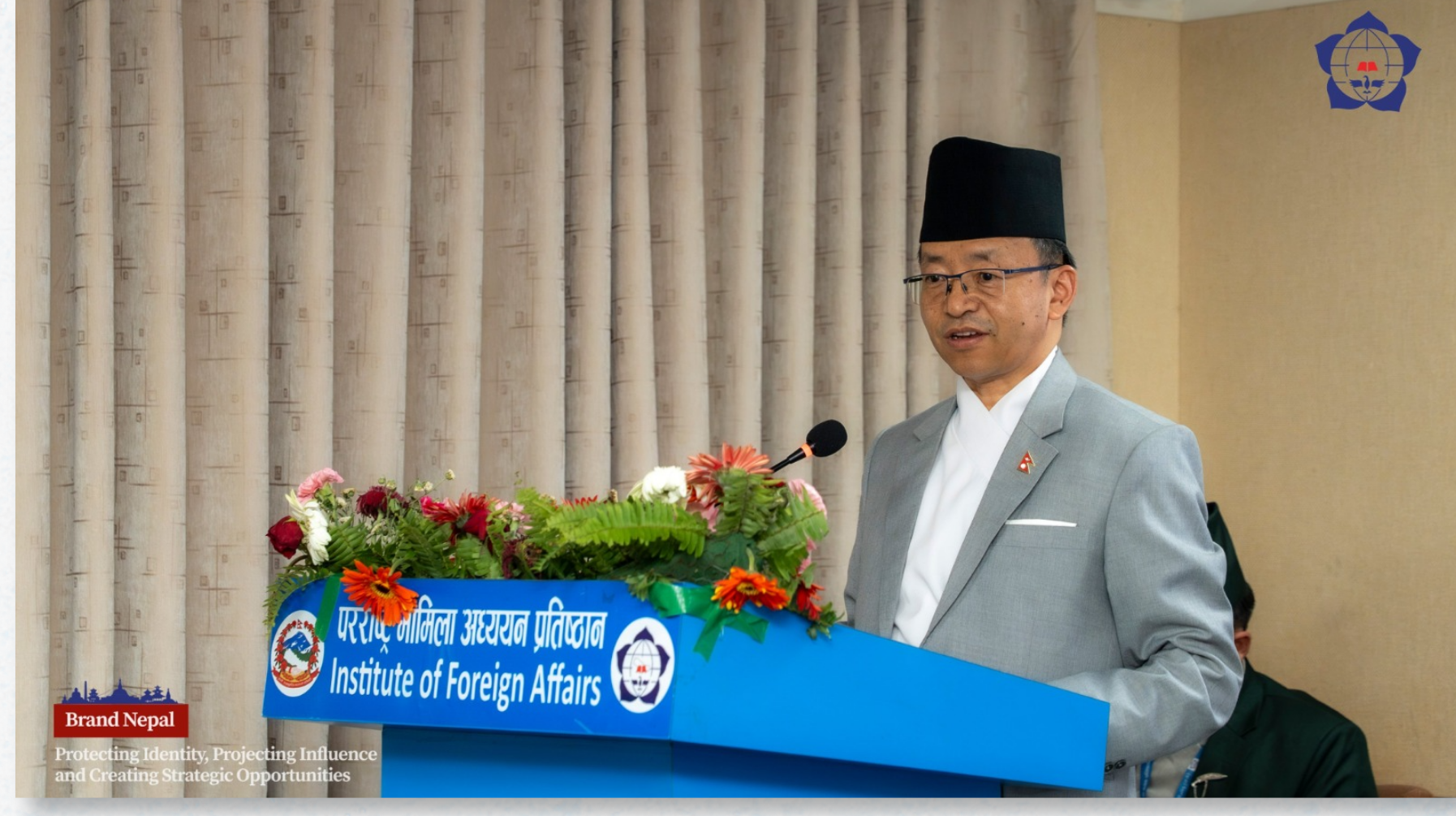
Kathmandu: Nepal needs to broaden and strengthen its national narrative by projecting not only its mountains and cultural heritage but also its resilience, knowledge, climate experience and contributions to global affairs, Foreign Secretary Amrit Bahadur Rai said.
Addressing the closing ceremony of a three-day seminar on “Brand Nepal: Protecting Identity, Projecting Influence and Creating Strategic Opportunities” at the Institute of Foreign Affairs (IFA) in Tripureswar on September 30, the Foreign Secretary said Nepal’s international identity should reflect the realities it faces, the knowledge it possesses and the contributions it can make to global conversations.
Referring to the devastating Bhote Koshi floods, which caused loss of life, infrastructure damage and disruption to economic and social activities, the Foreign Secretary said the disaster, along with other recent calamities, had highlighted Nepal’s vulnerability to complex climate and environmental risks.
“At the same time, it has demonstrated our resilience, community strength, preparedness and the importance of international cooperation,” the Foreign Secretary said.
The Foreign Secretary said Nepal should be known not only as a country of high mountains but also as a country of mountain knowledge, climate experience, living civilisation, cultural diversity, resilience, peace and constructive international engagement.
Nepal already possesses a wide range of assets that contribute to its soft power, including the Himalayas and Everest, Lumbini, living heritage, Hindu and Buddhist traditions, cultural and linguistic diversity, hospitality and adventure, the Foreign Secretary said.
Other assets, including Nepal’s contribution to UN peacekeeping, community forestry, traditional knowledge, Himalayan and climate knowledge, wellness traditions, creative industries, young people, innovation, diaspora networks and emerging capabilities in science and technology, also deserve greater recognition and systematic communication, the Foreign Secretary added.
“The task is not to replace one narrow narrative with another, but to enrich the Nepal narrative,” he said, stressing the need for a coherent, credible and authentic national identity.
He said promoting soft power is an important component of Nepal’s foreign policy, with economic diplomacy, trade and investment, tourism, technology, education, culture, climate diplomacy and the interests of Nepali citizens abroad all depending partly on how effectively Nepal communicates what it offers.
The establishment of the Public Diplomacy Division at the Ministry of Foreign Affairs last year has provided an institutional basis for communicating Nepal’s natural, cultural, historical and civilisational heritage and engaging international audiences more systematically, he informed.
Nepali diplomatic missions abroad also have an important role in the Brand Nepal campaign, the Foreign Secretary said, describing them not only as representatives of the country but also as “listening posts, relationship-builders, opportunity connectors and platforms” for presenting Nepal’s identity, capabilities and priorities.
The Foreign Secretary emphasised that Brand Nepal could not be created by the Ministry of Foreign Affairs alone and required a “whole-of-government and whole-of-society effort” involving public institutions, the private sector, academia, cultural institutions, communities, media, creative sectors, the diaspora and citizens.
The Foreign Secretary also noted that the Foreign Minister’s participation in more than 80 major conferences, meetings and bilateral and multilateral engagements during the period had provided opportunities to present Nepal’s priorities and perspectives to the international community.
The three-day seminar discussed how Nepal is perceived internationally, ways to broaden its national narratives, new pillars of soft power, key international audiences and ways of tailoring messages to tourists, investors, governments, universities, cultural institutions and the diaspora.
The Foreign Secretary called for moving “from narrative to delivery, from identifying strengths to demonstrating them, from promotion to proof, and from individual initiatives to sustained national effort.”
The Foreign Secretary also noted that Brand Nepal had been incorporated into the Government’s Policy and Programme for FY 2083/84 as a shared national responsibility, including through the Brand Nepal Campaign and the role of Nepali diplomatic missions abroad.
“Nepal possesses an extraordinary range of natural, cultural, civilisational, intellectual, human and diplomatic assets,” the Foreign Secretary said. “Our task is to recognise them, protect them, communicate them effectively and, where appropriate, convert them into sustainable value and opportunity.”
The Foreign Secretary stressed that the stories Nepal tells the world must be reinforced by the policies, institutions, standards, products, services and experiences encountered by international audiences.