
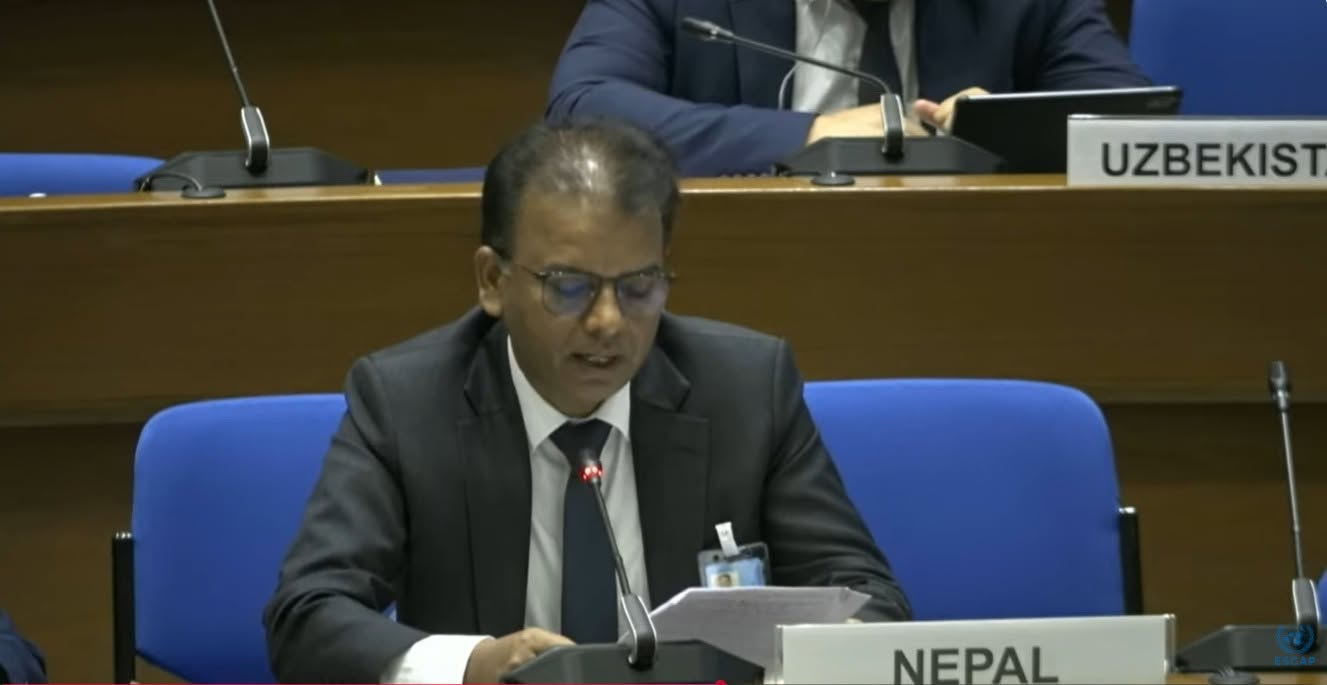
Kathmandu: H.E. Dhan Bahadur Oli, Ambassador of Nepal to the Kingdom of Thailand and Permanent Representative to the United Nations Economic and Social Commission for Asia and the Pacific (UNESCAP), attended the 5th Session of the Committee on Information and Communications Technology, Science, Technology and Innovation on September 2. The 5th Session of the Committee is being held in Bangkok, Thailand from September 2 to September 4 and discussed the Asia-Pacific digital transformation landscape; the Action Plan for Implementing the Asia-Pacific Information Superhighway Initiative, 2027–2030; the Review of the Implementation of the Astana Ministerial Declaration on Digital Inclusion and Transformation in Asia and the Pacific.
In the session, Ambassador Oli shared the current situation following the devastating disaster that occurred in Nepal on 26 August 2026, describing it as a “Himalayan Tsunami” of an unprecedented magnitude, far greater than a conventional flood. He stressed that Nepal has been bearing the severe consequences of such disasters despite its negligible contribution to global greenhouse gas (GHG) emissions. He underscored the importance of resilient connectivity and robust digital infrastructure for a country like Nepal, particularly when conventional infrastructure is damaged or cut off. In such circumstances, communication can make the difference between receiving a warning and receiving none, between locating those in need and losing contact with them, and between a coordinated emergency response and one that is severely constrained.
He called upon the international community to support Nepal in establishing an integrated, multi-hazard early warning system powered by modern information and communications technologies (ICT), satellite technologies, and artificial intelligence. Such a system would monitor risks across the Himalayas and downstream river basins, provide timely and accurate warnings, and ensure that alerts reach every vulnerable community through reliable last-mile connectivity, thereby enabling a shift from disaster anticipation to effective disaster response.
Ambassador Oli encouraged ESCAP, UN agencies, other development partners, international financial institutions, and other stakeholders to support these technologies as shared regional digital public goods, backed by capacity-building, technology transfer, and predictable financing. He reaffirmed Nepal’s commitment to working with all countries and partners to build a safer, digitally connected, and climate-resilient Asia-Pacific region.
The Chair of the Committee, Heads of Delegations from various countries, and the Executive Secretary of UNESCAP expressed their condolences and assured Nepal of their support during this difficult time. Ambassador Oli acknowledged the condolences and expressed his appreciation for the support and solidarity extended to Nepal.