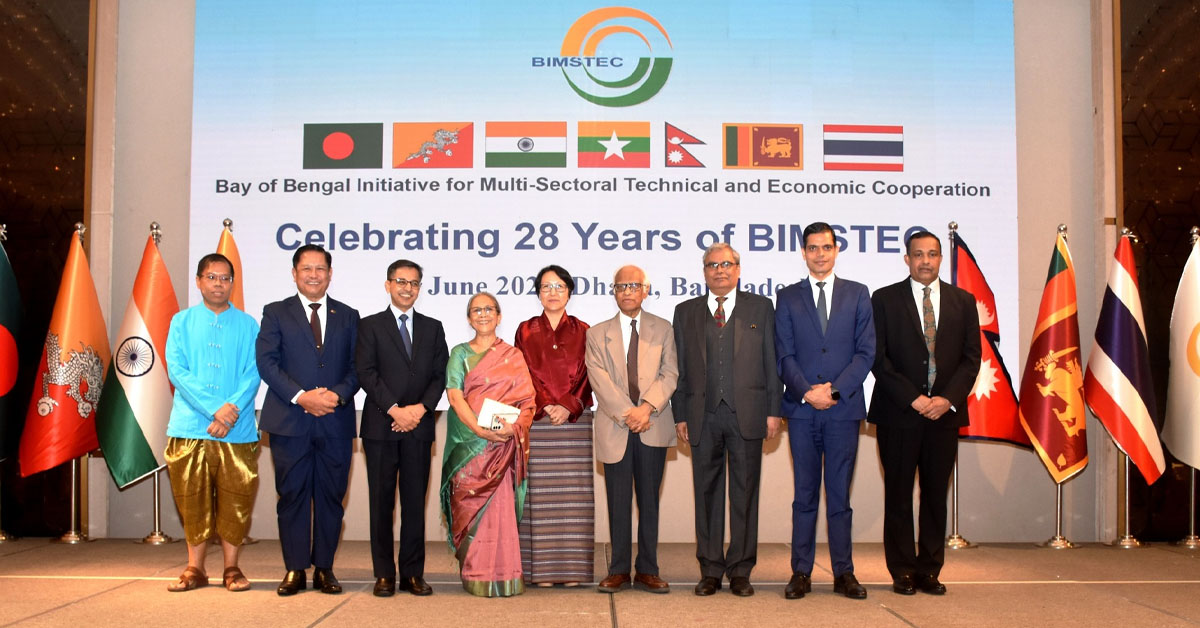
Most people compared the Bay of Bengal Initiative for Multi-Sectoral Technical and Economic Cooperation (BIMSTEC) with the South Asian Association for Regional Cooperation (SAARC) as an alternative regional organisation. But that is not true. BIMSTEC is a regional organization that has been bridging between South and Southeast Asia. It is not an alternative to SAARC, rather it is an essential regional organization for cooperation across the regions.
The organization, which was established in 1997, has gained momentum after 23 years of waiting for the adoption of the Charter. The BIMSTEC Charter was signed and adopted during the fifth BIMSTEC Summit held virtually in Colombo, Sri Lanka, on 30 March, 2022.
BIMSTEC was formed with the Bay of Bengal, Bangladesh, India, Sri Lanka and Thailand. Later, it included Myanmar, Bhutan and Nepal as members to foster regional ties and prosperity. In 1998, Nepal joined BIMSTEC as an observer and became an active member in 2004. Since then, Nepal has been successfully holding and participating in BIMSTEC summits and other minister-level and official-level programs.
BIMSTEC members work together for regional cooperation in sectors such as sustainable development, economic cooperation, energy cooperation, climate change, technology, innovation, cultural exchanges, historical ties, disaster management, humanitarian crisis, maritime security and cross-border security.
BIMSTEC consolidated its 14 priority areas for regional collaboration into seven core sectors in efforts to enhance effectiveness and coordination among member states. The decision was endorsed during the fifth BIMSTEC Summit. Under the revised structure, the seven core sectors are supported by 14 sub-sectors, with a member country leading each of the sectors.
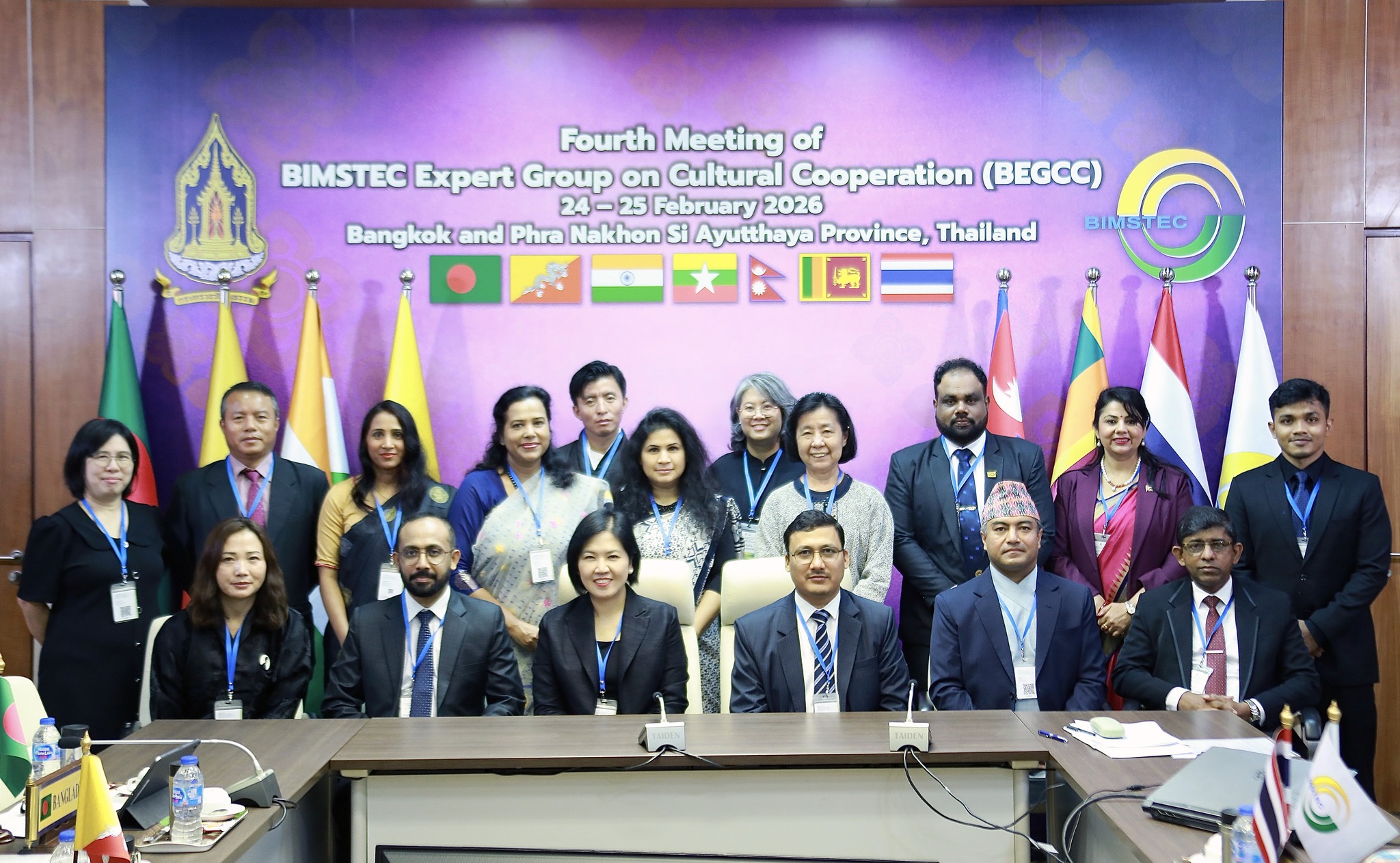
BIMSTEC is well-positioned to become a dynamic and vibrant regional organization as a legally binding Charter and well-established decision-making structure, including Summits, Ministerial and Senior Officials’ Meetings, the Permanent Working Committee, and various sectoral Working and Expert Groups.
The latest 6th BIMSTEC summit was held on 4 April, 2025, in Bangkok under the theme “Prosperous, Resilient, and Open BIMSTEC”, focusing on promoting collaboration among the member states to address shared security and developmental challenges.
There have been five summits so far: 2004 (Bangkok), 2008 (New Delhi), 2014 (Nay Pyi Taw), 2018 (Kathmandu), 2022 (Colombo), and 2025 (Bangkok) respectively.
BIMTEC is an intergovernmental organisation aimed at fostering economic and technical cooperation among member States and has focused on assisting its member States in realising the SDGs of Agenda 2030, as reflected in its vast and diverse agenda. BIMSTEC has a high priority for cooperation in economic, technical, and climate change.
By deepening cooperation across these areas, BIMSTEC can help member States tackle their shared challenges across the region. BIMSTEC is poised to grow into a vibrant platform for advancing peace, prosperity, and resilience in the Bay of Bengal region. The differences between individual countries or member states should not hamper this regional organisation. Firstly, the bilateral disputes should be solved through diplomacy and dialogue, and if that is not possible for now, those disputes should not enter into other forms.
BIMSTEC should be proactive in bridging between South and Southeast Asian countries for regional prosperity and stability.