Various Indian diplomats, scholars and journalists have extensively written on Nepal’s issues. For instance, most recently, Indian diplomat Ranjit Rae’s ‘Kathmandu Dilemma’ came out in 2021 and public scholar SD Muni wrote ‘Foreign Policy of Nepal’ in 1973. From a journalistic background, Girilal Jain wrote ‘India Meets China in Nepal’ in 1959.
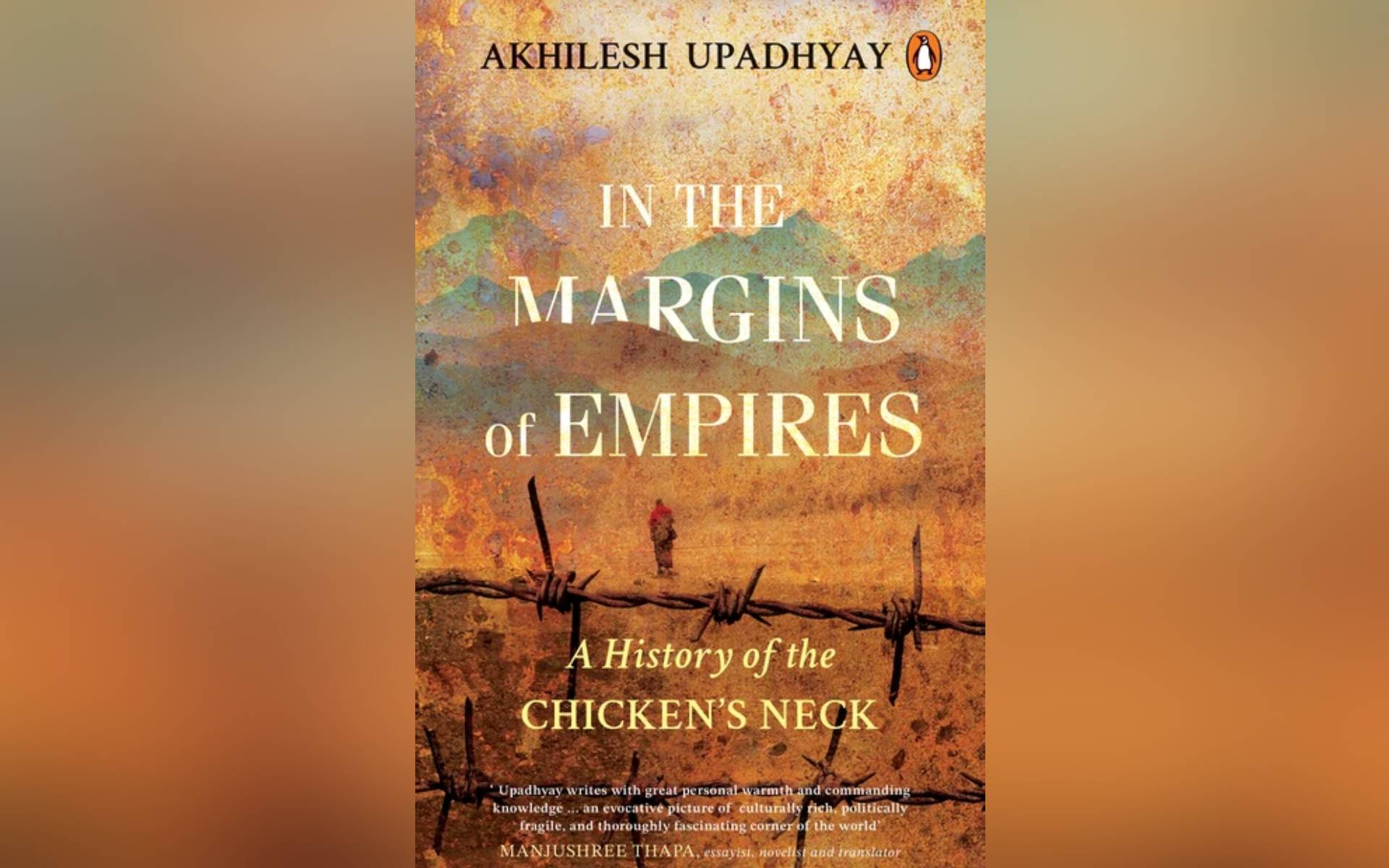
Not many Nepalis have written about India’s issue. Proven editor and author Akhilekh Upadhyay has, fortunately, written a fresh book on India issue. ‘IN THE MARGINS of EMPIRES: A History of the CHICKEN’S NECK’. Published from Penguin Random House India, Upadhyay’s debutant book is partly a history of Chicken’s neck, partly story of the Himalayan cultural camaraderie from Nepal, India and Bhutan and partly a research-based traveler’s field footnotes.
Chicken’s neck is also known as India’s Siliguri corridor with 22-kilometer-width and 60-kilometer-length and the strip of this South Asian region borders four countries: Nepal, Bangladesh, Bhutan and China. The crowds of the countries in its proximity and the confluence of the various cultures makes this region geopolitically sensitive and culturally diverse which is always an issue of constant curiosity for many.
Born in the immediate geographical and cultural proximity of the Chicken’s neck (East Nepal’s Jhapa district), author is naturally fit to tell the tales and trails of Chicken’s Neck. His first glance of car, cinema and railway station was in Siliguri, the epicenter of the Chicken’s Neck. His journalistic career also saw major events in the region. He started writing in the 1990s for Kathmandu-based media outlets when his locality was flooded with Nepali-speaking refugees from Bhutan, locally known as ‘Lhotshampas’ which means ‘people from the South’. When he was Editor-in-Chief at Nepal’s largest-selling The Kathmandu Post, he witnessed India-China Standoff at Bhutanese territory of Doklam. From Nepal-Bhutan issues of refugees to border issues of Asian giants China and India, the author has tried his best to picture the geopolitical friction in this fragile fringe of the Himalaya since the period of ‘the Qing from the North, the British from the South and Gorkha expansion in between, contested for space and influence.’
The book is not all about the chronological events of the Chicken’s Neck, nor is it a political history of the region. Still, it has much more to offer than mere historical events and geopolitical upheavals. The author treks to the local territory with the locals and also talks about the history and contemporary events. He picks Shankar Chhetri Luitel and Raju Karki, bordering Nepali citizens from Jhapa, to tell the story of transboundary connectivity between Nepal and India. He narrates the story of Nepali-speaking Indian citizen, Sanjay Gurung, to talk about Siliguri vibration and brings in story of Sunita Gurung, Nepali-speaking Bhutanese running café at India’s Jaigaun to tell how Nepali language is like a sort of Chicken’s Neck bridge in the region. He walks with Tashi, a Nepali from Olangchung Gola to narrate Tibet-Nepal-Sikkim-Bhutan ties from the ancient time.
He has told a story not just from the transboundary human movement but also from the transboundary movement of the animals: yaks and elephants. This gives a unique lens to look at the Himalaya not just as the barrier but also as the bridge.
From CIA-recruited Khampa fighters troubling China from Nepal’s North and China’s hold on Tibet to the Nepali-speaking Sikkimese advocating for merger into India to Bhutan’s expulsion of Nepali-speaking citizens, author Upadhyay has dived deep into many points of the history to highlight the Chicken’s Neck as the witness of all of these events. Everest debate between Nepal and China and border woes of India and China are also presented beautifully in this ‘blending reportage, history and lived experience, it illuminates why the margins often hold the key to South Asia’s future’ as said by Sudheer Sharma.
This book is rich in citations and references making it equivalent to some of the great academic writings of our time. Chicken’s neck is not just the friction point of big powers like contemporary republics India and China and erstwhile Qing and British empires, it is also a flashpoint between small states as seen from the histories of Gurkha-Sikkim and Sikkim-Bhutan wars to Nepal-Bhutan refugees’ tension.
The author rightly says, ‘The Himalayan triad—Nepal, Bhutan and Sikkim—is no longer a passive buffer zone. It is a dynamic geostrategic frontier where infrastructure, migration, technology and identity intersect.’
Despite trying his best for factchecking and independent narration, the author has slipped at times. He has described Nepal’s Prime Minister Prachanda’s 2023 India visit as ‘head of state’ on page 33, he was actually head of the government. The author has focused on ‘Hindutva’ politics of India’s ruling BJP but does not shed light on increasing Christian proselytization in the Chicken’s neck region.
In a nutshell, this is a must-read book for all those living in Bangladesh, Bhutan, India and Nepal region. The book is equally an important read for those who wish to understand the Himalaya and study it, as said by Chuden Kabimo, the recent Madan Puraskar 2081 winner.
Upadhyaya’s book inspires many aspiring Nepali authors, diplomats and journalists to look at the bigger picture of the region in their writings in the days ahead.