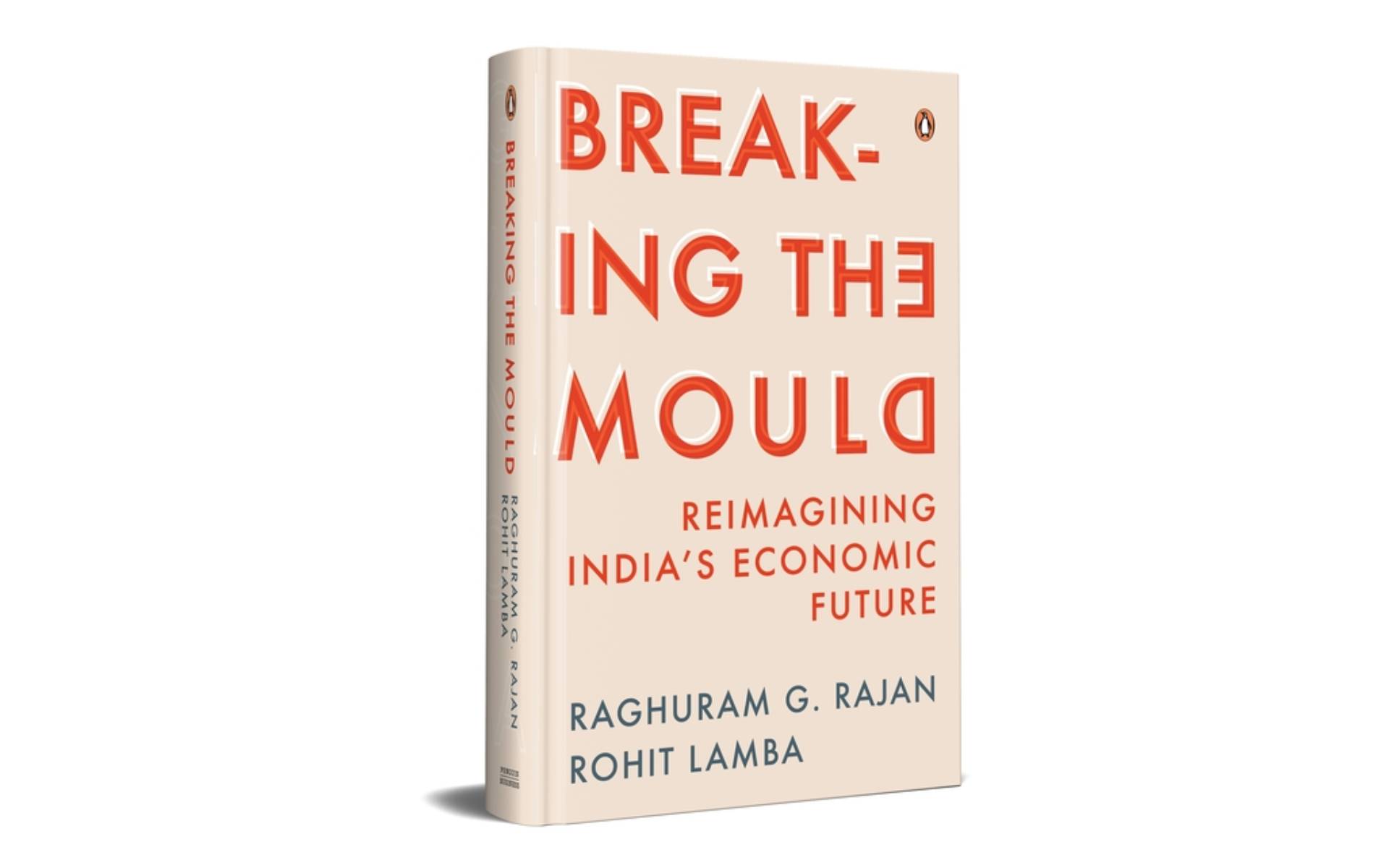
The book, “Breaking the Mould: Reimagining India’s Economic Future,” is co-authored by Dr. Raghu-ram G. Rajan, former Governor of Reserve Bank of India, Chief Economist of the International Monetary Fund, now at the University of Chicago as well as Dr. Rohit Lamba, an assistant professor of economics at Pennsylvania State University and a visiting assistant professor of economics at New York University Abu Dhabi. He has also worked as an economist at the office of the chief economic adviser to the Government of India.
Published in 2023 by Penguin Random House India, this 297-page book has an introduction and three parts across 13 chapters, mapping where India stands today and outlining a to-do list for its aspirations to be a global super power.
Major Arguments:
The micro level information and analysis in the book is testament to the authors’ academic expertise and work in the Indian Gov-ernment. They present the situation, anom-alies, and also provide recommendations on improvements for sections such as education and health system of India.
Authors call for investing in human capital through quality health and education so that it can contribute to high productivity of India.
Even though India produces 80,000 medical doctors every year, problems exist at all three levels of treatment: primary, secondary, and tertiary. And every year students go to China, Ukraine, Russia, Philippines, among others countries, to study medicine because of the lack of quotas and medical universities in India.
They also mention good practices such as JaJan Swasthya Sahyog, Aravind Eye Hospital, Christian Medical College, Vellore, and the recently introduced Pradhan Mantri Jan Arogya Yojana that aim to reduce out-of-pocket expenses on health. It meets a clear need because a health emergency can devastate a poor family and push a lower-middle-class one into poverty. In India, health care is under the jurisdiction of the state and authors stressed for decentralization of health to further local level as states are large entities. They said, “We must recognize that all health is ultimately local.”
As an aspiring global super power, India also needs to improve all benchmarks in every sector at global standards. They talked about the standard development path from agriculture to low skilled manufacturing, then high-skilled manufacturing and finally services. This is the linear path of development.
It is also equally important for Nepal where a large segment of the population is dependent on agriculture. In developed econo-mies, a small portion of the population i.e. less than 10% are involved in agriculture.
They have surplus production and export agro-product given the mechanization of agriculture. If Nepal’s population of around 5 to 10% engage in agriculture then the rest could shift to manufacturing sectors. Then we will also have surplus human resources in manufacturing upon optimum use of technology and then shift towards the service sector. Political stability can catalyze the movement in this direction. Nepal needs to shift into production-based revenue generation and follow the standard path of economic development.
As workers become more skilled and better educated, manufacturers move to more sophisticated goods, such as cameras, motorcycles, cars and machinery, leaving low-skilled manufacturing to newcomer countries on the development ladder. Today Japanese cameras, Korean TVs and Chinese electric vehicles have become global leaders. The authors state that in 1961, India’s income per person was $86, South Korea’s was $94 and China’s was $76 annually but today India’s is around $2300, China’s is around $12,500 and Korea’s is around $35,000. They reason that while India came late into manu-facturing, exporting, and opening its economy to the rest of the world, the other two nations moved earlier.
Another interesting part is about power and authority. The authors state that India always had a more centralized system of governance where the constitution decentralized governance only to the state level. They also mentioned how the License Raj or Permit Raj prevented India from building a manufacturing base.
They give the example of the economic ups and downs in Punjab, how it became successful through Hero Cycles but that it did not sustain because of the role of powerful politicians in Punjab. The entrepreneurs then shifted from Punjab to Haryana and Himachal Pradesh.
About the transformation in trade and services-led development, they took a few interesting examples of Lenskart, Tilfi: selling Banarasi Saris to the world, Cipla and they have suggested to follow manufacturing and services-led together as both are highly intertwined. About 70% of European trade is within Europe, 50% of East Asian trade with East Asian and 40% of North American trade within North America; India also needs to look at nearshoring an opportunity to get on the manufacturing bus.
Explaining about governance, the book mentions that in the US and China, two thirds of public employment is in local government whereas in India it is only 12%. Similarly, local government spending in India is only 3% of total governmental expenditure but it is 27% in the US and 51% in China.
In other chapters they highlighted the capabilities and childhood challenge, specifically about nutrition, schooling and necessary restructuring of schools, improvement in higher education, and vocational skills.
Chapter ten talks about addressing inequality in India where economic inequality is huge. India is the world’s largest country in terms of population but poverty is also equally high. Authors mentioned affirmative action, redesigning reservations, the U-shaped curve and pointed that India is stuck at the lower end of the U-curve.
They also suggested a way forward to address inequality through improving agricultural incomes and resilience, safety nets, direct transfers and the promise of technology and conditional support among others.
The next chapter is more about India’s foreign policy and its engagement with the world. The authors presented soft power vs hard power with examples of the US, China and India.
The chapter also talked about China’s increasing engagement with Nepal, Sri-Lanka and even Bhutan and examples of murals of Ashokan India in the new Parliament, incorporating Paki-stan, Bangladesh and Nepal which has irritated these neighbors. They suggested that India’s Tiger Warriors do not help and need to be sensitive to its smaller neighbors’ concerns and also have given in the context that SAARC is not performing well because of natural fear small neighbors have of being swamped by India. They also suggested that India should start con-voking SAARC before important global meetings to see if there are regional concerns that need to be represented like climate where we all face similar concerns.
They criticize India’s continuous lobbying for a permanent seat on the UN Security Council. They thought that the UN is a weak organization and instead india should offer a new view from the global south of what fair global arrangements can look like. To truly make India as Vishwaguru, they suggested spending more time with South Asia, Africa and Latin America in proposing and architecting a con-sensus, rather than pleading with the industrial west for global issues like creating a World Climate Authority and a Global Migration Organization.
Chapter twelve talks about a creative country where they focused on innovation and creativity and where the government should work as an enabler for creating a conducive environment. The government must enable many to succeed, rather than choosing a few winners.
The third part is in the form of a dialogue where they try to convince their ideas and views registered in previous chapters to reader’s questions. They conclude the book by stating that India is at a crossroads and it should embark on the way that will build India’s strengths rather than weaknesses. The future economy will be based on cre-ativity, innovation and skilled work dependent on the human capital of every citizen rather than augmenting the financial or physical capital of a few wealthy people. Also they stressed the need of an enlightened leadership that can inspire citizens to action. This leadership should preach unity and tolerance not divisiveness and hate.
Conclusion:
The book offers a useful blueprint for Nepal. As a close neighbor with similar constraints, we’ve strayed from the standard development path. The policymakers should pivot to produc-tion-led growth and invest in human capital such as education, nutrition, health, vocational skills, alongside innovation and the creative economy.
A line that resonates: “The greatest problem in international meetings is to get Japanese officials to speak up and Indian officials to shut up. We must speak up but prepare more so that others want to hear us!”