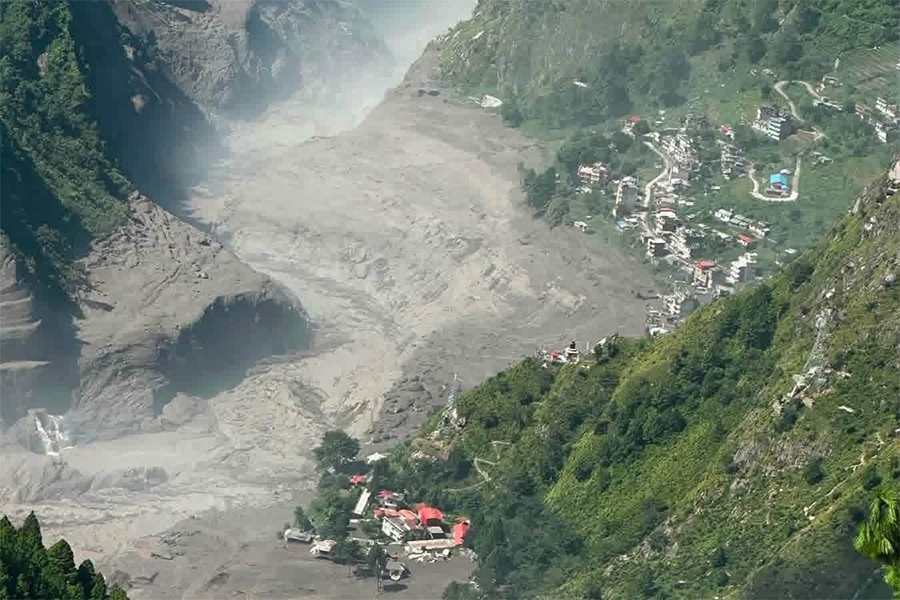
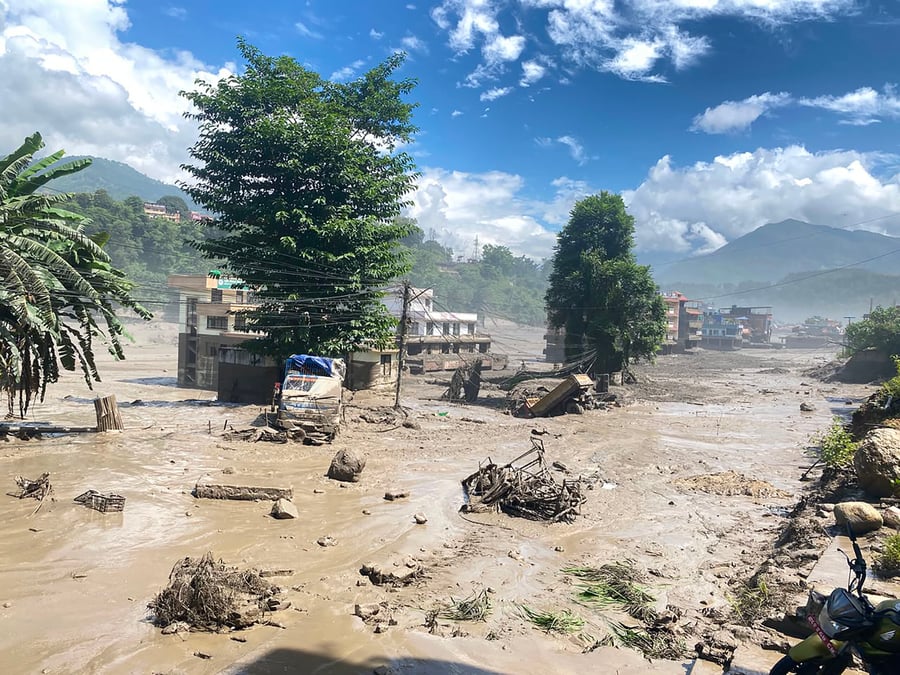
Kathmandu: Chinese embassy in Kathmandu has responded to comments and accusations that China failed to warn Nepal of the mudslide disaster on time. On August 27, the embassy had debunked the fake news that China did not issue early warning to Nepali side and said that an earthquake or earthquake like glacier collapse occurred on the Nepali side on the morning of August 26, 2026, triggering huge mudslides, which caused significant casualties and left people missing on both the Nepali and Chinese sides of the border region. “Accusation helps nothing, cooperation saves lives,” the embassy said.
On August 29, citing the research findings by Chinese and international experts, the embassy said a large number of glacial lakes and ice-rock masses are located in high-altitude frigid zones at elevations of 4,000 to 5,000 meters or above, where routine ground surveys by personnel cannot achieve the same comprehensive coverage as in low-altitude areas. Furthermore, image errors on steep slopes and high-precision monitoring over vast and complex terrains remain international challenges. In addition, the earthquake in Nepal on April 25, 2015 disturbed the rock structures on the southern slope of the Himalayas, increasing the uncertainty of alpine rock masses. Chinese expert teams have always made every effort, within the limits of existing technologies, to conduct monitoring, assessment and analysis, and have shared important information with the Nepali side in a timely manner.
The embassy said Nepal and China have maintained close communication on transboundary disaster management. In May this year, a delegation from the Ministry of Water Resources of China and the Department of Water Resources of Xizang Autonomous Region, visited Nepal and made substantial progress with the Ministry of Energy, Water Resources and Irrigation and the National Disaster Risk Reduction and Management Authority of Nepal in promoting the establishment of a transboundary disaster information-sharing mechanism. In August, a team from the Institute of Mountain Hazards and Environment of the Chinese Academy of Sciences visited Nepal for scientific research exchanges and shared China’s practical experience in glacial lake monitoring.
The embassy said that on August 26, the China Meteorological Administration held an urgent virtual meeting with the Department of Hydrology and Meteorology of Nepal to assess the disaster situation and share data simultaneously. According to the embassy, China is currently continuing to share hydrometeorological information with Nepal, including monitoring data on the barrier lake, to jointly support disaster relief and prevention efforts. The China Meteorological Administration has provided Nepal with preliminary customized services under the “MAZU”, the Chinese Intelligent Meteorological Early Warning Solution, enhancing the two countries’ capacity to respond to transboundary disasters. “These measures fully demonstrate the great importance and sincere attitude of China to Nepal’s needs for disaster prevention cooperation. We are confident that exchanges and cooperation between Nepal and China in these areas will be further deepened, better safeguarding the safety and well-being of the people of our two countries,” the embassy said.