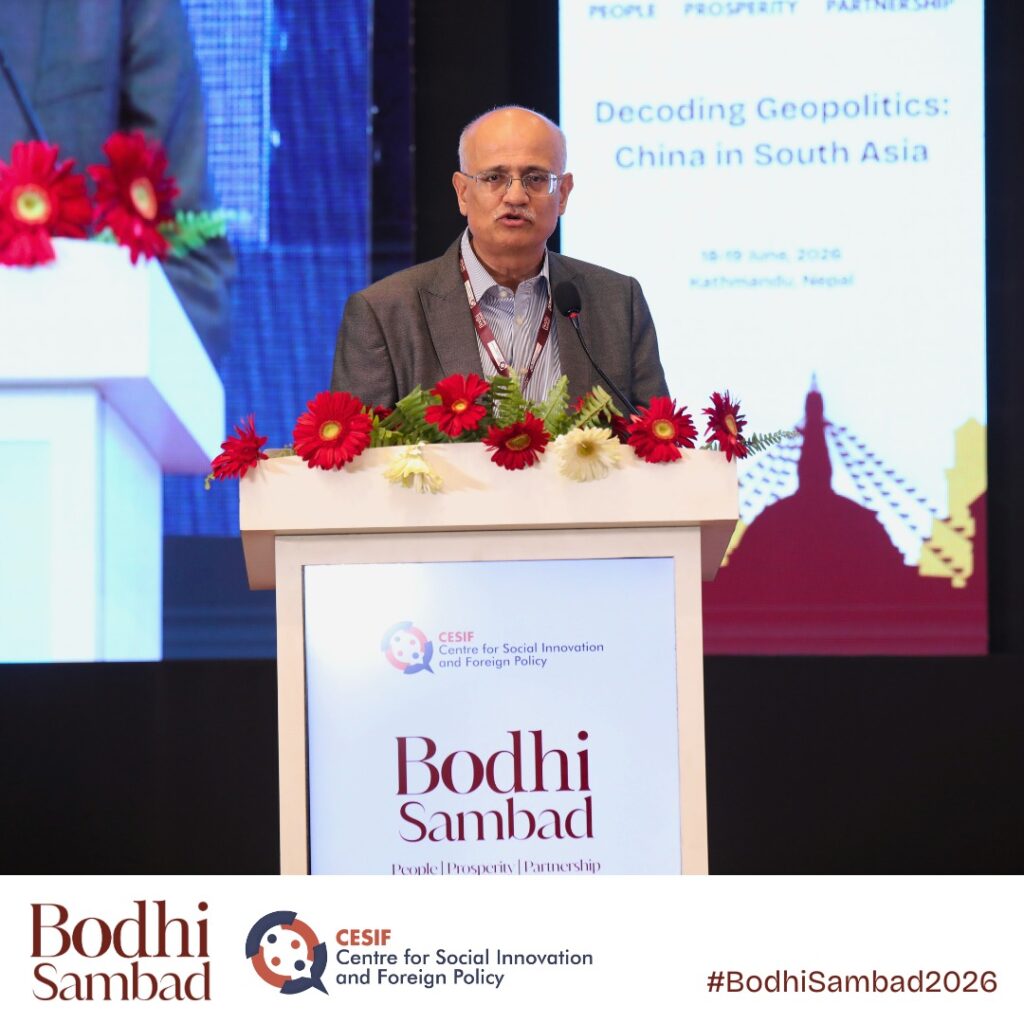
The Bodhi Sambad held in Kathmandu from June 16-19 brought together policymakers, economists, diplomats, scholars, and business leaders from South Asia and beyond to deliberate on Nepal’s economic transformation and the changing geopolitical landscape. The dialogue underscored that sustainable prosperity and strategic autonomy depend not only on geography and diplomacy, but also on capable institutions, informed policymaking, and resilient societies.
For four days Kathmandu became a meeting point for an ambitious conversation about the country’s future. Organized by the Centre for Social Innovation and Foreign Policy (CESIF), the Bodhi Sambad sought to revive the Kathmandu Valley’s historic identity as a neutral intellectual space where ideas are debated through reason rather than ideology. The conference convened ministers, former diplomats, economists, business leaders, security experts, and academics from across South Asia and beyond. Nepal’s economic transformation and the evolving geopolitical dynamics of the region were two key focus areas.
Nepal’s economic moment
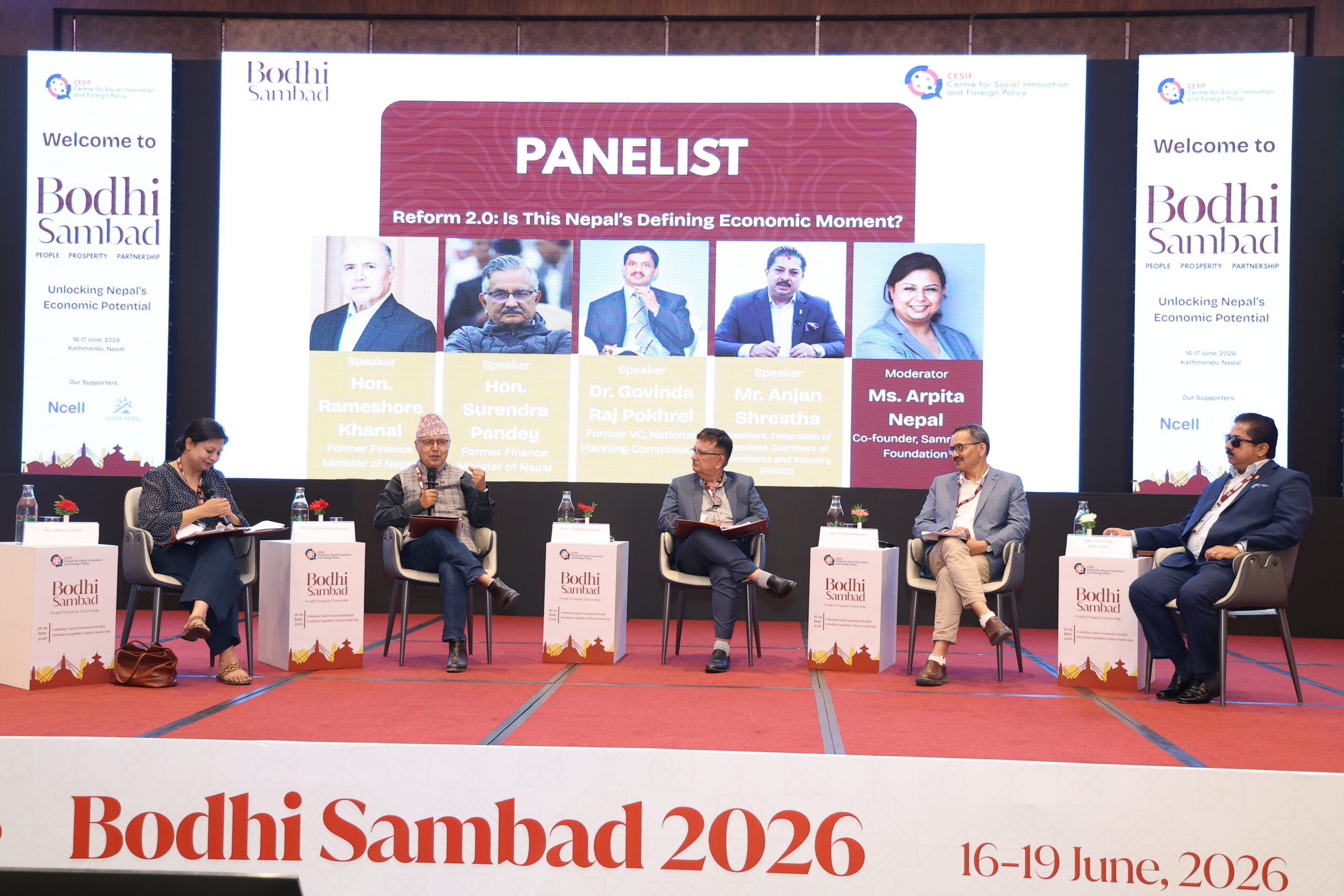
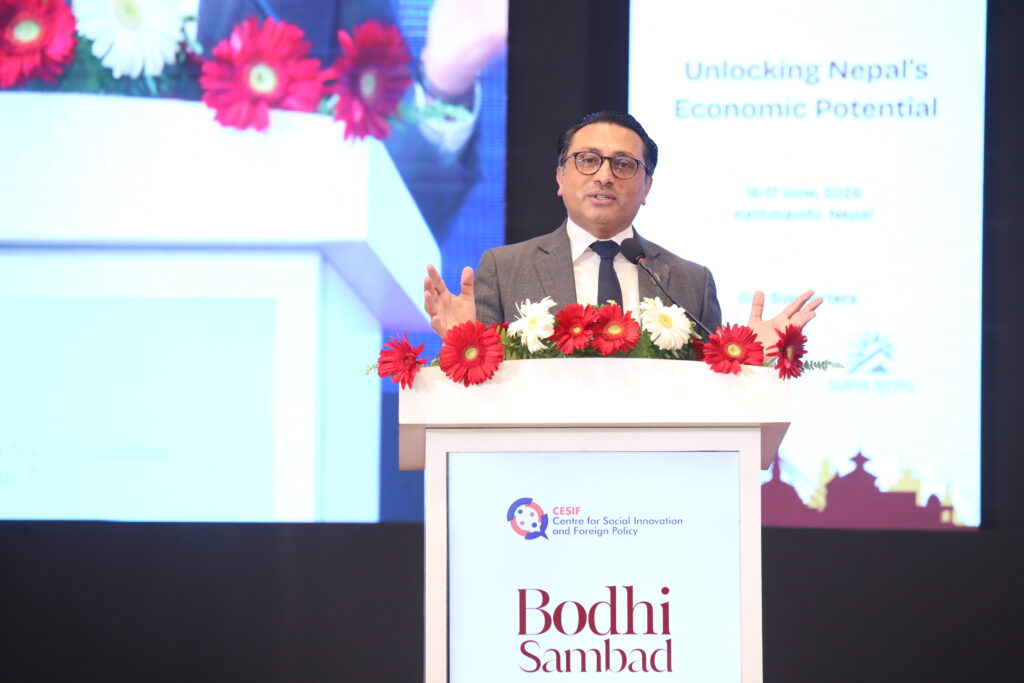
Addressing the opening of the conference, Finance Minister Dr. Swarnim Wagle framed Nepal’s current predicament as both a challenge and an opportunity. He argued that the country stands at a “critical juncture,” where bold political and economic choices can no longer be postponed. With Nepal’s demographic dividend narrowing, he urged policymakers to think beyond short-term political cycles and instead pursue structural reforms capable of transforming the economy over the next decade.
Acknowledging the widespread institutional distrust, Dr. Wagle proposed what he described as “Reform 2.0,” a new development compact that envisions a capable state working alongside a dynamic private sector rather than competing with it. Raising alarm on overdependence on remittance-fueled consumption, he warned, “No nation has ever built a foundation of prosperity by prioritizing consumption over production.”
Rather than viewing Nepal’s limited industrial base and geographic constraints as permanent disadvantages, Wagle argued that the country’s comparative advantages lie in sustainable energy and the digital economy. He proposed integrating Nepal’s vast hydropower potential with artificial intelligence and data centres, allowing the country to move beyond exporting electricity alone toward exporting high-value digital services. Dr Wagle said economic growth requires institutional reform, and institutional reform requires political courage.
Participants highlighted that Nepal has no shortage of policy documents or ambitious plans and the country’s greatest weakness lies in execution.
Former Finance Secretary Rameshwor Khanal sought to put Nepal’s fiscal position into perspective by noting that debt servicing currently consumes only 1.3 percent of GDP, substantially below comparable countries. Yet he argued that institutional design—not debt—is the larger constraint on development.
Representing the private sector, Anjan Shrestha, Senior Vice President of the Federation of Nepalese Chambers of Commerce and Industry (FNCCI), warned that demographic change is rapidly becoming an economic emergency. Nepal, he observed, risks “growing old before growing rich.”
Former Finance Minister Surendra Pandey questioned whether the state should continue operating commercially unviable public enterprises. Rather than attempting to revive factories that no longer possess competitive advantages, he argued that the government should focus on creating an enabling environment for private enterprise instead of selling everyday consumer products through state-owned corporations.
Former National Planning Commission Vice-Chair Dr. Govinda Raj Pokhrel advocated negotiating long-term 10-to-15-year Power Purchase Agreements with India rather than relying on volatile spot markets.
Dr. Shankar Sharma, who served as Nepal’s ambassador to India, warned that Nepal’s capital is becoming increasingly unproductive. Pointing to the country’s worsening Incremental Capital-Output Ratio (ICOR), now estimated at 6.5, he noted that nearly sixty percent of bank lending continues to flow into low-productivity sectors such as real estate. He argued that deeper integration into regional production networks offers one of the few viable paths toward improving productivity.
Dr. Achyut Wagle argued Nepal’s 15.7 million fragmented land plots make genuine agricultural commercialization structurally impossible. He urged policymakers to shift attention from merely enforcing laws to fundamentally improving how laws are designed and enacted.
Offering an important counterpoint, Dr. Sucheta Pyakuryal cautioned against evaluating the state exclusively through financial indicators. “The state,” she argued, exists not only to generate economic returns but to safeguard citizens’ rights. Laws should therefore function as a shield for ordinary people rather than simply instruments of economic efficiency.
Meanwhile, entrepreneur Manish Shrestha illustrated the practical consequences of administrative inefficiency through a simple but powerful example. Registering an ordinary startup, he recounted, required navigating seven separate government agencies over the course of a month.
Barriers of transformation
The second day of the conference examined the practical barriers that continue to prevent economic transformation. Delivering a special address, Pranav Kumar Gupta, the International Monetary Fund’s Resident Representative for Nepal, struck a cautiously optimistic tone. While acknowledging that economic growth had slowed to around three percent during FY2025/26 owing to domestic unrest, political uncertainty, and external shocks, he emphasized that Nepal had demonstrated considerable resilience.
Gupta highlighted the successful completion of the seventh and final review of Nepal’s Extended Credit Facility (ECF), describing it as evidence of the country’s continued commitment to macroeconomic reforms. He pointed to improvements in monetary operations, financial sector oversight, fiscal transparency, and governance, while stressing that sustaining reform momentum would be essential for preserving macroeconomic stability.
The discussion on foreign direct investment painted a sobering picture of Nepal’s competitiveness.
Birendra Raj Pandey, President of the Confederation of Nepalese Industries (CNI), warned that Nepal is witnessing gradual “de-industrialization,” noting that manufacturing now contributes less than five percent of the national economy. While neighbouring countries routinely approve investment proposals within one or two months, he observed that investors in Nepal often wait as long as ten months merely to obtain necessary approvals.
Former Industry Secretary and Ambassador Chandra Ghimire argued that improving the investment climate requires more than administrative reform. Nepal’s diplomatic missions, he suggested, must become active instruments of economic diplomacy rather than remaining confined to traditional political engagement.
Representatives of multinational companies reinforced this concern.
According to Saibal Ghosh, Co-Convenor of the Indian Business Forum, said high taxation, delayed government payments, inflexible labour regulations, and policy uncertainty collectively discourage investment.
Outmigration of Nepal’s youth was another topic of discussion during the conference. Rather than viewing migration solely through the lens of foreign employment, participants examined deeper structural problems within education and the labour market.
Human resource expert Mohan Ojha observed that employers frequently expect university graduates to become immediately productive while simultaneously treating workplace training as an unnecessary expense. The resulting mismatch leaves graduates ill-prepared and employers dissatisfied.
Former Minister for Education Sumana Shrestha argued that Nepal has developed a severe case of “credential inflation.” Employers increasingly demand academic qualifications unrelated to actual job requirements, encouraging students to pursue certificates instead of practical competencies. At the same time, she noted that inadequate access to working capital continues to discourage young entrepreneurs from building businesses at home.
Artificial intelligence introduced another dimension to the discussion. Technology entrepreneur Sixit Bhatta warned that rapid advances in AI threaten to eliminate many entry-level programming jobs that have traditionally provided opportunities for young professionals. Rather than resisting technological change, however, he urged Nepal to invest in robust Digital Public Infrastructure (DPI) while ensuring equitable access to AI models so that emerging technologies do not widen existing global inequalities.
Offering a more optimistic perspective, Dr. Sudan Jha of the National Planning Commission outlined government efforts to prepare Nepal’s workforce for this transition. He described plans to train 15,000 export-ready AI professionals, while emphasizing that genuine digital inclusion means ensuring that citizens in remote districts such as Jumla enjoy the same quality of digital access as users in Kathmandu.
The conference devoted considerable attention to the financing challenges surrounding Nepal’s ambitious energy aspirations.
Ganesh Karki, Immediate Past President of the Independent Power Producers’ Association Nepal (IPPAN), cautioned that public enthusiasm for clean energy must be matched by investment in transmission infrastructure.
Quantifying the challenge, Satish Narayan Joshi, Director of Vrock Company, estimated that Nepal faces an annual funding gap of nearly NPR 100 billion merely to modernize its electricity grid.
Suman Joshi, an IPPAN member, warned that international investors remain wary because retrospective tax policies and arbitrary bureaucratic interventions effectively “change the rules of the game” after investments have already been committed.
Former Deputy Managing Director of Nepal Electricity Authority Prabal Adhikari reminded participants that electricity is not merely an economic commodity but a geopolitical one. Despite exporting surplus electricity during the monsoon, Nepal continues to depend on imports during winter, while access to markets such as Bangladesh remains constrained by regional transit realities, he said.
The conference also dwelled on the foundations of a digital economy. Former Nepal Telecommunications Authority Senior Director Anand Raj Khanal noted that Nepal has achieved impressive expansion of broadband and mobile connectivity, extending internet access and 4G services to all seventy-seven districts. Yet physical connectivity alone, he argued, cannot create a globally competitive digital economy.
Nepal Telecommunications Authority Director Min Prasad Aryal highlighted government efforts to extend optical fibre networks across the Mid-Hill Highway while acknowledging that Nepal’s nearly three-decade-old Telecommunications Act urgently requires modernization.
Digital policy scholar Dr. Amrita Sharma noted that Nepal currently ranks second from the bottom in South Asia on the Global Innovation Index. Weak digital trust systems and unreliable energy infrastructure, she argued, continue to undermine the country’s technological competitiveness.
Strategic autonomy and geopolitics
The final two days of the conference broadened the conversation to the changing strategic landscape of South Asia. Rather than treating geopolitics as an external concern detached from domestic governance, participants argued that economic resilience, technological capability, and institutional strength form the foundation of a country’s foreign policy.
CESIF Executive Chairperson Ambassador Vijay Kanta Karna urged South Asian countries to avoid becoming passive arenas for competition among major powers. Drawing inspiration from the Buddhist “middle path,” he proposed a framework for navigating contemporary geopolitics through balance, dialogue, and strategic agency rather than ideological alignment.
The keynote address by former Indian Foreign Secretary Vijay Keshav Gokhale provided a broader regional perspective. He argued that China’s engagement with South Asia has evolved far beyond trade and investment.
Former Foreign Secretary Madhu Raman Acharya observed that China should no longer be viewed as an emerging actor in South Asia but as a permanent strategic reality. Rather than responding episodically to Chinese engagement, he argued, regional countries must develop coherent long-term strategies.
Among the conference’s most forward-looking discussions was the recognition that sovereignty increasingly extends beyond territory into cyberspace.
Enhancing soft power
The conference’s final day shifted from hard power to soft power, examining how history, culture, and democratic values influence contemporary diplomacy.
Former U.S. Assistant Secretary of State Tom Malinowski criticized what he described as the growing tendency toward purely transactional international politics. He argued that smaller democratic countries possess an opportunity to exercise influence disproportionate to their material capabilities by becoming “moral superpowers.”
Historian Professor Ramesh Dhungel argued that Nepal’s significance extends far beyond being the birthplace of the Buddha. For centuries, he noted, Nepal served as a vital bridge transmitting Buddhist philosophy across the Himalayas into Tibet and China. Rather than relying solely on historical symbolism, Nepal could draw upon this living heritage to strengthen its cultural diplomacy.
Journalist Akhilesh Upadhyay said that Nepal’s cultural diplomacy should move beyond the familiar slogan that “Buddha was born in Nepal.” Instead, he argued, the country’s unique traditions of Hindu-Buddhist coexistence and the living heritage of the Kathmandu Valley offer far richer foundations for projecting Nepal’s identity internationally.
Reimagining regionalism
The conference raised a question regarding whether South Asia requires a new conceptual framework. Former Foreign Secretary Shanker Das Bairagi acknowledged that geopolitical tensions have steadily weakened SAARC’s original aspirations.
Former Indian Foreign Secretary Vijay Gokhale argued that countries should organize partnerships around shared interests and practical collaboration.
Professor Lailufar Yasmin of University of Dhaka advocated placing greater emphasis on academic exchanges, Track II diplomacy, and borderland communities rather than viewing every regional interaction exclusively through the lens of state security.
Across four days of discussion, participants rejected the notion that Nepal—or South Asia’s smaller states more broadly—must choose between competing global powers. Instead, they argued that capable governance, diversified partnerships, technological preparedness, and strong democratic institutions provide the strongest foundations for independent foreign policy.