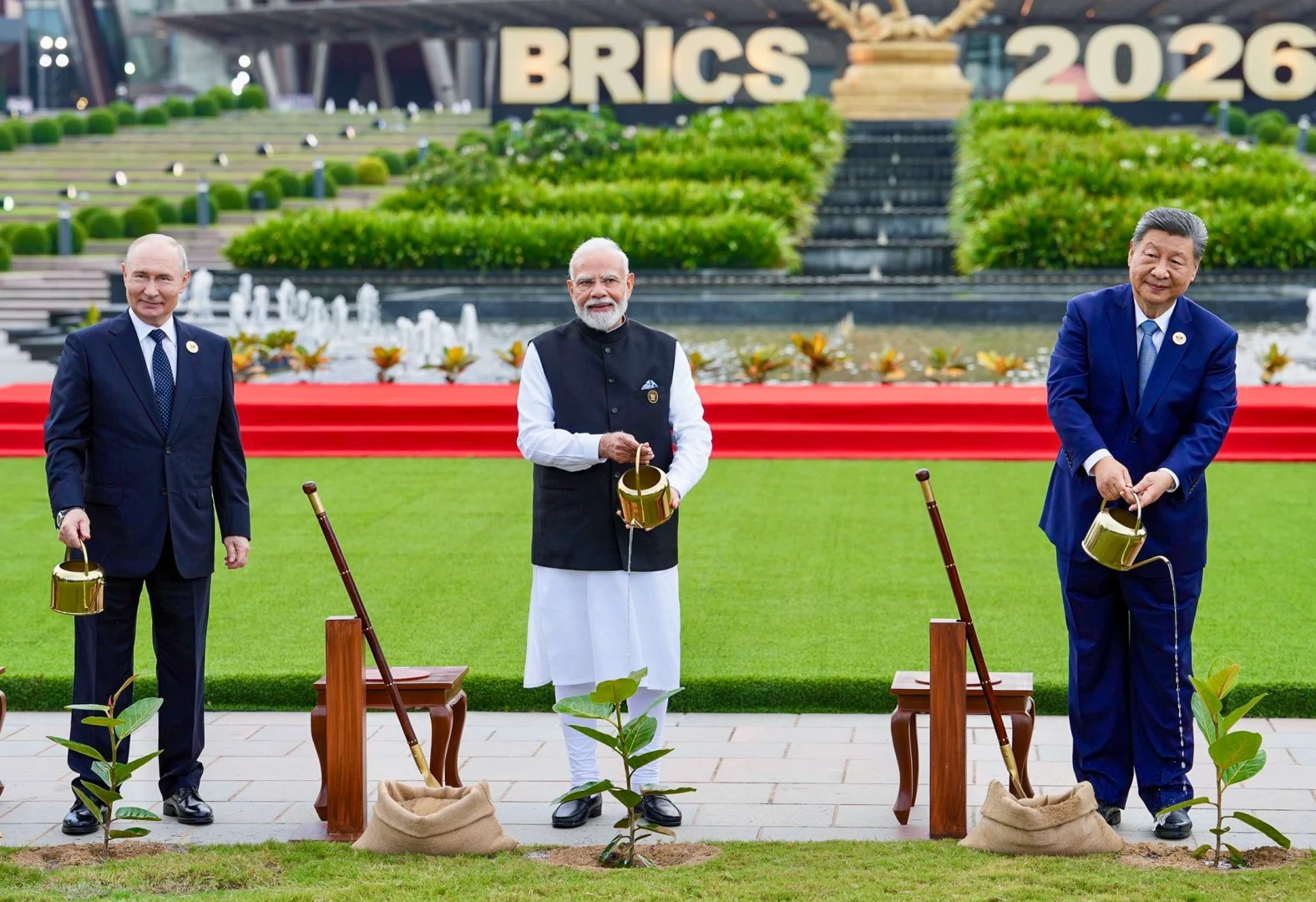
The 18th BRICS Summit in New Delhi is significant not merely because another summit of emerging powers has taken place, but because BRICS has evolved into a broader instrument of Global South diplomacy. Its importance now extends across trade, development finance, infrastructure, energy, technology, climate change and the restructuring of global institutions. India and China are both central to this expanding architecture, making BRICS particularly relevant to South Asia. Against this changing backdrop, the strategic choices of Bangladesh, Nepal and Pakistan deserve examination. Their absence from the core BRICS structure is not, in itself, the central issue. The deeper question is whether their governments are capable of converting geography, economic necessity and diplomatic relationships into national advantage, or whether domestic political calculations and regime interests are increasingly determining their external policies.
The BRICS Summit in Delhi has therefore exposed a much larger question than membership. It has exposed the difference between regime diplomacy and statecraft.
Regime diplomacy seeks immediate political advantage. Statecraft seeks durable national advantage. Regime diplomacy may prioritise external approval, ideological affinity or political survival. Statecraft prioritises employment, trade, security, investment, connectivity and sovereignty. South Asia cannot afford another generation of foreign policy in which the interests of governments are repeatedly confused with the interests of nations.
Nepal’s geography will remain after every government changes. Bangladesh’s economic position will remain after every election. Pakistan’s population, borders and strategic location will remain after every political settlement.
The responsibility of the present regimes is therefore straightforward: use external relationships without becoming dependent upon them, defend national sovereignty without becoming diplomatically isolated, and pursue political power without sacrificing national prosperity.
The most consequential question arising from the Delhi’s BRICS summit is consequently not who was invited and who was left outside. It is whether Bangladesh, Nepal and Pakistan can recognise that geopolitical opportunities belong to the nation, not to the regime that happens to be in power.
For Nepal, Bangladesh and Pakistan, the strategic future will depend less on choosing sides than on becoming strong enough to work with everyone while remaining answerable to their own people. The regime is temporary. Geography is permanent. National interest must therefore come first.
The three countries are different in political structure, geography and strategic orientation, yet they face a remarkably similar dilemma. Governments change, political movements rise and fall, and external alliances evolve, but national geography, economic requirements and strategic vulnerabilities remain.
Foreign policy may not become productive enough when it is designed around the survival, prestige or ideological preferences of a government rather than around employment, trade, investment, security and long-term national development.
India’s importance to Nepal is not simply a matter of political preference. It is the consequence of geography, historical connectivity, economic interdependence, open-border movement and the structure of Nepal’s external trade. Treating every effort by India to deepen economic or diplomatic engagement as ‘Indian hegemony’ risks turning an objective geographical reality into a political slogan.
Nepal’s relationship with India should instead be managed through negotiation, reciprocity and national interest. The same principle applies to China.
The recent devastation in Rasuwa has demonstrated why Nepal’s geographical position can also become a source of diplomatic leverage. The question becomes sharper because the government is preparing for the United Nations General Assembly in New York. Nepal clearly recognises the value of high-level international diplomacy. The UNGA provides a universal platform from which Prime Minister Balendra Shah can speak about climate change, development, sovereignty and Nepal’s national priorities.
Prime Minister Balendra Shah could have used such circumstances to develop a stronger Himalayan diplomatic agenda involving India, China and international development institutions. Early-warning systems, glacier and flood monitoring, resilient infrastructure, emergency communications, disaster-response mechanisms and long-term climate financing are areas where Nepal has legitimate regional interests.
This could also connect Nepal with the broader BRICS and Global South development agenda. The strategic opportunity is to transform vulnerability into influence: Nepal should present itself not merely as a country seeking assistance after disasters, but as a Himalayan state capable of proposing regional solutions.
This makes Nepal’s limited engagement around the New Delhi BRICS Summit more difficult to overlook. Former Prime Minister Pushpa Kamal Dahal “Prachanda” participated in the BRICS-BIMSTEC Outreach Summit in Goa in 2016. Nepal, therefore, has a diplomatic precedent for engaging the wider BRICS-BIMSTEC architecture.
The question today is not whether Nepal had an automatic right to an invitation. It did not. India, as BRICS chair, determines the summit’s outreach arrangements. The question is whether Kathmandu made the maximum diplomatic effort to secure an invitation, an outreach role, bilateral meetings or another meaningful channel of participation. That distinction matters. Diplomacy is not merely the acceptance of invitations. It is the creation of opportunities through lobbying, consultation and agenda-building.
With India hosting the summit next door and China participating as one of BRICS’ most important members, Nepal had a potentially valuable diplomatic window. It could have presented its climate concerns, hydropower potential, disaster vulnerability, connectivity requirements and development-financing needs directly to the major powers assembled in Delhi.
The United Nations provides universal multilateral legitimacy. BRICS provides access to an expanding network of emerging economic powers and development institutions. For a small state seeking greater international relevance, the two platforms should complement each other. If Kathmandu could prepare extensively for New York while a major Global South summit was taking place in neighbouring India, the obvious strategic question is why comparable diplomatic energy was not devoted to securing a meaningful presence around BRICS. Nepal did not necessarily need a seat at the main summit table. It needed to make itself diplomatically difficult to overlook. That is a question of diplomatic capacity, not entitlement.
This leads to the broader South Asian question: What happens when relations between neighbouring countries deteriorate, trade suffers, investment becomes uncertain, borders become securitised and governments divert resources towards defence rather than development?
India’s economic importance to Nepal is principally a consequence of geography. China’s importance to Nepal is increasingly a consequence of economic diversification and infrastructure. Bangladesh needs both regional connectivity and international investment. Pakistan needs wider trade and economic access if it is to generate sustainable growth.
This is why BRICS matters to Nepal, Bangladesh and Pakistan.
This is why BRICS matters to Nepal even without immediate membership.
Nepal can place Himalayan climate resilience, hydropower, disaster management and connectivity on the Global South agenda. Bangladesh can leverage its manufacturing capacity, maritime position and climate experience. Pakistan can use its enormous requirements in energy, water, infrastructure, employment and industrial development to seek broader investment and development partnerships with India.
The objective should not be BRICS membership for prestige. The objective should be access to capital, markets, technology, investment and diplomatic networks.