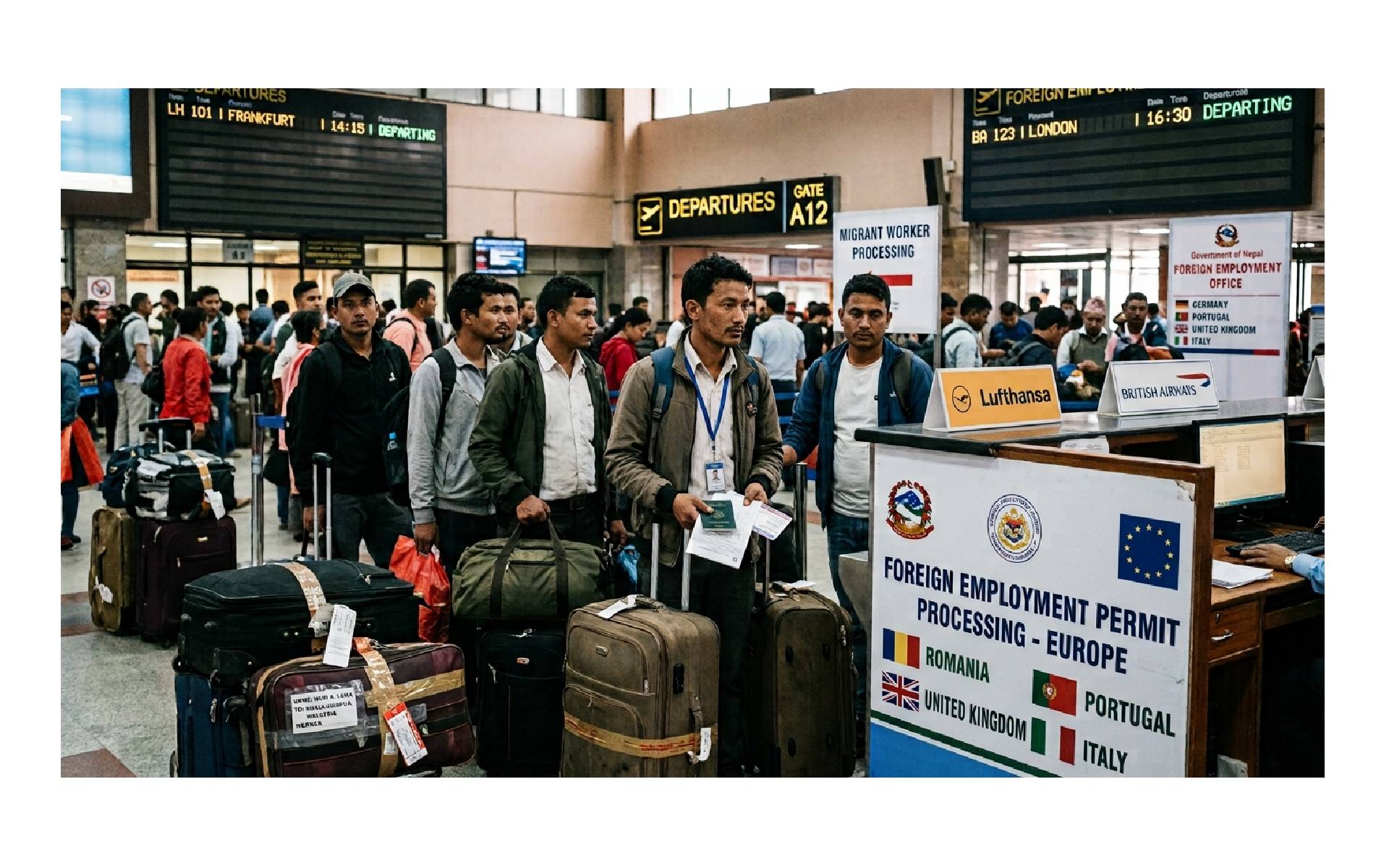
Kathmandu: For a long time, Gulf and South-East Asian countries have remained major destinations for Nepali migrant workers. But a noticeable shift has emerged in recent years, with an increasing number of Nepalis looking towards European countries for employment.
Advanced technological infrastructure, higher standards of education and living, prospects of higher wages, safer working conditions, and superior job prospects, among other factors, appear to have made European nations attractive long-term destinations for Nepalis.
According to a 2024 DW report, between 2019 and 2024, the population of Nepali workers across several European countries more than doubled. Romania emerged as the single largest European destination, experiencing a remarkable 640% surge in Nepali migrants. In total, Romania attracted 24,767 Nepali workers during this period, including 3,144 women, the report said.
Likewise, a joint study by Nepal Economic Forum (NEF) and EU Delegation to Nepal revealed that the Nepal-Europe migration corridor has expanded significantly over the past decade, with labour permits for Europe increasing from just 4,585 in Fiscal Year 2016/17 to above 77,000 in FY 2024/25. At present, an approximately 450,000-500,000 Nepali nationals live across Europe, reflecting the growing significance of Europe as a destination for Nepali workers.
The study identifies several persistent challenges to Nepali migration to Europe, such as migration costs, limited recognition of skills, fragmented governance, and continued reliance on informal recruitment intermediaries.
The research identifies the factors driving Nepali migration to Europe, including better employment opportunities, higher wages, stronger social protection systems, and increasing aspirations for education and long-term settlement. The findings underline the need for policies that better align workers’ skills with labour market needs while ensuring migrants are protected throughout the migration cycle.
The study also places significant emphasis on reintegration, noting that many Nepali migrants return home with valuable skills, professional experience, savings, and entrepreneurial ambitions.
The research claims that the rapid growth of the Nepal–Europe migration corridor presents a valuable opportunity for both Nepal and the European Union adding that Nepal–Europe migration corridor can continue to evolve as a model of safe, orderly, and mutually beneficial labour mobility.
Despite the opportunities, Nepali workers heading to Europe face a number of challenges. Language remains an important barrier that poses a significant hurdle for Nepali workers heading to Europe, both before departure and after arrival. Eight out of ten Nepalis already living in Europe arrived with no knowledge of the local language, and two-thirds of prospective migrants leave Nepal without any language training at all, putting them at an immediate disadvantage when trying to integrate and find better work, according to the study.
Human rights lawyer and founder of the People Forum for Human Rights in Nepal, Som Luitel, says Nepal needs to develop a more systematic approach to European labour migration.
According to him, formulating sound policies, strong laws and efficient systems specifically for European labour migration, signing bilateral labour agreements with relevant receiving countries, raising workers awareness regarding job opportunities and potential risks in Europe, regulating manpower agencies strictly and prosecuting fraudulent businesses are among the measures Nepal should take.
Luitel also calls for a shift from individual labour permits towards institutional recruitment by streamlining the demand-letter attestation process. He suggests helping manpower agencies expand their reach and market access through job fairs.
He emphasises that workers themselves also have important responsibilities. They should avoid rushing into foreign employment without adequate preparation and research and acquire basic language skills, vocational training and pre-departure orientation on the culture, policies and laws of their destination countries.
Workers should also learn essential life and safety skills, including basic road-safety rules and the safe operation of household appliances and equipment.
Luitel further stresses the importance of using legal and official migration channels and avoiding human-trafficking networks and illegal agents, particularly along high-risk migration routes to Europe and the Americas. Workers, he said, should travel through authorised channels and remain aware of their rights and available protections.
“Nepali migrant workers are facilitating the economic and labour diplomacy of the country. They serve as the brand ambassadors of Nepal in foreign countries,” he said.