President Ramchandra Paudel paid an official visit to Japan from 1 to 4 February at the invitation of the Government of Japan to commemorate the platinum jubilee of the establishment of diplomatic relations between Nepal and Japan. Although formal diplomatic relations between the two countries were established only in 1956, their socio-cultural linkages date back to the late eighteenth century, with Buddhism serving as an important bridge. The founding of formal diplomatic ties subsequently led to the opening of resident diplomatic missions in each other’s capitals. Nepal established its Embassy in Japan in 1965, followed by the opening of the Embassy of Japan in Nepal in 1968.
Consistent Development Partner:
Subsequent to cultural linkages in different periods, the ties between Nepal and Japan have consistently grown deeper and broader. The relationship has been nurtured through extensive socio-cultural and economic engagements, and it was further strengthened by the exchanges of high-level visits and also vibrant interactions.
The regular contacts between two countries at various levels, encouraged Japan to support Nepal in its socio-economic endeavors. Since the late 1950s, Japan, which consistently provided substantial economic and technical assistance, has remained one of Nepal’s most important and reliable development partners. Through the proactive efforts of the Japan International Cooperation Agency (JICA), Japan’s support has been instrumental in the construction of hospitals, roads, bridges, hydropower projects, and urban infrastructure. The notable projects include the modernization of Tribhuvan International Airport, the establishment of the Maharajgunj Teaching Hospital, the construction of the BP Highway, drinking water supply initiatives in the Kathmandu Valley and other areas, and the recent completion of the Nagdhunga Fast Track Tunnel, each reflecting Japan’s long-term commitment to the Nepal’s overall development. Hence, it is worth underscoring here that the drinking water projects, undertaken with Japan’s support, were largely inspired by the enduring interest and thoughtful vision of His Majesty Emperor Naruhito, who during his visit to Nepal in 1987 as the Crown Prince, had personally observed the arduous challenges faced by women in mountainous regions while fetching water.

Educational and Cultural Exchanges:
Cultural and educational exchanges constitute a vital pillar of Nepal–Japan relations. Each year many Nepali students travel to Japan for higher education and technical training, often under scholarship programs. Likewise, Japanese volunteers, through the Japan Overseas Cooperation Volunteers (JOCV) program, have also contributed extensively to rural development in Nepal, strengthening people-to-people ties at the grassroots level. Over the seven decades, the tourism domain too played a significant role in reinforcing bilateral relations. Japanese visitors have consistently shown their interest in Nepal’s cultural heritage, mountaineering opportunities, and Buddhist pilgrimage sites such as Lumbini. According to the available data, from 2015 and 2018, the number of Japanese tourists visiting Nepal was 22,997 and 30,534, respectively. Although in 2025 the influx of Japanese tourists lagged behind as compared to some other countries in the region their arrival in Nepal has been steady and substantial.
In the meantime, the Nepali diaspora in Japan continues to expand. At the moment, the strength of the diaspora is estimated to be about three hundred thousand. Among them, Deputy Foreign Minister Iwao Horii, during a courtesy call on President Ramchandra Paudel on 2 February, noted that about 60,000 Nepali students are pursuing higher studies in Japan. Prime Minister Takaichi, credited with a landslide victory in the recent elections, expressed satisfaction during bilateral talks with President Paudel over the growing student and mountaineering exchanges between the two countries. It is particularly heartening that many members of the Nepali diaspora are increasingly engaged in entrepreneurship, contributing to Japan’s local economy while also actively participating in bilateral socioeconomic and cultural exchanges.
Acme Level Talks:
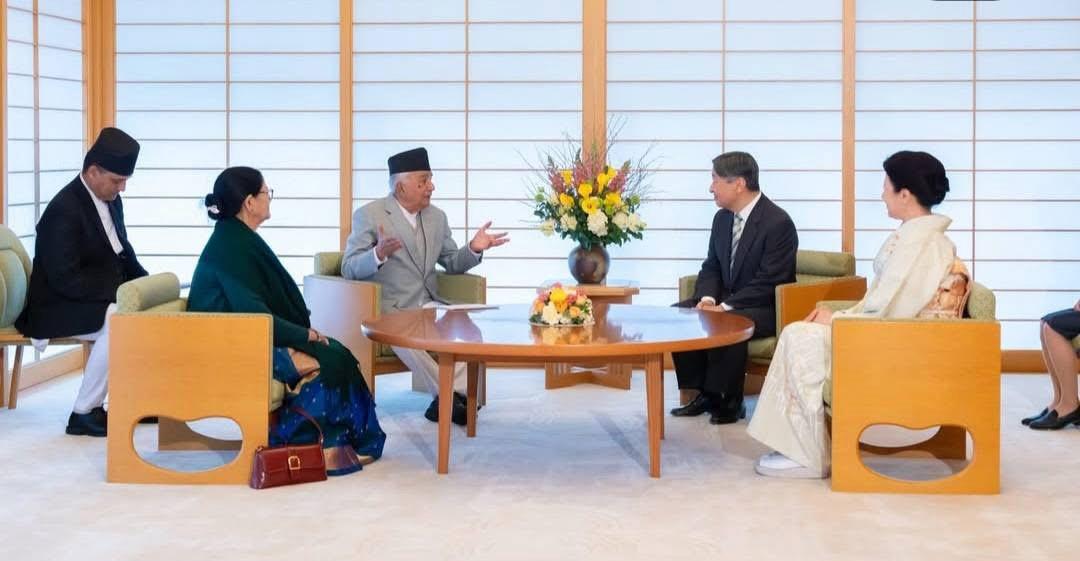
On 3 February, the President Paudel and First Lady, Mrs. Sabita Paudel, visited the Imperial Palace. The historic palace, which stands on the site of the former Edo Castle, had served as the seat of the Tokugawa Shogunate during the Edo period between 1603–1868. At the gate of the palace, Emperor Naruhito and Empress Masako warmly welcomed the President and the First Lady, greeting them with smiles and an affectionate handshake. During the audience, President Paudel humbly began saying, “I have come here carrying the warmest good wishes of the Government and the people of Nepal as a token of love and respect to Your Majesty.” His Majesty the emperor, expressing satisfaction over the state of bilateral relations, fondly recalled his visit to Nepal in 1987 as the crown prince. He also shared several photographs that he had personally captured on his camera during his trip.
Interestingly, one among them was about women fetching water in a mountainous region, which deeply moved the crown prince and heightened his interest in the issue of safe drinking waters in Nepal. Since then, the Government of Japan, through the Japan International Cooperation Agency (JICA), has extended substantial assistance to support safe drinking water projects across Nepal. As a gesture of friendship and goodwill, His Majesty presented some of the photographs to President Paudel, which he had taken some 39 years ago in Nepal.
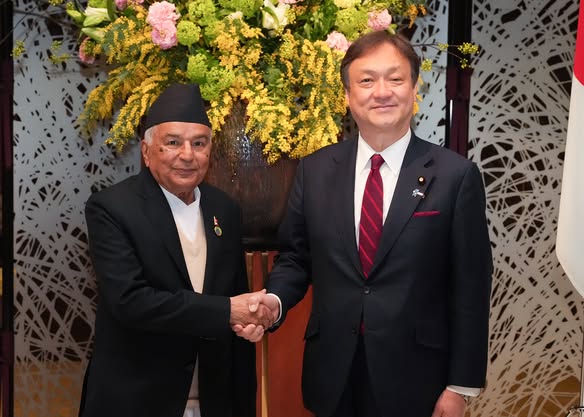
On the occasion, His Majesty Emperor Naruhito expressed his heartfelt sympathy for the devastating earthquake that struck Nepal in 2015 and conveyed appreciation for the compassion and support extended by the Government and people of Nepal in the aftermath of the Great East Japan Earthquake of 2011. His Majesty, while commending President Paudel for his significant contribution to strengthening the age-old and friendly relations between Nepal and Japan, also added that the decoration of Japan’s prestigious Grand Cordon of the Order of the Rising Sun on him in 2020, was in recognition of his distinguished role. The President and the First Lady, at the end of warm and affable talks, extended a warm invitation to Their Majesties the Emperor and Empress to visit Nepal at a mutually convenient time. In this context, it was heartening to note the remarks that Her Majesty Empress Masako made: “I have heard that Nepal is a very beautiful country, but I have yet to visit it.”
In essence, in the course of seven decades of their relationship, Nepal and Japan have cultivated a bond of friendship characterized by goodwill, mutual trust, and multifaceted cooperation. Anchored in longstanding historical and cultural linkages and further strengthened through robust development partnerships and vibrant people-to-people exchanges, Nepal–Japan relations continue to expand in both scope and significance.
The visit of the President of Nepal to Japan, on the auspicious occasion of the 70th anniversary of the establishment of diplomatic relations, has not only further enriched the existing ties but also elevated them to a new height. During the visit, the acknowledgement by Japan’s high-level dignitaries of the successful and progressive trajectory of bilateral relations, indeed underscores the depth and maturity of the corporation subsisting between the two nations. In particular, the President’s meetings with His Majesty the Emperor and the Prime Minister, and their shared recognition of the importance of further strengthening existing bilateral ties, lent special significance to the longstanding and enduring friendship between Nepal and Japan.