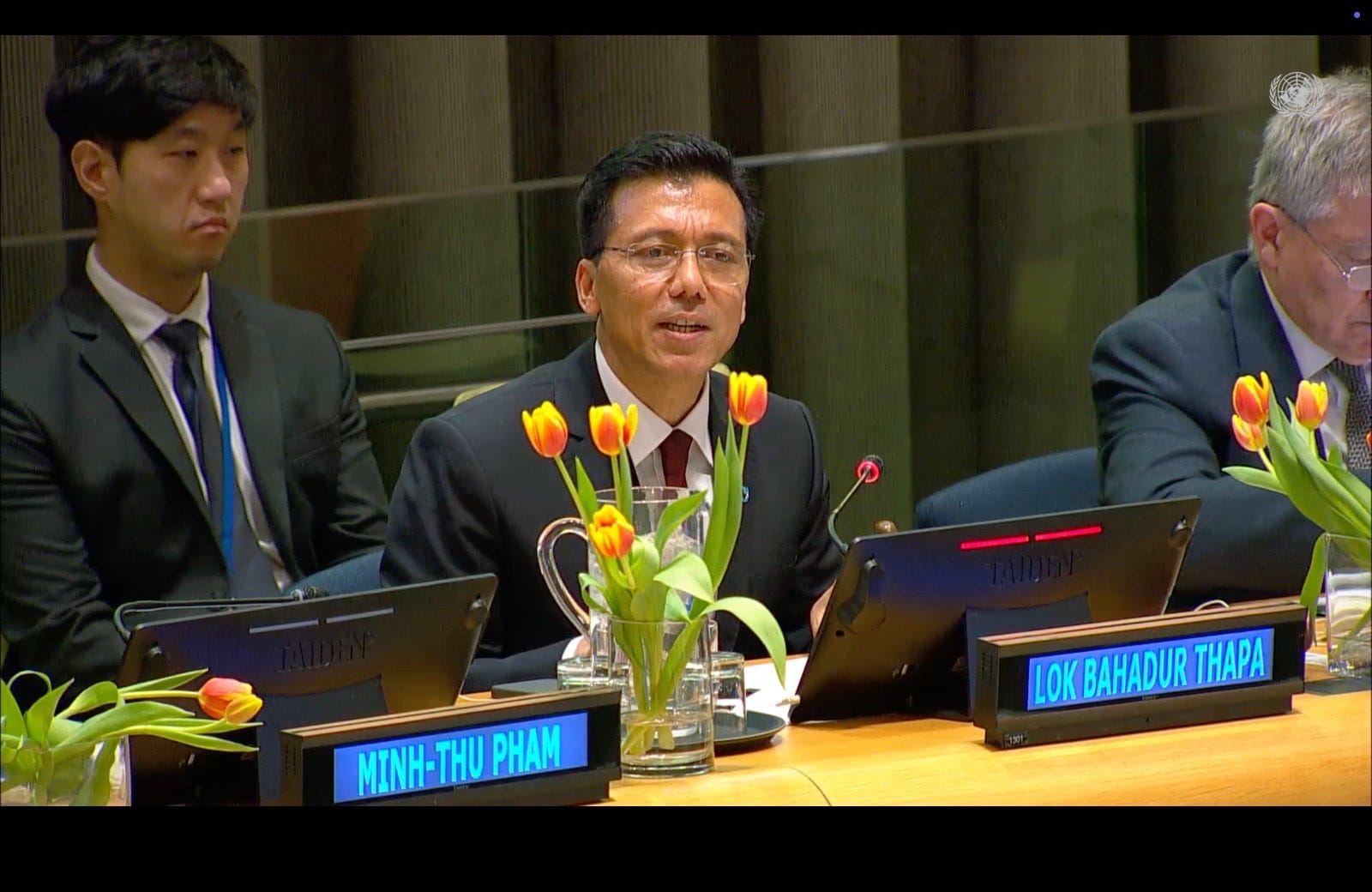
Kathmandu: President of the United Nations Economic and Social Council (ECOSOC), Amb. Lok Bahadur Thapa, has called for urgent, coordinated global action to transform agrifood systems, warning that the world is drifting away from its promise to end hunger and food insecurity by 2030.
Delivering opening remarks at the ECOSOC Special Meeting on Agrifood Systems Transformations at UN Headquarters in New York on February 16, President Thapa described the current global hunger situation as not only a development setback but also a “profound moral failure.” Citing the 2025 State of Food Security and Nutrition report, he noted that between 638 and 720 million people were affected by hunger in 2024, while about 2.3 billion people faced moderate or severe food insecurity. He added that 96 million more people are experiencing chronic hunger compared to 2015.
“Hunger today is not born of scarcity or inadequate production, but of injustice, conflict, exclusion, and systems that deny millions the means to live with dignity,” he said. President Thapa stressed that transforming agrifood systems is fundamental to achieving food security, protecting livelihoods, improving health, and ensuring environmental sustainability. He underlined that agrifood systems are central to economic growth, employing around 40 percent of the global workforce and accounting for more than 60 percent of jobs across Africa, while providing livelihoods to over a billion people worldwide.
Despite their vast potential — estimated at more than 10 trillion US dollars in benefits across health, social well-being, economic growth, and environmental sustainability — Thapa warned that financing and technological access remain far from adequate, particularly in Least Developed Countries (LDCs), Landlocked Developing Countries (LLDCs), Small Island Developing States (SIDS), and across Africa.
He emphasized that finance, technology, capacity building, and expanded market access must be treated as critical enablers of agrifood transformation.
The meeting, organized with the support of the Food and Agriculture Organization (FAO), the World Food Programme (WFP), and the International Fund for Agricultural Development (IFAD), features discussions on scaling up financing and fostering cross-sectoral partnerships. It also highlights the role of digital innovation and youth engagement in advancing sustainable agrifood systems.
President Thapa noted that with 1.2 billion young people aged between 15 and 24 globally — and a projected 7 percent rise in the youth population by 2030 — empowering youth and ensuring their meaningful participation is essential for building inclusive and future-ready agrifood systems.
Describing the meeting as a timely opportunity to identify priority actions, President Thapa expressed hope for a substantive and solutions-driven discussion to ensure agrifood systems deliver prosperity for current and future generations.