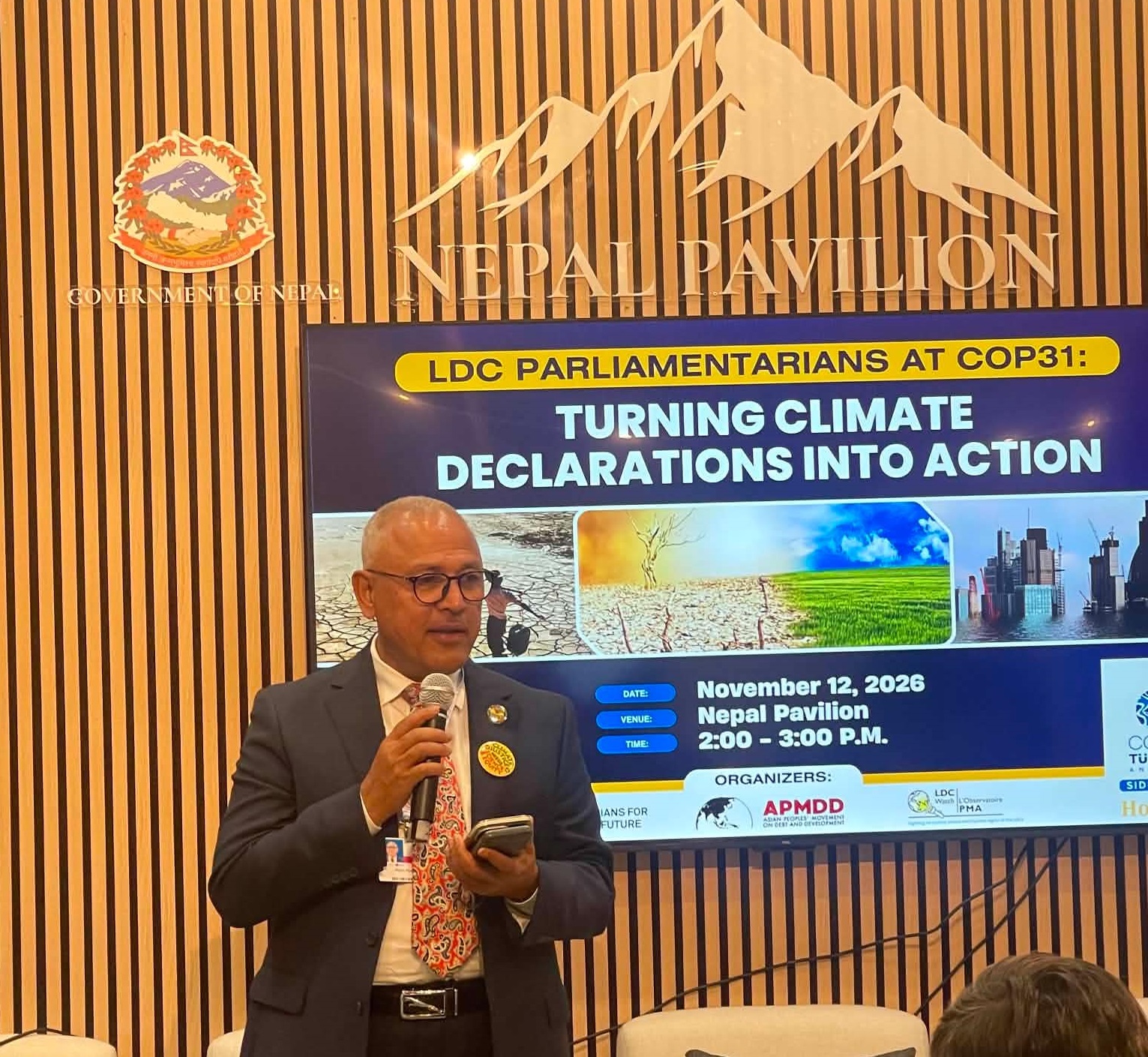
Member of Parliament Hon. Dr Arjun Kumar Karki has urged developed countries to meet their climate finance obligations through predictable, transparent and grant-based funding rather than loans, saying climate justice requires compensation worth trillions, not billions, of dollars.
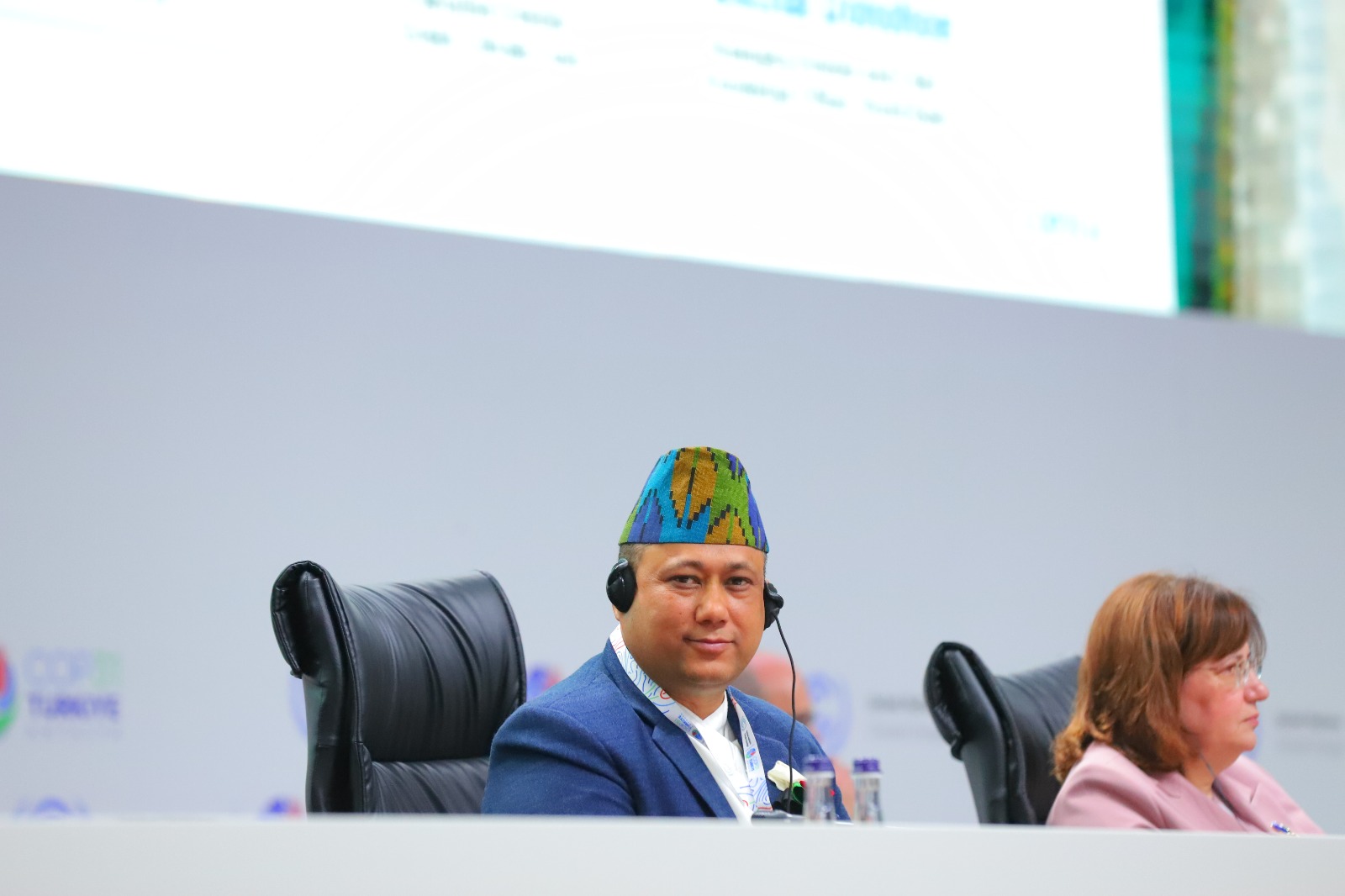
Speaking at a recent panel discussion titled ‘Turning Climate Promises into Action’ at the Nepal Pavilion on the sidelines of the ongoing UN Climate Change Conference (COP31) in Antalya, Türkiye, Karki said climate finance was neither charity nor aid but a moral and historical debt owed by the Global North to the Global South.
The event was jointly organized by LDC Watch, the Asian People’s Movement on Debt and Development (APMDD), and the Parliamentarians Network for a Fossil-Free Future.
Representing a Himalayan country that has contributed negligibly to the climate crisis but is bearing its severe consequences, Karki highlighted the recent avalanches and devastating floods in Nepal, which have caused loss of life, destroyed infrastructure and displaced communities.
“Climate finance is not merely a matter of international financial commitments or negotiating figures. It is about people’s lives, their right to safety, livelihoods and future,” he said.
Karki criticized the new collective quantified goal (NCQG) agreed at COP29 in Baku, which sets a target of mobilizing $300 billion annually by 2035, calling it “grossly inadequate and delayed”. He said the broader call to scale up climate finance to $1.3 trillion remained merely an aspiration rather than a binding target.
Referring to Article 9.1 of the Paris Agreement, Karki said developed countries were legally obliged to provide financial resources to developing countries, rather than merely mobilize private capital. He called for the full implementation of the provision.
He also warned that loan-based climate financing would further deepen the debt crisis in least developed countries (LDCs).
“We cannot be expected to borrow money to confront a crisis that we have played little role in creating,” he said.
Speaking on behalf of the Parliamentarians Network for a Fossil-Free Future, Karki said adequate financing was essential for developing countries to make a rapid and practical transition to 100 percent renewable energy systems.
He also called on wealthy nations to achieve net-zero emissions domestically while directly financing emission-reduction efforts in the Global South as part of their fair share of global climate action, rather than relying on carbon offsets.
During the session, lawmakers from LDCs and partner countries expressed solidarity with Karki’s call to advance the 2026 Delhi Ministerial Declaration on Climate Change. They urged governments in the Global South to remain firm in demanding accessible, grant-based public climate finance.