When the meaning of democracy is constantly and intentionally shaped and reshaped to serve political interests, it does not remain confined to political spaces. It begins to spread, through conversations, social media, algorithm, communities and often times in a speed faster than people can process. Individuals begin to assemble their understanding from fragments and leftovers, guided by emotion, urgency, partial information and rage-filled advocacy. They act not because they fully understand but because they care.
Nepal comprises a population whose social structure is built on traditional values such as respect, faith and seniority but it continuously tries to adapt to independent thinking, sometimes new ideologies and sometimes divided ideologies, and currently is moving towards early leadership. Of course, the patterns of strict hierarchy, authoritarian seniority and traditional concepts unwilling to adapt gradually loses effectiveness over time and the true power in turn lies in being “ageless.” Being ageless, therefore, means encompassing the present needs, voices, demands and promoting newer concepts. At the same time, its sustainability and longevity lie in creating and maintaining a balance, without foreshadowing the voices of the conservatives, the older generation, those who are on the brighter side and those who are committed to and fought for democracy during their time.
Nepal embraced democracy at a time when literacy rates were rather low. Literacy is not the same as political awareness. The ability to simply read and identify numbers does not guarantee the ability to distinguish information from propaganda, or to critically evaluate long-term policy decisions.
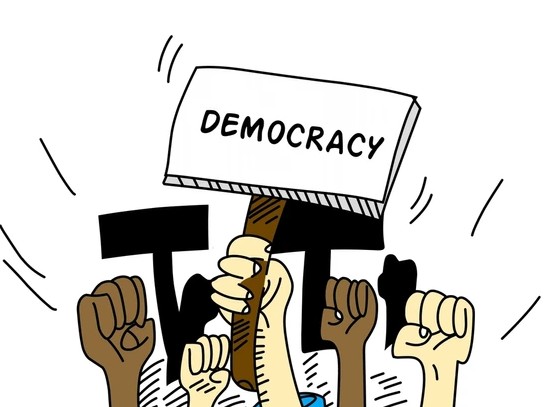
Yet, people fought for democracy. Not just fought for it but also pushed further for absolute democracy. When a lot of the grassroots people fought and pushed for it on the streets, the actual stakeholders of democracy did not seem to clearly understand what democracy really was. The same democracy they fought to bring in had left them behind and had not benefitted them as it became a subject to elite capture. It was becoming a fire that was being difficult to be contained. So, people revolted against the consequences of this tendency.
True strength of democracy lies not in permanence but in its dependence on those willing to understand it, question it and improve it.
Democracy may be understood as something that is not necessarily derived from perfect understanding but from collective aspiration. Democracy is not born out of readiness. It is born out of necessity and is then shaped over time. Not as something fixed but as something constructed and working with continuous maintenance. Like a system that reflects the people who sustain it, like something that responds to us, almost like Newton’s third law of motion. Every action has a reaction, but in democracy, that reaction is not equal and opposite but becomes delayed and charged. It returns eventually while being charged with policy consequences, institutional strain, economic shifts and social unrest. Democracy is not inherently self-correcting. In theory, it distributes power but in practice, it often times concentrates it.
People choose leaders based on strength, influence and capability. That instinct is understandable as no society seeks weak leadership and tries to select the best to represent us. In choosing strength, we also create the conditions for imbalance. Power once accumulated does not always remain accountable. It adapts, it expands and it resists opposition.
The elements of autocracy have the capacity to emerge from within democracy itself. In the global context, there are a handful of popular leaders whose trajectories might differ in context, but share a structural similarity: Rise through democratic processes and gradually reshaping of those very systems to consolidate control. Something called what scholars describe as ‘electoral autocracy.’ Democracy does not always collapse suddenly but it can erode gradually, often times with public consent.
In Nepal, we have a history of overthrowing systems in the moment of crisis but during the September 2025 protests a big question was raised: Does replacing the individuals truly address the deeper issue? Removing a leader does not necessarily dismantle the conditions that allowed power to be concentrated in the first place. It replaces a figure, not a structure. The protestors were not only protesting, they were organizing, asserting themselves and engaging. It was a small act but symbolically significant. It suggested that participation in democracy is not only about opposition, but also about stewardship. It showcased the young Nepali population’s openness and readiness towards reconciliation, peace building and ethical sense.
If democracy reflects its people, then its strength depends not only on leadership but also on the intellectual and civic capacity of its citizens. Institutions matter but so does the ability of the individuals to question, analyze and engage constructively.
Youths should be engaged and should be given the space to engage not simply as participants in moments of crisis but also as contributors to long-term stability. To move beyond reaction and towards understanding. To engage not only in being limited to protests but intellectually through dialogue, policy and institution building. Democracy is not sustained by idealism alone. It requires discipline. It requires education. It requires the ability to balance majority rule with minority rights, to manage disagreement without fragmentation and to pursue reforms without collapsing into instability.
Democracy is not something people inherit fully formed. It is something citizens are continuously responsible for shaping. Perhaps that is where its true strength lies, not in permanence but in its dependence on those willing to understand it, question it and improve it.