For generations, Nepal has proudly identified itself as a nation rich in water resources. Over the past two decades, that natural endowment has steadily evolved into strategic infrastructure. Nepal has moved from the era of 18-hour daily load-shedding to becoming a net seasonal electricity exporter. By 2025, Nepal’s installed electricity generation capacity had crossed 3,400 MW, while peak domestic demand remains significantly below future generation potential. At the same time, the government has committed to producing 28,500 MW by 2035, signaling that domestic electricity consumption alone will not absorb the coming supply surge.
This emerging electricity surplus is not an energy problem, it is Nepal’s greatest industrial opportunity. Yet a fundamental economic contradiction remains: While clean electricity is increasingly abundant, Nepal continues to spend billions of dollars annually importing petroleum products, coal, chemical fertilizers, and industrial raw materials. In a world increasingly shaped by geopolitical disruptions, supply-chain shocks, and carbon border regulations, Nepal’s economic strategy must now evolve from electricity generation to green industrialization and high-value energy exports.
Geopolitical window
Global geopolitical instability in fossil fuel-producing regions has exposed the strategic vulnerability of energy import dependence. Across Asia, industrial economies are urgently searching for politically stable and long-term clean energy partners.
Major economies such as Japan and South Korea have already acknowledged that domestic renewable resources alone will not meet their decarbonization goals. Both countries are investing aggressively in imports of green hydrogen and green ammonia to power heavy industry, electricity generation, and maritime transport.
Meanwhile, China and India, despite their massive renewable energy expansion, remain among the world’s largest importers of coal, oil, and natural gas, underscoring how fossil fuels still underpin industrial growth across major developing economies.
This presents a strategic opportunity for Nepal.
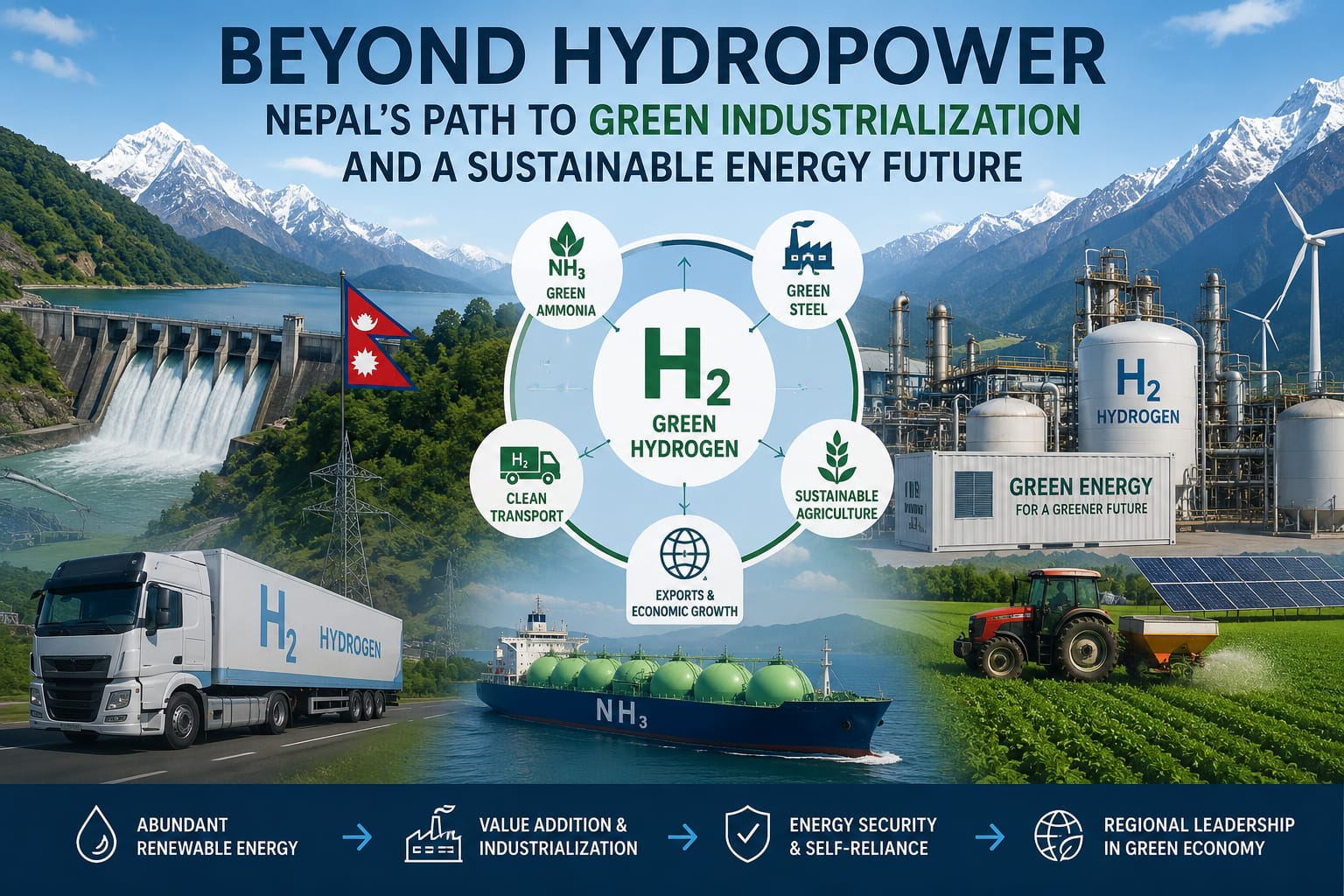
Located between the world’s two fastest-growing industrial markets and endowed with vast untapped hydropower potential, Nepal is uniquely positioned to convert surplus electricity into tradable green commodities such as green hydrogen, green ammonia, and green steel, serving not only India and Bangladesh, but eventually broader Asian markets.
Countries including China, India, Brazil, Saudi Arabia, and United Arab Emirates have already moved green hydrogen and green ammonia beyond pilot projects into commercial deployment, demonstrating that these technologies are no longer experimental, but central to next-generation industrial competitiveness.
Building domestic base
Export credibility begins at home. Despite hydropower expansion, nearly 30 percent of Nepal’s total energy consumption still depends on imported fossil fuels, including diesel, petrol, coal, and furnace oil. This creates an immediate domestic market for green industrial fuels.
Nepal’s cement plants, brick kilns, ceramic industries, and metal processing facilities remain heavily dependent on imported coal. These industries require temperatures exceeding 1,400–1,600°C, making direct electrification technically challenging and economically inefficient.
At the same time, Nepal remains heavily dependent on imported steel and metal products. In 2024 alone, Nepal imported over USD 731 million worth of iron and steel products, exposing a major industrial vulnerability. Replacing imported coal with green hydrogen for direct reduced iron and high-temperature industrial heat could unlock a domestic market opportunity approaching USD 2 billion annually.
Nepal currently imports virtually all of its chemical fertilizers. The government allocates nearly NPR 28.82 billion annually in fertilizer subsidies, targeting approximately 550,000 metric tons of supply.
By utilizing surplus hydropower at industrial tariffs to produce green ammonia domestically, Nepal can reduce import dependency, strengthen food security, and shield farmers from global fertilizer price volatility.
Likewise, diesel remains the backbone of Nepal’s freight transport, mining, construction, and industrial machinery sectors, with annual diesel imports exceeding USD 1 billion.
Transitioning heavy-duty logistics, construction equipment, and industrial fleets toward hydrogen-based fuel systems presents one of Nepal’s largest near-term clean energy markets.
Institutional gap
Nepal has already made important progress. Academic and policy institutions have helped catalyze the country’s Green Hydrogen Policy (2024), alongside tax incentives and regulatory recognition. However, the industrial transition remains stalled by a deeper governance challenge of institutional fragmentation.
Today, Nepal still lacks dedicated industrial standards for hydrogen production, storage, transport, and usage, commercial licensing frameworks allowing industries to legally substitute fossil fuels with hydrogen and coordinated mechanisms between energy, industry, environment, finance, and investment agencies.
Without these foundations, private investors will remain cautious, and climate finance opportunities will bypass Nepal.
What Nepal needs
To convert electricity surplus into industrial transformation, Nepal needs more than policy declarations, it needs institutional execution. The government should immediately establish a Nepal Green Industrial Authority under the Office of the Prime Minister or Deputy Prime Minister, with a mandate to coordinate across ministries, fast-track flagship hydrogen, ammonia, and green steel projects, structure bankable public-private partnership models, mobilize climate finance and foreign direct investment and develop dedicated Green Industrial Parks near hydropower corridors.
This authority should follow a parallel implementation strategy: First, launch through cabinet formation to begin immediate execution. Second, simultaneously introduce permanent legislation through Parliament to institutionalize long-term authority.
The next 24 months will determine whether Nepal becomes merely an exporter of raw electricity, or emerges as Asia’s next green industrial hub.
Nepal’s hydropower revolution has solved the energy crisis the country once faced. The challenge now is transforming that electricity into industrial sovereignty.
By converting surplus hydropower into green steel, green ammonia, and hydrogen-based industrial fuels, Nepal can simultaneously reduce its trade deficit, strengthen food and energy security, and establish itself as a reliable supplier of high-value green commodities to an energy-hungry Asia. The technology exists. The markets are emerging. The capital is available. What Nepal needs now is institutional urgency, and the political courage to industrialize beyond hydropower.