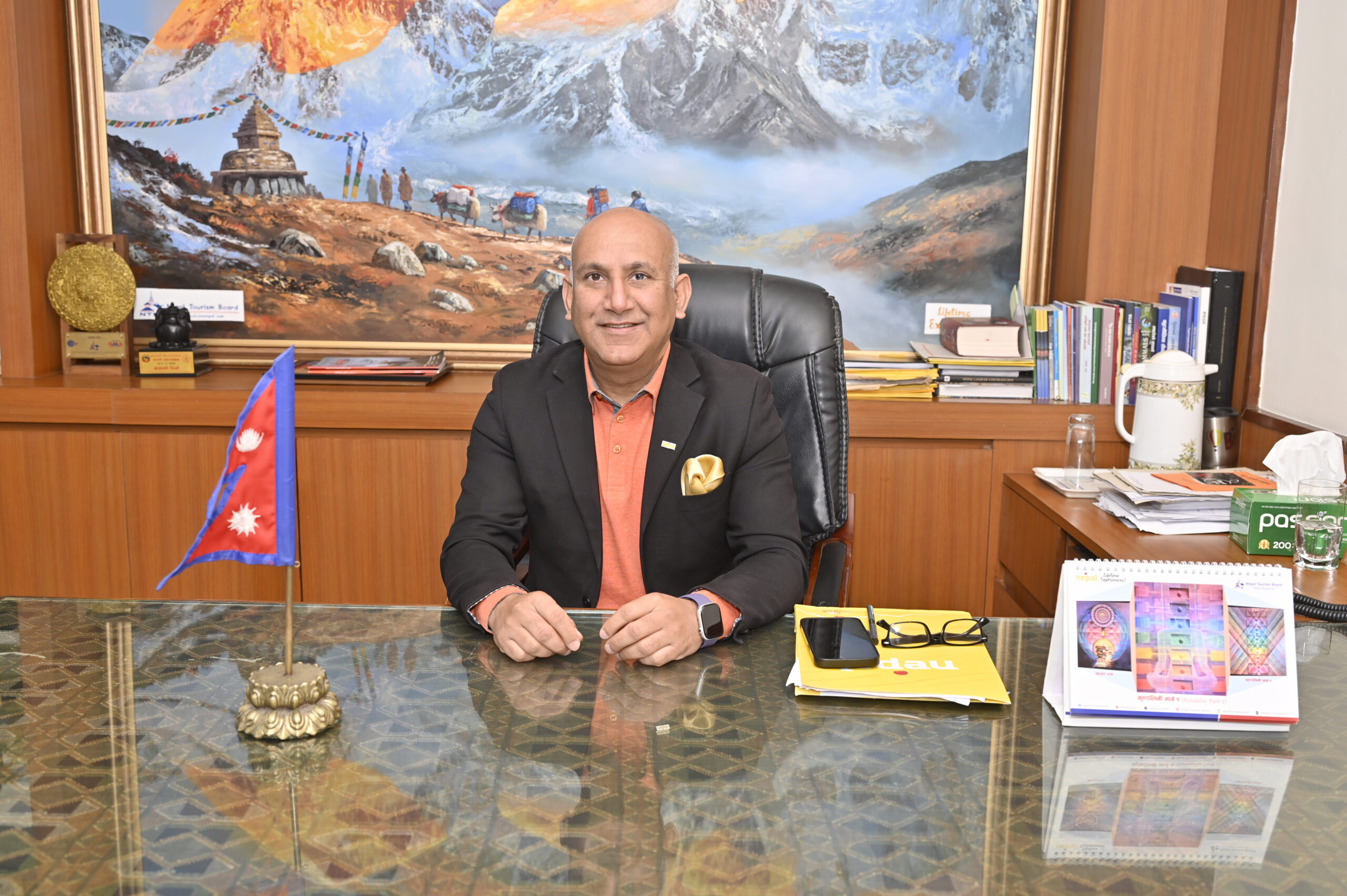
Let’s begin with the current state of tourism. How is Nepal performing in the post-COVID period?
If we look at the post-COVID statistics, Nepal’s international tourism in 2025 has grown by around four percent. However, we are still at about 98 percent of pre-COVID levels, leaving a gap of roughly two percent. In other words, we have not yet fully reached the pre-pandemic situation. One reason is that there were not many promotional programmes during the intervening period. There was also some instability, which affected momentum. But at the same time, there has been very encouraging investment in the hospitality industry. Several international chain hotels have started operations in Nepal. In the past, such developments were limited largely because of frequent government changes and policy instability. Governments often did not last long, and consistency in policies and programmes was difficult. That created uncertainty for investors. Now, with a new government in place, there is a sense of stability. Many young and innovative leaders are involved, and tourism benefits from such fresh thinking. There has also been progress in rules and regulations, which allows us to move forward more quickly. We are hopeful that these improvements will help close the remaining gap.
What are the key challenges Nepal’s tourism sector is currently facing?
At present, we are handling two main challenges. One is the impact of the West Asia crisis, which affects travel sentiment and connectivity. The other is the need for rebranding and re-messaging Nepal in global markets. For this, coordination among various bodies is extremely important.
What role does the Nepal Tourism Board play in this coordination?
Nepal Tourism Board is an autonomous organization, and our objective is to position Nepal as a premier holiday destination in the global market. Tourism cannot develop in isolation. It requires multi-sector coordination and collaboration. Structurally, our board includes the Director General of the Civil Aviation Authority of Nepal, the Department of Immigration, and the Department of National Parks and Wildlife Conservation. We aim to strengthen coordination with these institutions. Collaboration with the Ministry of Foreign Affairs and its missions abroad is also crucial. While we already work together in source markets—such as promoting Nepal and briefing about destinations—we need to make this collaboration more targeted and focused. We have therefore started continuous dialogue with them.
How important is inter-ministerial coordination, particularly in relation to safety and security of tourists?
Safety and security of tourists is always a prime concern. This requires close coordination with the Ministry of Home Affairs and other relevant bodies. For example, travellers entering through land borders may sometimes face minor hassles, and protected areas also involve security arrangements. In such areas, stronger coordination is necessary. Similarly, Nepal’s geography makes us prone to natural disasters. Whenever such situations arise, we collaborate with local authorities and other agencies. We have established a crisis coordination cell that operates across sectors. For instance, if there is a strike or curfew in Kathmandu, we arrange shuttle buses from the airport to hotels. These kinds of mechanisms help maintain tourist confidence.
What kind of international collaboration is Nepal pursuing for tourism promotion?
We collaborate widely with international partners. We organize tourism promotion programmes in more than 55 cities globally, working with marts, expos and exhibition organisers. These platforms help bring Nepal’s private sector into B2B interactions. We also invite influencers, media professionals and travel bloggers to Nepal so they can experience and promote the destination. Institutionally, we collaborate with global tourism bodies such as UN Tourism, the Pacific Asia Travel Association, the World Travel and Tourism Council, SKAL International, the International Mountain Tourism Alliance, the Adventure Travel Trade Association, and the World Tourism Network. We also maintain ongoing collaboration with travel-related associations of various countries.
Nepal is often seen as an adventure destination. Are you trying to diversify this image?
Yes. Nepal has long been perceived mainly as an adventure destination centered on mountains. While adventure remains important, Nepal offers much more diversity. We have introduced the theme of “lifetime experiences,” highlighting cultural heritage, festivals and community-based tourism. Festivals such as Seto Machhindranath and Indra Jatra offer unique and vibrant experiences for visitors. We are also promoting wildlife tourism and conservation stories. Another milestone is Nepal’s proposal to celebrate April 15 as International Wellness Day, which has been endorsed by the United Nations. From now on, every April 15 will be observed as Wellness Day. We are also preparing to declare 2027 as Wellness Tourism Year and run year-round campaigns focusing on wellness, spirituality and adventure. These are some of our new initiatives.
There are some misconceptions about Nepal. Many think it is only a mountain destination or suitable only for adventure travellers. This is not true. Nepal offers diverse experiences for families, cultural travellers, wellness seekers and nature lovers. There are also concerns about transport infrastructure, but Nepal has significantly improved safety standards, road connectivity and access to major destinations. Food hygiene is another area where standards have improved, with accredited tourism service providers. Hospitality is deeply rooted in Nepali culture—guests are treated as gods. Tourism here is not just business; it is hospitality. Nepal is also one of the most diverse destinations in the world, where visitors can experience multiple attractions within a short time and distance.
Could you elaborate on your long-term vision for tourism?
We are working on a vision document covering the period 2025 to 2035. It proposes a Tourism Priority Decade with ten years, ten priorities and a clear action plan. The preparation has been completed and will be submitted to the government for implementation. This document provides a structured roadmap for sustainable tourism growth.
What is your message to stakeholders in Nepal?
Tourism is one of Nepal’s most promising sectors for sustainable development. It cannot be developed by a single institution or the private sector alone. A strong ecosystem is required, with coordination among all concerned authorities. With high priority, a clear vision and an action plan, Nepal can achieve significant results within a few years.
Every year, NTB with the Ministry of Foreign Affairs has been hosting programs to share different experiences of Nepal. What kind of feedback do you receive from ambassadors and international partners?
The feedback has been very positive. Ambassadors regularly share information with their citizens and promote new attractions based on their own experiences. They also highlight how welcoming Nepal is. This positive engagement often helps countries quickly relax travel advisories, even after natural disasters or political protests.