Kathmandu: The Centre for Social Innovation and Foreign Policy (CESIF) held a commemorative event on August 25 to mark the 250th Anniversary of American Independence, bringing together representatives from the Government of Nepal, the US Embassy, the diplomatic community, academia, young scholars and media. The event reflected on the enduring principles of democracy, constitutional governance, and individual liberty that have shaped the United States, while highlighting the longstanding partnership between Nepal and the United States.
The event commenced with welcome remarks by Amb. Vijay Kant Karna, Executive Chairperson of CESIF, who noted that the 250th anniversary of American independence provides an opportunity to reflect on the broader global significance of democracy, constitutional government, and human rights. He highlighted how American ideals of self-determination and individual liberty have influenced political thought and anti-colonial movements beyond the United States. He further emphasized that Nepal–US relations are rooted in shared democratic values and stressed that democratic institutions must remain accountable to the people, with legitimacy earned through public trust and responsive governance.
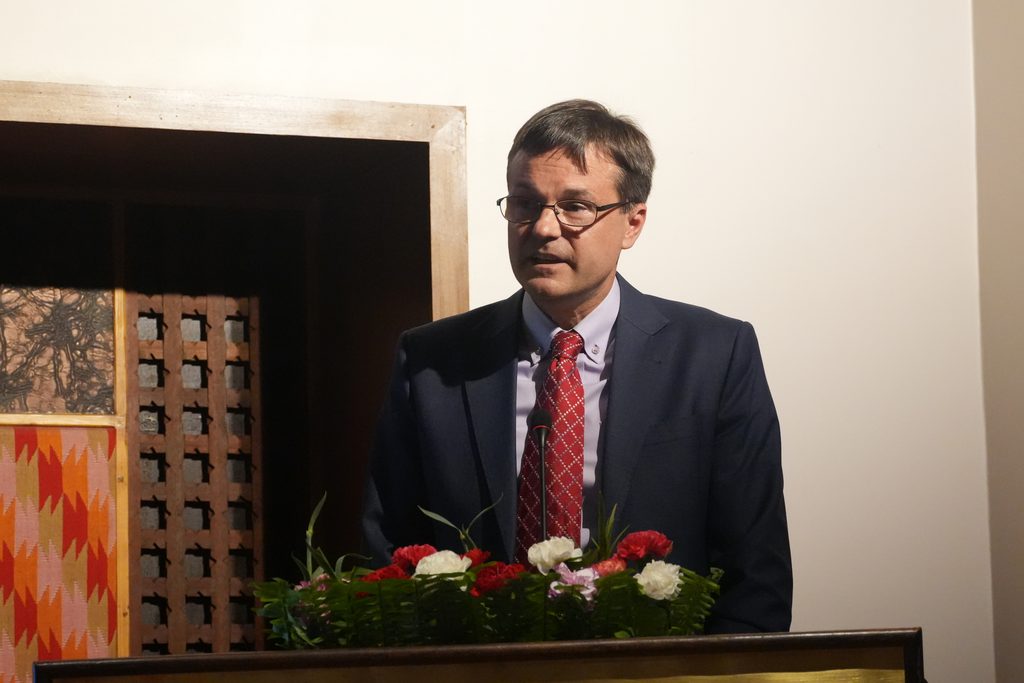
Mr. Scott Urbom, Chargé d’Affaires a.i. at the U.S. Embassy in Kathmandu, delivered his special remarks, reflecting on the 250th anniversary of American Independence, emphasizing the strong, value-driven partnership between the US and Nepal. He highlighted the importance of shared democratic principles and ongoing economic collaboration in tech and creative sectors. He stated that investment in young Nepali talent and the US-Nepal relationship promotes long-term shared prosperity. He highlighted that beyond tech, U.S. commitments remain anchored in vital physical and health infrastructure—highlighting the $500M+ Millennium Challenge Corporation (MCC) compact to build high-voltage cross-border electricity transmission lines and upgrade strategic road corridors.
Delivering the keynote address Chief Guest, Minister of Foreign Affairs Hon. Shisir Khanal, highlighted Nepal and the United States’ shared commitment to constitutionalism, democracy, and human freedom. As Nepal and the US prepare to mark the 80th anniversary of diplomatic relations next year, he emphasized the longstanding US contribution to Nepal’s development and outlined three pillars for strengthening bilateral ties: access to American innovation and capital, cooperation on climate resilience and the green economy, and mobilizing the human capital of the Nepali diaspora in the United States.
Former UN Ambassador Prof. Dr. Jayaraj Acharya shared historical accounts of early US–Nepal diplomacy dating back to April 1947. He highlighted how US-backed malaria eradication reshaped the Terai’s economy, how bipartisan Congressional diplomacy supported Nepal’s 1990 democratic restoration, and why constitutional checks, balances, and educational exchanges remain vital anchors for democratic governance today.
Reshu Aryal, Member of the National Planning Commission, reflected on the shared democratic values and people-to-people ties between Nepal and the United States, emphasising the role of younger generations in strengthening democratic institutions. She highlighted the need to understand emerging Gen Z political realities, strengthen civic maturity and accountability, and move from feudal modes of political thinking towards an empowered citizenry. She stressed that democracy requires not only a constitution but also institutions that uphold democratic norms and remain stronger than individual personalities. She also proposed a year-long foundational liberal arts curriculum across higher education to foster critical inquiry and civic engagement, while encouraging greater tolerance for experimentation and failure. Underscoring the importance of educational partnerships, cultural exchanges, and human capital, she noted that Nepal, as a young republic, can draw lessons from the US experience in building durable democratic institutions and upholding equality and inclusive citizenship.
Historian Ajapa Sharma reflected on the 250th anniversary of the American Republic as a project that is continually “made and remade,” rather than a fixed political achievement. She traced the enduring relevance of principles such as natural rights, social contract, and self-governance, from early colonial political thought and the Declaration of Independence to their later expansion through abolition, Reconstruction, and civil rights movements. Highlighting the challenges of balancing central authority with individual liberty, majority rule with minority rights, and competing national and local interests, she emphasised that democratic institutions require continuous negotiation, compromise, and accommodation. She concluded that sustaining a republic is a demanding and unfinished process that requires citizens and institutions to continually uphold and redefine principles of self-governance and justice across generations.
In her keynote, Political Scientist Ms. Devika Thapa offered a forward-looking perspective on the next 250 years of democratic experience and Nepal–US relations, examining the future through three interconnected lenses: institutions, opportunities, and partnerships. She emphasized that while institutional design and rules matter, the strength of democratic systems ultimately depends on how people participate and engage with them. She also highlighted the need to view economic and technological opportunities as forms of political agency for young people, while underscoring the growing importance of people-to-people ties, diaspora networks, and cross-border partnerships in shaping Nepal–US relations. Framing youth as active participants in this process, she urged the next generation to be “protons”—bringing constructive energy and purpose to democratic and public spaces rather than remaining passive observers.
The event concluded with closing remarks by Mr. Arpan Gelal, Research and Program Coordinator at CESIF. He emphasized that “democracy is not something that is completed once a constitution is written or an institution is established, but requires constant work.”