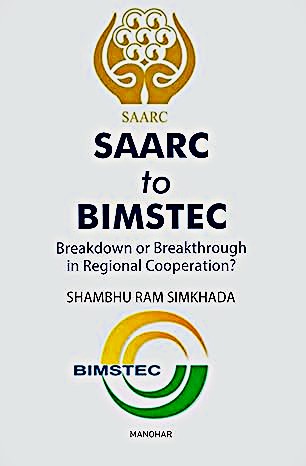
“SAARC to BIMSTEC: Breakdown or Breakthrough in Regional Cooperation?” analyses the attempts at regional cooperation undertaken by the South Asian Association for Regional Cooperation (SAARC) and the Bay of Bengal Initiative for Multi-Sectoral Technical and Economic Cooperation (BIMSTEC), despite the region’s shared geographical, historical and developmental characteristics.
Written by former Ambassador Dr.Shambhu Ram Simkhada, the book lies at the intersection of international relations, regional politics and development cooperation.
With regard to SAARC, the book identifies three major challenges: the limited commitment of member states to regional cooperation, the restricted mandate of the SAARC Secretariat, and the marginalisation of civil society from regional processes. Dr. Simkhada argues that both SAARC and BIMSTEC will continue to struggle unless these fundamental issues are addressed. He also points to the deep layers of distrust and the lack of economic complementarity that have constrained regionalism in the Global South.
Placing the study within the evolving strategic landscape of the Indo-Pacific, Dr. Simkhada argues that South and Trans-Himalayan Asia is confronting an expanding range of challenges and opportunities driven by the passage of time, rapid technological advancement and intensifying competition. In this context, he contends that regional cooperation should transcend political barriers and instead promote flexible balancing and shared institutional arrangements.
Dr.Simkhada, who also taught Master’s students of International Relations and Diplomacy at Tribhuvan University, often told his students that he would “take off his diplomat’s coat” whenever he entered the classroom. By this, he meant that while a diplomat is expected to present issues in a manner that avoids offending others and often conveys views in a nuanced and indirect way, academic engagement demands a more critical approach. Accordingly, he would set aside the constraints of diplomacy while teaching and analysing issues from an academic perspective.
“In SAARC to BIMSTEC: Breakdown or Breakthrough in Regional Cooperation?”, Dr. Simkhada expands upon the ideas he frequently shared in the classroom and presents his considered reflections on the subject, drawing on decades of experience in diplomacy and policy analysis.
No SAARC summit has been held since the 18th Summit hosted by Nepal in November 2014. Following the attack in Uri in September 2016, which India blamed on Pakistan-backed militants, New Delhi argued that terrorism and dialogue could not proceed side by side and announced that it would not participate in the 19th SAARC Summit scheduled to be held in Islamabad later that year. As a result, SAARC has remained virtually moribund.
At a time when SAARC’s activities have been largely paralysed and India has sought to place greater emphasis on BIMSTEC—an organisation comprising five of the eight SAARC member states—Dr. Simkhada’s book offers a profound and thought-provoking assessment of whether BIMSTEC can effectively assume the role that SAARC has traditionally played in fostering regional cooperation. More broadly, the work engages with the question of whether the shift from SAARC to BIMSTEC represents a breakdown or a breakthrough in South Asian regionalism.
The book’s unique point of view is its biggest asset. This volume offers a cogent narrative fashioned by the observations of a practitioner-scholar, in contrast to many studies on South Asian regionalism, which are frequently edited collections or academic works with a narrow focus. Throughout, Dr. Simkhada’s dedication to the concept of regional cooperation is clear, as is his belief that organisations like SAARC were intended to be tools capable of tackling the more serious issues of poverty, underdevelopment, and instability that still plague South Asia.
A recurring theme running through the book is the author’s concern over the inability of regional institutions to fulfil their potential. Revisiting arguments advanced in articles and papers written over a span of thirty-five years, Dr. Simkhada repeatedly raises a fundamental question: Can an organisation designed primarily around economic cooperation succeed without also engaging with issues of conflict and political mistrust? His reflections reveal both frustration with SAARC’s limitations and a persistent belief in the value of regionalism.
The development of the author’s ideas is one of the book’s most interesting features. Dr. Simkhada gradually shifts away from traditional state-centric explanations and emphasizes the role that institutions, ideas, leadership, individuals, and issue-based collaboration have in determining regional outcomes. These insights give the book a depth of thought that goes beyond a straightforward historical narrative of SAARC and BIMSTEC.
The volume’s ability to provide an informed Nepali perspective on South Asian regional events may be its most significant contribution. Effective regional institutions give smaller nations like Nepal a crucial forum for expressing their diplomatic interests, economic goals, and security concerns. In an otherwise unbalanced strategic environment, Dr. Simkhada shows how regional cooperation can strengthen smaller nations’ ability to negotiate and give them a stronger voice.
However, in certain parts of the book, the author appears to be guided by a liberal school of thought, and at times his arguments carry a distinctly idealist tone. There are occasions when the work seems to place greater emphasis on the normative appeal of regional cooperation than on the realist proposition that international relations are ultimately driven not by sentiment but by national interests. Such an emphasis is somewhat unexpected from Dr.Simkhada, a seasoned practitioner of diplomacy.
Yet, his idealism may itself be rooted in Nepal’s national interests. After all, Dr.Simkhada is fully aware that in the rapidly changing global order, the importance of regional cooperation for a country like Nepal has only grown. His enduring faith in regionalism, therefore, should perhaps be understood not as a departure from national interest, but as a reflection of what he believes best serves Nepal’s long-term strategic interests.
Nonetheless, there are a few places where small changes might improve the book even more. The book focuses far more on SAARC, even if the title emphasizes BIMSTEC. Readers would be better able to comprehend the book’s purpose if the introduction provided a more thorough explanation of this imbalance. The growth of bilateral, minilateral, and microlateral agreements, which have increasingly challenged conventional forms of regional cooperation, might also be discussed more directly in the introduction.