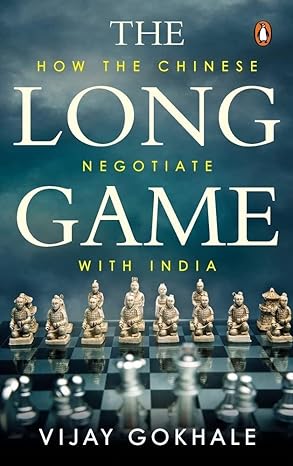
“The Long Game: How the Chinese Negotiate with India” was written by Vijaya Gokhale, the former Foreign Secretary of the Indian Ministry of External Affairs. Gokhale spent nearly four decades in the Indian Foreign Service working in different capacities.
During his long diplomatic career, he worked on matters related to China most of the time and was assigned to Hong Kong, Taipei, and Beijing. He was also personally involved in various negotiations with China. After his retirement from Indian Foreign Secretary in 2017, he started his career in academic journey and has researched as well as published books on China affairs.
Published by Penguin Random House India in 2021, the book has a volume of 181 pages, and includes seven chapters with additional rich preface. The book begins with the chapter of recognition and concludes with lessons for India. He also wrote the book, “After Tiananmen: The Rise of China” in 2022.
The book examines India’s major engagements with China since 1949. Both the bilateral and multilateral nature of the negotiation technique of China was well reflected in the book. It is a great resource for those interested in China’s affairs, and is especially helpful for Nepali diplomats engaging with China in various range of issues.
China and India are two biggest nations of Asia. India was independent from the British East India Company in 1947 whereas the new Communist regime in China had liberated China by using military force to overthrow a legitimate government. Both had similar situations in the 1940s. After the formation of the new communist regime. It was obvious to get recognition from the world to validate its regime by the Chinese Communist Party.
The first chapter talks about the negotiation between two countries on recognition; the author mentioned about the skill and technique of Chinese negotiation which is well prepared and looks like a one man-show. The topic of Tibet and Indian special privileges in Tibet, Indian dilemma and divided voices among top leadership China were some of the major issues discussed in this chapter.
The next chapter on Tibet: Price of Friendship described how the Chinese leadership gave extra care to the topic. Before sitting at the negotiation table, they had studied and researched Tibet history and past agreements and negotiation with the British whereas India side preparation was not as expected as per the author. Due to lack of preparation from the Indian side, they lost without gaining the status of special privileges in Tibet and other trade related privileges.
As he mentioned, “Deception is a legitimate tactic in diplomacy and negotiation.” In May 1955, India and China signed the 17-Point Agreement that gave Tibet an autonomous status, although the opening sentence was explicit in stating that Tibet lay within the boundaries of China.
The third chapter was about the Indian nuclear test and its political message at bilateral and global level. The NPT, CTBT and NSG related global politics are well described here. What he found in the Chinese negotiations is still valid today, “One of the difficulties in dealing with the Chinese, even up to the present day, is the problem of access. Unless they wish to meet you, it is virtually impossible to meet them. In those days, mobile phones were rare and even the interest was uncommon, and even today despite the advantages of modern communications technology in the twenty-first century, the problem remains.”
The next chapter is about “Sikkim: Half a Linguistic Pirouette”. The chapter discusses Sikkim’s annexation to India and India’s painstaking efforts for recognition.
The fifth chapter is about the India-United States agreement signed in 2006. The chapter clearly showed that the national interests are bigger than that of the relations between a state. It focuses on how the United States negotiated secretly with India, ignoring Chinese concern and its own earlier position. There is a need to review and prioritize national interests given the changing international circumstances.
The second last chapter is about India’s long struggle to enlist Masood Azhar at the UN terrorist list and how it was delayed due to the principle of consensus at the security council. And the final chapter shares the lessons for India and Indian diplomats while negotiating with their Chinese counterpart.
Nepali politicians and bureaucrats would greatly benefit from reading and understanding the Chinese way of negotiation. Also for academics, the book is useful to understand the Chinese side and their involvement in international politics and how they handled issues beyond their national boundary.
Since the book was written by the person who directly led or was part of negotiations with China, this book is very authentic. He largely framed the narrative through a Sino-Indian lens and, having been part of the government, is also sharply critical of China. It would have been beneficial to get a deeper engagement on China’s long civilizational history, the “century of humiliation,” and the modern trajectory of the People’s Republic since 1949 under Communist Party rule.
Similarly, India’s immense diversity, with thousands of castes and communities, contrasts with China’s comparatively more homogeneous majority society, shaping work cultures and social norms in different ways. Further exploration of both countries’ histories and the foundations of their state-building would make the analysis more balanced and credible.
That said, the book is rich in incidents and lived experiences, which makes it engaging, readable, and authentic.