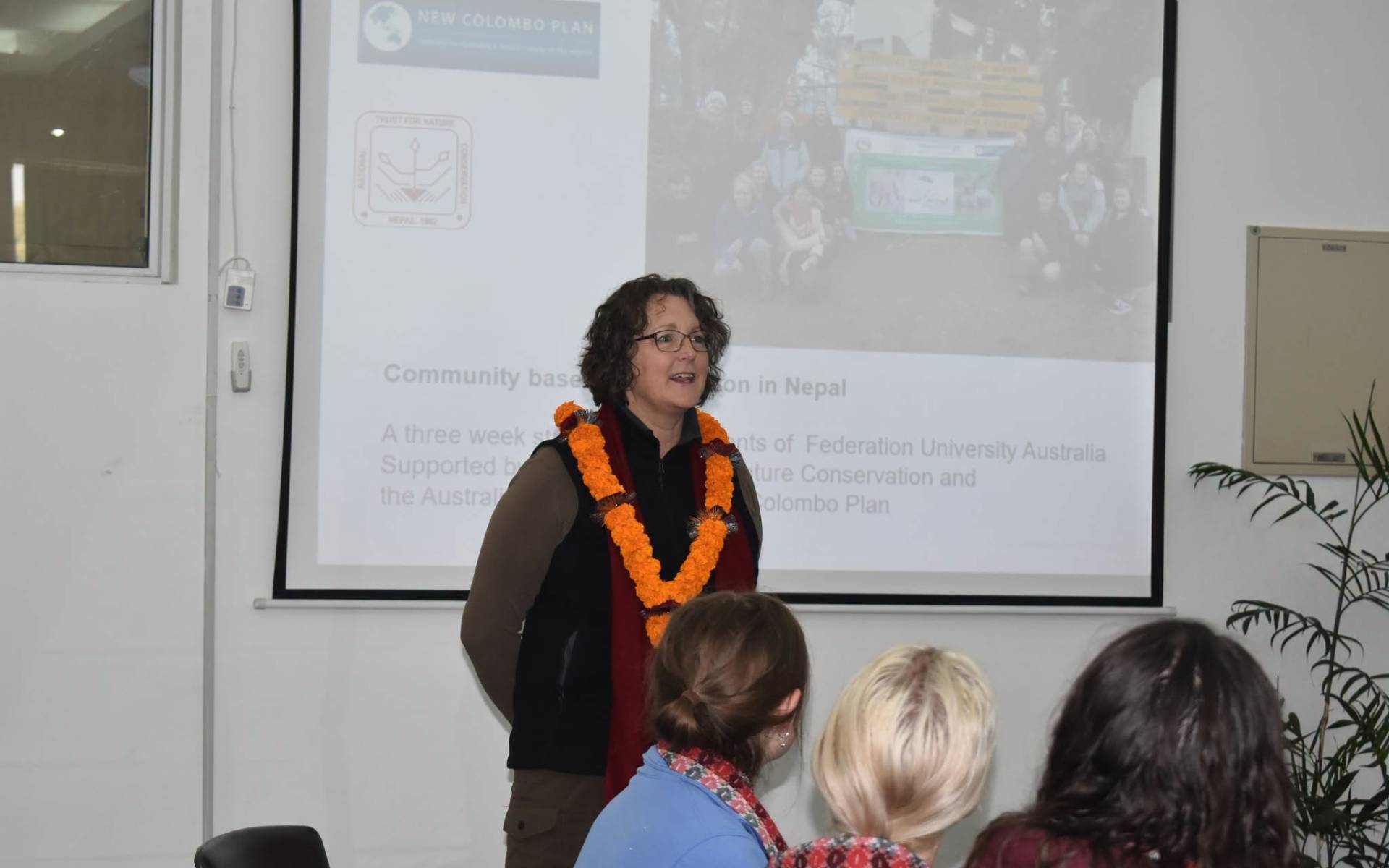
Kathmandu: Professor Wendy Wright has been appointed to the Governing Board of Trustees of Nepal’s National Trust for Nature Conservation (NTNC) which has further strengthened the decade of collaboration, exchange, and shared learning between Federation University Australia and Nepal.
The longstanding relationship between the University and the NTNC is a great source of pride for Professor Wright, from immersive study tours benefiting almost 100 Federation students so far, to research projects addressing human-wildlife conflict and the discovery of five new species of gecko.
She will be joining the NTNC Board of Trustees as one of the only two international members, supporting the not-for-profit organization’s work in and wildlife conservation including species such as the Bengal Tiger and One-Horned Rhinoceros.
“I am very honoured to accept the role. It’s a great opportunity for me to continue to work with colleagues who have become very important to me over the last 10 years or so,” Professor Wright said.
Professor Wright originally visited Nepal in 2015 at the invitation of her first Nepali PhD student. She was then introduced to key members of the NTNC team. She returned to lead a nature-training guide program with NTNC in 2016 and established the first Federation student study tour in 2019.
According to the Federation University, the study tour gives the students hands-on skills in wildlife and habitat monitoring while learning about Nepal’s rural society, natural resource management and local culture through homestays.
“We can show students something they would never see in Australia, which is a real connectedness to the environment and to wildlife conservation demonstrated by local communities,” Professor Wright said. “The student visits really consolidated the relationship because it allowed me to visit Nepal regularly, building on and developing relationships and collaborations. We’ve since had a couple more Nepali students come to do their PhD with Federation because of these relationships.”
Professor Wright said it was the dedicated team of wildlife conservation specialists at NTNC who kept her going back to Nepal, along with her fascination with the research questions that exist there, particularly those around human-wildlife interactions.
“Nepal is still a very rural and regional society where many people’s livelihoods are directly connected to forests and other natural landscapes, so they are faced with daily challenges around managing conflict with wildlife, including predators such as tigers, who threaten livestock and human lives, and megaherbivores such as elephants who inflict substantial crop damage,” Professor Wright said. “The stakes are so high for people, and I feel we can really make a difference in the research space and help improve the lives and livelihoods of people while also taking care of the wildlife.”
The University stated that Professor Wright’s research has helped advocate for better support for Nepali farmers who face losses from human-wildlife conflict.
Her other research has investigated the role of women in Nepalese forest management, while PhD student Santosh Bhattarai, working on the reptiles and amphibians of Nepal, discovered five new gecko species.
Work led by Federation Associate Professor Fiona Hogan, in collaboration with Professor Wright, has identified a new genetic line of pangolins in Nepal – a fascinating group of mammals with similar habits to Australian echidnas.
During the five-year board term, Professor Wright will support the NTNC’s efforts in advancing biodiversity conservation, sustainable development and environmental resilience in Nepal.