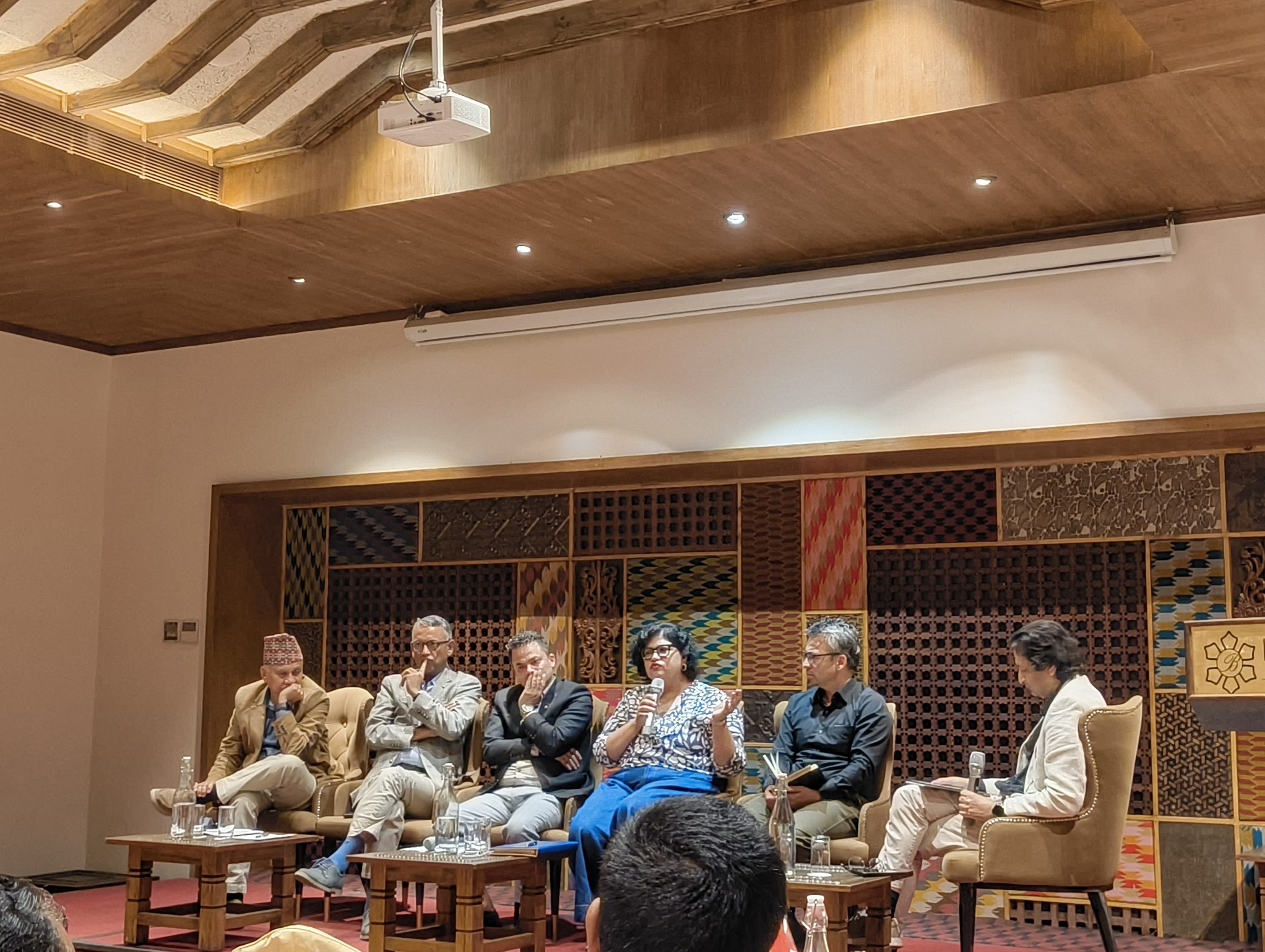
Kathmandu: The Centre for Social Innovation and Foreign Policy (CESIF), Nepal, hosted a seminar on Nepal-India Economic Connectivity on May 20 in Kathmandu. The seminar featured a research presentation and a panel discussion, bringing together policymakers, diplomats, civil society leaders, and young scholars to discuss prospects and challenges in Nepal-India Economic Connectivity.
Speaking in the program, Amb. Vijay Kant Karna, CESIF’s Executive Chairperson, emphasized that Nepal’s geographic positioning between two global economic giants is no longer enough to guarantee prosperity. “The question before us is not whether Nepal should engage more deeply with India economically. That reality already exists. The more important question is how Nepal can engage more strategically, more productively, and more confidently,” he said, urging policymakers and private sector leaders to pivot from abstract diplomatic concepts to practical economic realities.
Nimesh Mani Risal, Research Associate at CESIF, presented his key findings and policy recommendations of the research “Nepal-India Economic Connectivity.” He argued that Nepal’s primary challenge is not a lack of market opportunity, but a fundamental gap in state and institutional preparedness to capitalize on India’s economic momentum. He introduced key sectors of engagement, including energy, tourism, and cross-border digital connectivity, highlighting the opportunities as well as the challenges in each sector.
Speaking during the panel discussion, Krishna Gyawali emphasized that while the Nepal-India relationship remains asymmetrical, its untapped potential continues to be constrained by weak delivery, politicized narratives, and insufficient focus on structural bottlenecks. He argued that many bilateral challenges require technical and evidence-based solutions rather than political settlements, stressing the need to depoliticize policy discussions and approach issues through a technocratic and political economy lens. He warned against the state’s obsession with superficial “optics,” such as fixating on airport reception decorum during bilateral prime ministerial visits, urging instead a direct, unbundled deconstruction of contentious issues.
Ambassador Chandra Ghimire emphasized that the relationship must now transition from a historically rooted partnership to the one driven by deeper economic transformation and connectivity. He highlighted the importance of improving cross-border infrastructure, air connectivity, and regional integration, arguing that inadequate connectivity often allows security concerns to dominate the bilateral agenda, while greater Indian economic stakes in Nepal could generate stronger mutual benefits. Ghimire highlighted severe gaps in operationalizing hard-won technical agreements, pointing out that despite successfully incorporating inland waterways into the transit treaty around 2019/2020, designated hubs like Sahibganj, Varanasi, and Kalughat remain entirely unoperational.
Speaking on the complexities of informal Nepal-India cross-border trade, Dikshya Singh stated, “Nepal-India informal trade closely mirrors formal trade, and we can see a clear deficit persisting here too.” She explained the economic rationale behind households choosing to buy cheaper goods from India, noting that this vast, unrecorded flow creates severe economic distortions. Ultimately, Singh characterized informal trade as a “wicked problem” that defies a single and concise solution.
Satish Joshi emphasized that while India’s interest in purchasing Nepali hydropower is clear, Nepal must move swiftly to capitalize on the opportunity before shifting technological and market dynamics narrow its strategic advantage.
Discussing the tourism potential between Nepal and India, Kumar Mani Thapaliya highlighted that Nepal still sees over 30% of tourist inflow via air from India and an even bigger number of tourists via land. Nepal remains an accessible tourism market for India. However, he emphasized that Nepal must improve border infrastructure, road conditions, and overall connectivity while investing in stronger international promotion and destination branding, arguing that negative perceptions linked to poor infrastructure and accidents continue to undermine the country’s tourism potential.