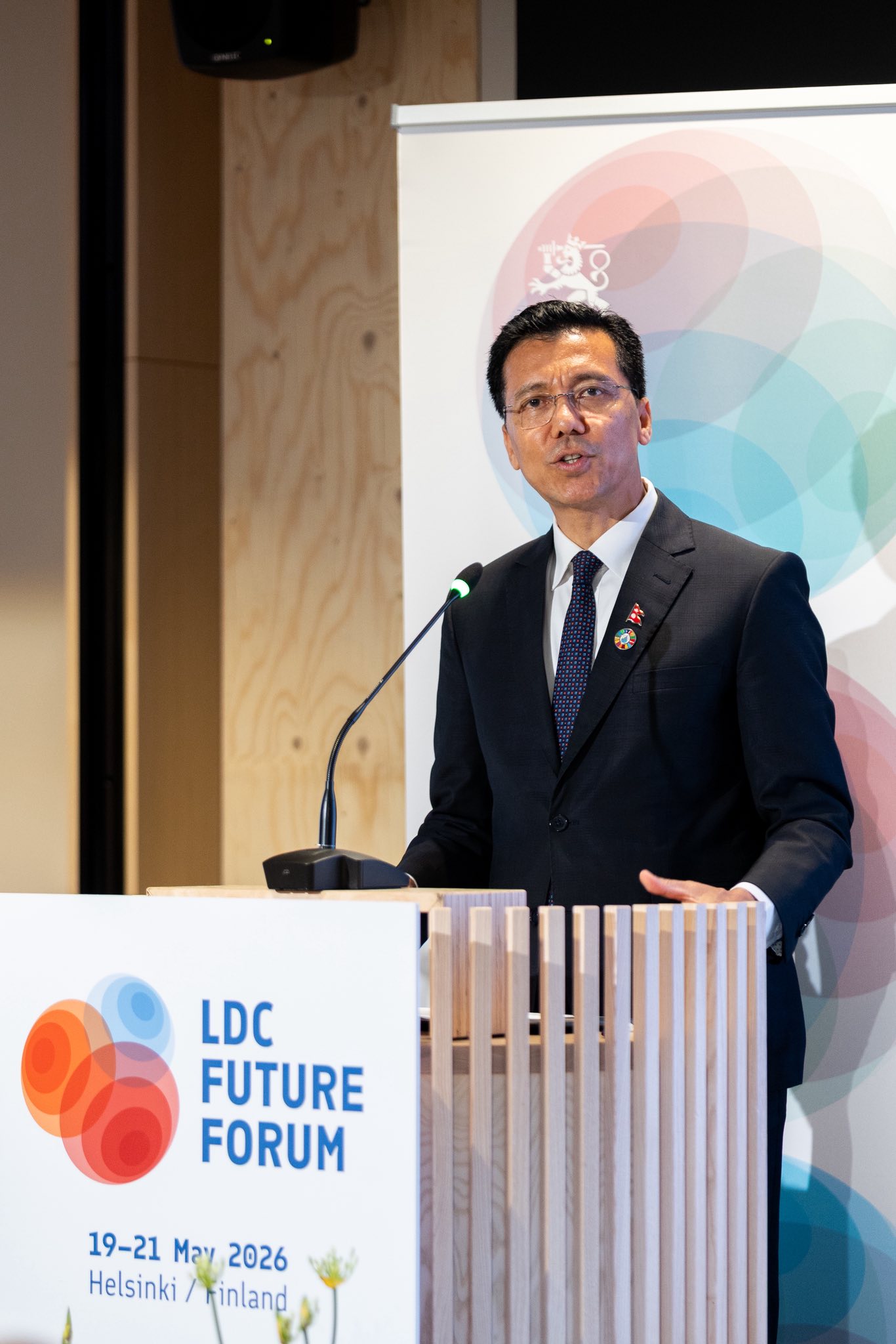
The theme of the 4th LDC Future Forum, “Transforming LDCs by Empowering the Youth Population through Education, Innovation and Inclusive Growth”, could not be more relevant and timelier as it speaks directly to the political choices before us. No platform is better positioned than the LDC Future Forum to advance a serious dialogue on the future of youth in LDCs. The importance of this year’s LDC Future Forum lies not only because it is part of a larger political moment but because its outcomes will feed directly and visibly into the comprehensive high-level Midterm Review of the Doha Programme of Action, being held in Doha in March 2027.
LDCs expect that the evidence, policy options and commitments generated here in Helsinki will translate into concrete deliverables at the MTR.
Youth in LDCs
Across our 44 Least Developed Countries, 60-70 percent of citizens are under 30. This extraordinary youth population is not merely a statistic. It is our greatest strategic asset. It is our engine of renewal, and it is the foundation of our inclusive growth and transformation. This is indeed an extraordinary demographic force whose energy, creativity, and aspirations can reshape our development trajectory.
To capitalize on this immense potential and demographic dividend, however, we need to equip our youth with the skills, knowledge, technology, and entrepreneurship. We need policies and platforms that treat youth not as beneficiaries of development, but as partners, cocreators, and drivers of national progress. For this, we need bold investments in education, meaningful digital access and connectivity, decent jobs and entrepreneurship for this generation, strong ecosystems for innovation, and inclusive growth pathways that leave no young person behind.
But the question before us is this: Will we unlock the single greatest driver of structural transformation in our history, or will we allow another cycle of poverty, exclusion, and instability to take root? This is not a theoretical debate. It is a choice—one that will determine whether our 44 Least Developed Countries rise to meet the promise of this century or remain constrained by the legacies of the past. Yet the reality is stark. Too many young people in LDCs still lack access to quality education. They leave school without the skills demanded by rapidly changing labour markets shaped by frontier technologies and the green transition.
Too many face unemployment, underemployment, or exclusion from the digital economy. Young entrepreneurs confront high capital costs, weak infrastructure and underdeveloped innovation ecosystems. And, too many are denied the tools to innovate, to create, and to lead.
To our utmost dismay, about two-thirds of the LDC population still remain offline. They face numerous barriers to meaningful connectivity, including a lack of infrastructure, affordability, and skills. These are not technical inevitabilities, but political failures. This is not only a development gap, it is a justice gap. And it is the one we must close with urgency and purpose.
Against this backdrop, the LDC Group expects the Forum to send some clear and concrete messages. Nepal speaks from its own experience of trying to turn a youthful population into a driver of resilience and transformation. We are investing in education reform, expanding technical and vocational training, and promoting digital skills, even as we grapple with fiscal constraints, climate vulnerabilities, and the risk of growing inequalities. We are working to strengthen our national innovation ecosystem, including support to start ups and MSMEs, and to align our graduation pathway with a future of productive and decent employment for our young people.
Our journey underlines a simple truth: National leadership is indispensable, but it cannot substitute for the international support that the Doha Programme of Action has promised.
What should be done?
Allow me to share some thoughts and recommendations. First, we must close the skills gap with urgency and scale. This means a political commitment to universal completion of quality secondary education, ambitious expansion of TVET, and curricula that prioritize foundational, digital and green skills. It means investing in robust school-to-work transition systems so that education leads to decent jobs, not to frustration and disillusionment, particularly for young women and rural youth.
Second, LDCs need a digital learning revolution that is designed for our realities. The Doha Programme of Action’s flagship initiative on an online university or equivalent platform for LDCs needs to be operationalized with a clear roadmap, dedicated financing, and genuine LDC ownership. We call for a coalition of willing partners, including Finland and other generous partner countries, UN entities, development banks and the private sector, to support low-bandwidth, mobile-first, affordable solutions that expand access to high-quality STEM and digital programmes for all.
Third, supporting youthled innovation and entrepreneurship must move to the centre of our development agenda. We need to expand and connect the spaces where young people can innovate and build businesses. Startups, technology hubs, and creative workspaces—backed by simpler rules and far greater concessional financing — are essential. No young innovator should be trapped in the informal sector simply because the economic and regulatory environment works against them.
Fourth, these initiatives must rest on a clear commitment to inclusive growth. Micro, small, and mediumsized enterprises must be at the centre of our employment strategies, supported with financing, digital capabilities, and access to markets. Digital trade and ecommerce must be expanded. We must ensure real economic opportunity for women, persons with disabilities, and those living in remote or crisisaffected areas. Because if the digital and innovation transitions simply widen existing gaps, they will undermine the very transformation we seek to achieve.
Fifth, stronger partnership is critical. No Least Developed Country can unlock the full potential of its youth in isolation. We need global partnerships that strengthen education systems, expand meaningful digital connectivity, create decent jobs, and build innovation ecosystems where ideas can grow into enterprises. We need development cooperation—and private finance—that drives truly inclusive growth, reaching rural communities, uplifting young women, and empowering young entrepreneurs.
For this, we need a broad coalition of governments, multilateral institutions, the private sector, civil society, and philanthropy working together to turn the promise of our youth into the progress of our nations.
Conclusion
Empowering our youth through education, innovation and inclusive growth is not a side issue. It is the litmus test for the credibility of the DPoA and for the 2030 Agenda in LDCs.
It is, in fact, the litmus test of multilateralism itself. If we fail young people in the poorest countries, we fail the global partnership as a whole.
If we choose to act with ambition and urgency, we can still turn this decade into one of real opportunity and transformation for our countries.
The LDCs stand ready to do our part. Our youth are ready. The world must be ready for them.
(The article is an abridged version of the remarks delivered by Lok Bahadur Thapa, Permanent Representative of Nepal to the United Nations and Chair of the LDC group, at the Fourth UN LDC Future Forum held in Helsinki, Finland in May.)